


Democratic Progressive Party (DPP) Chairperson Tsai Ing-wen (蔡英文) on Monday said that her “core goal” for the nation was “a more consistent and sustainable relationship with China.”
Tsai made the statement in a bylined commentary published by the Wall Street Journal as she flew into Washington for a key five-day visit to the US capital.
Tsai called for “open channels of communication, both with China’s leadership and the Taiwanese people.”
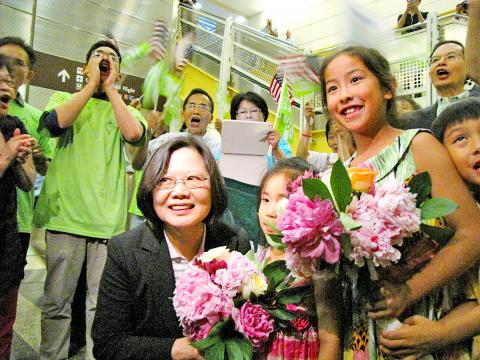
Photo: Tsao Yu-fen, Taipei Times
She faces a whirlwind of meetings with officials in US President Barack Obama’s administration, US Congress and the US Department of State, as well as think tanks and Taiwanese-American organizations.
It will be her main opportunity to convince Washington that if she wins next year’s presidential election, she will follow policies that will maintain peace and stability across the Taiwan Strait.
Tsai is in the US for a total of 12 days and has already visited Los Angeles and Chicago.
Tsai’s Wall Street Journal article laid out the platform she is presenting in Washington.
“My priority will be to implement a transparent process to enhance trust and cooperation across the Taiwan Strait,” she wrote.
“Through principled engagements, joint initiatives and dialogue, I will ensure that the spirit of cooperation that has guided the betterment of China-Taiwan relations continues,” Tsai wrote.
She wrote that 36 years ago, the US Congress enacted the Taiwan Relations Act (TRA) and launched a “historic friendship.”
“I have no doubt that our mutual interests in the region’s peace and prosperity will further strengthen these bonds and ensure that they will endure for many decades to come,” Tsai wrote.
While the US is Taiwan’s most important strategic partner, she said that the nation must also expand its contributions toward a more promising future for the region.
Tsai wrote that Taiwan needs to articulate an open and forward-looking strategy for the future that is “fundamentally premised” on robust economic, defense and people-to-people relationships with the US in parallel with a comprehensive and principled engagement with China.
Tsai outlined a four-pronged foreign policy based on multifaceted cooperation with the US, identifying and participating in international projects, protecting Taiwan’s economic autonomy through trade diversification and enhancing principled cooperation with China.
“The net impact of this strategy will not only depend on the successful execution of each pillar, but on how we are able to draw linkages between the four elements and put forth a comprehensive paradigm for Taiwan’s international role,” she wrote.
Tsai wrote that she was committed to enhancing cooperation with the US on joint military training, exercises and defense-industrial cooperation.
“In addition to strengthening our already extensive ties in these traditional security areas, it is equally important for Taiwan to support the region’s capabilities to address nontraditional security threats, highlighted by the growing challenges presented by climate change and the increasing frequency of natural disasters across the Asia-Pacific,” she wrote. “I am committed to advancing an open dialogue with the US, China, Japan, South Korea and other like-minded nations on how we can fortify the region’s humanitarian and natural-disaster relief architecture and capabilities.”
Tsai said that Taiwan must articulate a stronger trade agenda, necessitating changes in how the nation conducts business and establishes strong frameworks to bolster investor confidence.
“In the near term, ensuring that Taiwan is ready for future candidacy into the Trans-Pacific Partnership and other regional economic agreements will be an important cornerstone of my economic policy,” she said.
In response, an unnamed source from the Presidential Office asked why has Tsai not mentioned “maintaining the ‘status quo’” as she did in Taiwan, and whether she takes different stances when in Taiwan and abroad.
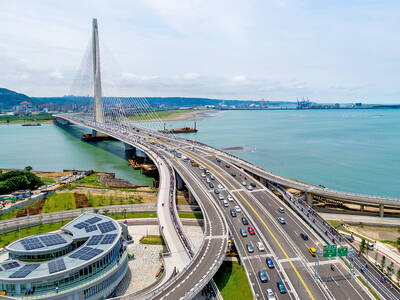
The Ministry of Transportation and Communications yesterday inaugurated the Danjiang Bridge across the Tamsui River in New Taipei City, saying that the structure would be an architectural icon and traffic artery for Taiwan. Feted as a major engineering achievement, the Danjiang Bridge is 920m long, 211m tall at the top of its pylon, and is the longest single-pylon asymmetric cable-stayed bridge in the world, the government’s Web site for the structure said. It was designed by late Iraqi-British architect Zaha Hadid. The structure, with a maximum deck of 70m, accommodates road and light rail traffic, and affords a 200m navigation channel for boats,
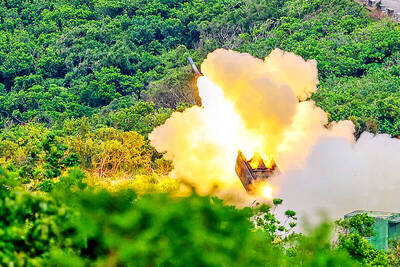
PRECISION STRIKES: The most significant reason to deploy HIMARS to outlying islands is to establish a ‘dead zone’ that the PLA would not dare enter, a source said A High Mobility Artillery Rocket System (HIMARS) would be deployed to Penghu County and Dongyin Island (東引) in Lienchiang County (Matsu) to force the Chinese military to retreat at least 100km from the coastline, a military source said yesterday. Taiwan has been procuring HIMARS and Army Tactical Missile Systems (ATACMS) from the US in batches. Once all batches have been delivered, Taiwan would possess 111 HIMARS units and 504 ATACMS, which have a range of 300km. Considering that “offense is the best defense,” the military plans to forward-deploy the systems to outlying islands such as Penghu and Dongyin so that
Taiwan Semiconductor Manufacturing Co (TSMC, 台積電), the world’s largest foundry service provider, yesterday said that global semiconductor revenue is projected to hit US$1.5 trillion in 2030, after the figure exceeds US$1 trillion this year, as artificial intelligence (AI) demand boosts consumption of token and compute power. “We are still at the beginning of the AI revolution, but we already see a significant impact across the whole semiconductor ecosystem,” TSMC deputy cochief operating officer Kevin Zhang (張曉強) said at the company’s annual technology symposium in Hsinchu City. “It is fair to say that in the past decade, smartphones and other mobile devices were
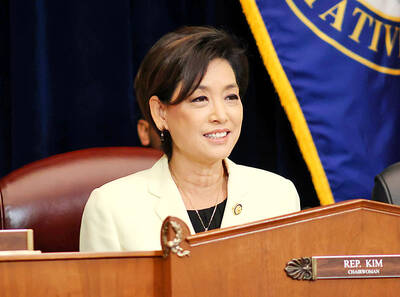
‘CLEAR MESSAGE’: The bill would set up an interagency ‘tiger team’ to review sanctions tools and other economic options to help deter any Chinese aggression toward Taiwan US Representative Young Kim has introduced a bill to deter Chinese aggression against Taiwan, calling for an interagency “tiger team” to preplan coordinated sanctions and economic measures in response to possible Chinese military or political action against Taiwan. “[Chinese President] Xi Jinping [習近平] has directed the People’s Liberation Army to be ready to invade Taiwan by 2027. China has a plan. America should have one too,” Kim said in a news release on Thursday last week. She introduced the “Deter PRC [People’s Republic of China] aggression against Taiwan act” to “ensure the US has a coordinated sanctions strategy ready should


 RSS
RSS