


The nation yesterday celebrated film director Hou Hsiao-hsien (侯孝賢) winning the best director award at the Cannes Film Festival on Sunday night in France.
Hou’s film The Assassin (聶隱娘), a martial arts drama set in Tang Dynasty China, stars Taiwanese actress Shu Qi (舒淇) as a trained killer who is sent back to her home province to assassinate its governor, who is also the man she loves, portrayed by Taiwanese actor Chang Chen (張震).
In an interview with Chinese-language media after his win, Hou said that first impressions are more important than understanding the plot when it comes to movies, because images create feelings and thoughts.
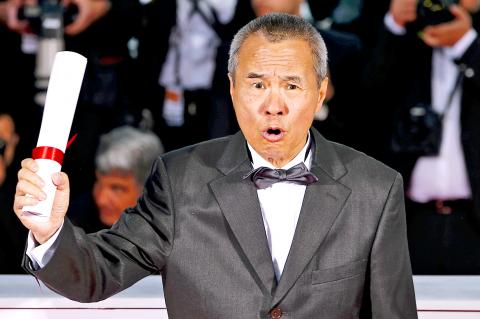
Photo: Reuters
Although some critics have said the film is not easy to understand, Hou said there are some people who think it is “very beautiful” and “very poetic.”
“Seeing a movie should not be just about understanding plots and details,” Hou said.
The Ministry of Culture yesterday said that Hou would receive NT$5 million (US$163,553) for winning the best director prize and another NT$500,000 for the film making it into the main competition of the festival.
The Assassin cost NT$450 million to make. The government gave Hou NT$45 million in subsidies during the production: NT$20 million in 2010 and NT$25 million in 2011.
Sunday night’s award was the first time the 68-year-old Hou has won the director’s award at Cannes. His film The Puppetmaster (戲夢人生) took the third-place Jury Prize at the 1993 festival.
President Ma Ying-jeou (馬英九) was among those sending congratulations to Hou after the winners were announced at the festival.
“[His] innovation and colorful way of telling the story has inspired a new trend in the world of film and shone in international skies, bringing glory for Taiwan,” he said.
The top prize, the Palme d’Or. went to a French film, Dheepan, directed by Jacques Audiard. about Sri Lankan asylum-seekers trying to build new lives, one of two movies at the festival to focus on the plight of migrants.
A Holocaust drama, Son of Saul, by Hungarian director Laszlo Nemes, claimed the runner-up Grand Prize, while The Lobster, a surreal black comedy about modern love by Greece’s Yorgos Lanthimos, starring Colin Farrell and Rachel Weisz, took the Jury Prize.
The best-actress trophy was won by Rooney Mara for her work in the lesbian love story Carol and Emmanuelle Bercot for Mon Roi (My King). France’s Vincent Lindon won best actor for his portrayal of a job-seeker trying to preserve his dignity in La Loi du Marche (The Measure of a Man).
Mexican director Michel Franco won best screenplay for Chronic, which stars British actor Tim Roth as a nurse caring for dying patients.
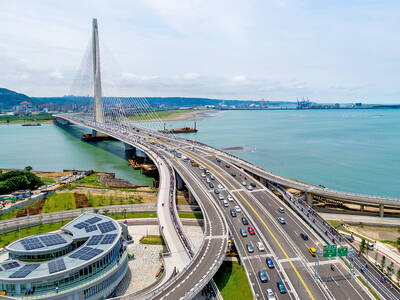
The Ministry of Transportation and Communications yesterday inaugurated the Danjiang Bridge across the Tamsui River in New Taipei City, saying that the structure would be an architectural icon and traffic artery for Taiwan. Feted as a major engineering achievement, the Danjiang Bridge is 920m long, 211m tall at the top of its pylon, and is the longest single-pylon asymmetric cable-stayed bridge in the world, the government’s Web site for the structure said. It was designed by late Iraqi-British architect Zaha Hadid. The structure, with a maximum deck of 70m, accommodates road and light rail traffic, and affords a 200m navigation channel for boats,
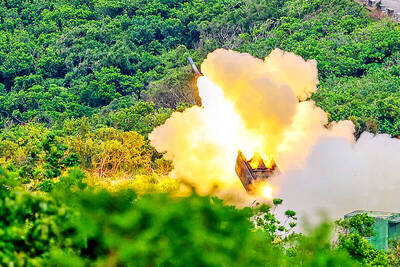
PRECISION STRIKES: The most significant reason to deploy HIMARS to outlying islands is to establish a ‘dead zone’ that the PLA would not dare enter, a source said A High Mobility Artillery Rocket System (HIMARS) would be deployed to Penghu County and Dongyin Island (東引) in Lienchiang County (Matsu) to force the Chinese military to retreat at least 100km from the coastline, a military source said yesterday. Taiwan has been procuring HIMARS and Army Tactical Missile Systems (ATACMS) from the US in batches. Once all batches have been delivered, Taiwan would possess 111 HIMARS units and 504 ATACMS, which have a range of 300km. Considering that “offense is the best defense,” the military plans to forward-deploy the systems to outlying islands such as Penghu and Dongyin so that

WHAT WAS ALL THAT FOR? Jaw Shaw-kong said that Cheng Li-wen had pushed for more drastic cuts and attacked him, just for the outcome to be nearly identical to his bill The legislature yesterday passed a supplementary budget bill to fund the purchase of separate packages of US military equipment, with the combined amount of spending capped at NT$780 billion (US$24.8 billion). The Chinese Nationalist Party (KMT) and Taiwan People’s Party (TPP) used their legislative majority to pass the bill, which runs until 2033 and has two main funding provisions. One was for NT$300 billion of arms sales already approved by the US for Taiwan on Dec. 17 last year, the other was for NT$480 billion for another arms package expected to be announced by Washington. The bill, which fell short of the NT$1.25

‘CLEAR MESSAGE’: The bill would set up an interagency ‘tiger team’ to review sanctions tools and other economic options to help deter any Chinese aggression toward Taiwan US Representative Young Kim has introduced a bill to deter Chinese aggression against Taiwan, calling for an interagency “tiger team” to preplan coordinated sanctions and economic measures in response to possible Chinese military or political action against Taiwan. “[Chinese President] Xi Jinping [習近平] has directed the People’s Liberation Army to be ready to invade Taiwan by 2027. China has a plan. America should have one too,” Kim said in a news release on Thursday last week. She introduced the “Deter PRC [People’s Republic of China] aggression against Taiwan act” to “ensure the US has a coordinated sanctions strategy ready should


 RSS
RSS