


Eslite Group (誠品集團) yesterday announced its intention to acquire the superficies rights to its store and the hotel in Taipei’s Songshan Cultural and Creative Park (松山文創園區) from Taipei New Horizon Co Ltd (臺北文創) in an attempt to end a controversy over royalty payments to the city, which owns the land.
The group unveiled the plan after Pegatron Corp (和碩聯合科技) chairman Tung Tsu-hsien (童子賢), who is also one of the largest shareholders of Eslite Corp (誠品), reached a preliminary agreement with Daniel Tsai (蔡明忠), chairman of the Fubon Group (富邦集團) — Taipei New Horizon’s parent group — and Taipei Mayor Ko Wen-je (柯文哲) a day earlier.
“We are happy that the company’s major shareholder was able to reach a consensus with the Taipei City Government and the Fubon Group,” Eslite Group vice chairwoman Mercy Wu (吳旻潔) told a news conference.

Photo: Chang Chia-ming, Taipei Times
The group also plans to revise the contract with the Taipei City Government. It proposed to pay a 0.5 percent royalty on a basis of the department store’s annual revenues and said it would pay an extra royalty for its hotel operation, Eslite Hotel (誠品行旅), based on the hotel’s 60 percent average rate of room occupancy, after buying the property’s superficies rights, Wu said.
The revision is expected to increase Eslite’s corporate income tax to at least NT$6 million (US$194,932) as the Eslite Spectrum Songyan Store (誠品生活松菸店) generated NT$1.19 billion in revenue last year.
Wu dismissed allegations that Eslite Group reaped significant profits from operating the store, saying the store had accumulated losses of NT$49.97 million thus far.
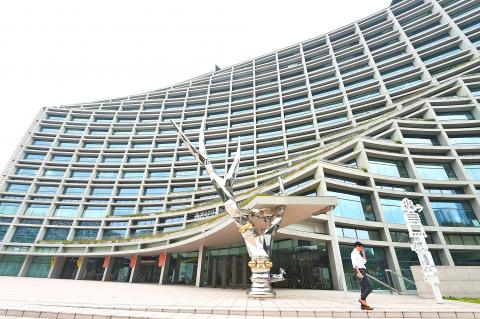
Photo: Chang Chia-ming, Taipei Times
The controversy over the issue were made public earlier this month when Ko said the build-operate-transfer (BOT) contract involving the cultural and creative park project — which the government had signed with Fubon Land Development Co (富邦建設) and Taiwan Mobile Co (台灣大哥大), both affiliates of the Fubon Group — was “legal but unreasonable.”
The BOT project, which includes development of an office building, a department store and a hotel, cost Taipei New Horizon — created by the Fubon Group to execute the project — a total of NT$1.3 billion in royalty payments, with annual rent of NT$6 million.
Ko’s announcement led to allegations that Taipei New Horizon had leased the store and hotel to Eslite Group, a veteran in the cultural and creative industry, at an unreasonably low price.
The claims ignited disputes between the two sides, prompting Eslite Group’s decision to attempt to acquire the superficies rights.
Wu said the details of the proposed acquisition might need more discussions before being made public, with the price still unknown.
The city government’s objective regarding Fubon and Eslite is to ensure that the city receives the money it is owed and to help the New Horizon complex make a real contribution to the development of the nation’s cultural and creative industry, Ko said.
He said the annual NT$560,000 in royalties which the city had previously received for the site’s usage was “a joke.” The city government previously said that one of the reasons for the low revenues was that parts of the Eslite portion of the complex had not been included in royalty calculations.
Ko said the city government would not interfere in the two sides’ negotiations, but that it would review their final agreement. He said the city government would seek to play the role of a “steering wheel” in relation to an “engine” provided by the firms, to ensure that their final agreement would best serve the public’s interests.
Additional reporting by Abraham Gerber

CREDIT-GRABBER: China said its coast guard rescued the crew of a fishing vessel that caught fire, who were actually rescued by a nearby Taiwanese boat and the CGA Maritime search and rescue operations do not have borders, and China should not use a shipwreck to infringe upon Taiwanese sovereignty, the Coast Guard Administration (CGA) said yesterday. The coast guard made the statement in response to the China Coast Guard (CCG) saying it saved a Taiwanese fishing boat. The Chuan Yu No. 6 (全漁6號), a fishing vessel registered in Keelung, on Thursday caught fire and sank in waters northeast of Diaoyutai Islands (釣魚台). The vessel left Keelung’s Badouzih Fishing Harbor (八斗子漁港) at 3:35pm on Sunday last week, with seven people on board — a 62-year-old Taiwanese captain surnamed Chang (張) and six

The Legislative Yuan’s Finance Committee yesterday approved proposed amendments to the Amusement Tax Act (娛樂稅法) that would abolish taxes on films, cultural activities and competitive sporting events, retaining the fee only for dance halls and golf courses. The proposed changes would set the maximum tax rate for dance halls and golf courses at 50 and 20 percent respectively, with local governments authorized to suspend the levies. Article 2 of the act says that “amusement tax shall be levied on tickets sold or fees charged by amusement places, facilities or activities” in six categories: “Cinema; professional singing, story-telling, dancing, circus, magic show, acrobatics
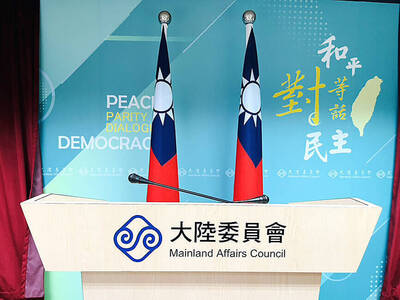
RISKY BUSINESS: The ‘incentives’ include initiatives that get suspended for no reason, creating uncertainty and resulting in considerable losses for Taiwanese, the MAC said China’s “incentives” failed to sway sentiment in Taiwan, as willingness to work in China hit a record low of 1.6 percent, a Ministry of Labor survey showed. The Directorate-General of Budget, Accounting and Statistics (DGBAS) also reported that the number of Taiwanese workers in China has nearly halved from a peak of 430,000 in 2012 to an estimated 231,000 in 2024. That marked a new low in the proportion of Taiwanese going abroad to work. The ministry’s annual survey on “Labor Life and Employment Status” includes questions respondents’ willingness to seek employment overseas. Willingness to work in China has steadily declined from

Tainan, Taipei and New Taipei City recorded the highest fines nationwide for illegal accommodations in the first quarter of this year, with fines issued in the three cities each exceeding NT$7 million (US$220,639), Tourism Administration data showed. Among them, Taipei had the highest number of illegal short-term rental units, with 410. There were 3,280 legally registered hotels nationwide in the first quarter, down by 14 properties, or 0.43 percent, from a year earlier, likely indicating operators exiting the market, the agency said. However, the number of unregistered properties rose to 1,174, including 314 illegal hotels and 860 illegal short-term rental


 RSS
RSS