


Chinese Nationalist Party (KMT) Chairman and New Taipei City Mayor Eric Chu (朱立倫) yesterday vowed to ensure transparency in his upcoming talks with Chinese President and Chinese Communist Party (CCP) General Secretary Xi Jinping (習近平), but he chose to withhold the agenda of the meeting for the sake of “respecting the other side.”
Chu was pressed with questions at a news conference at 6pm yesterday about issues to be discussed in the highest-level exchange between the KMT and the CCP in recent years, ahead of his departure today on a three-day trip to China.
The meeting is scheduled to take place on Monday morning at Beijing’s Great Hall of the People and begin with Chu and Xi delivering statements before a closed-door roundtable meeting attended by 10 officials from each side.
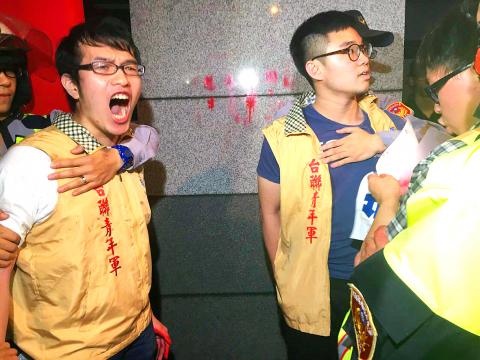
Photo courtesy: Taiwan Solidarity Union
In an apparent response to criticism leveled by opposition parties that have condemned the KMT-CCP forum as a “black box” operation, Chu said in his opening remarks yesterday that any exchanges between Taiwan and China should be viewed “in a positive light,” including party-to-party exchanges.
“There will be no black-box operation nor backroom negotiations involved in the entire process [of the meeting]. We will be fully transparent,” Chu said, adding that he would make public at a post-meeting news conference the discussions from the meeting.
Chu gave the general themes of the meeting, but gave no specific details about the agenda at yesterday’s news conference, citing the need to “show respect” for the other side.
The issues involve “three middles and the youth,” who have some doubts over the exchanges between the two sides and concerns over uneven distribution of peace dividends, Chu said, referring to the groups identified by Beijing to extend its outreach — residents of central and southern Taiwan; middle and low-income families; small and medium-sized enterprises; and young people.
President Ma Ying-jeou (馬英九) said on Wednesday that Chu told him his meeting with Xi would “consolidate” and “deepen” the so-called “1992 consensus,” a tacit agreement between the KMT and the CCP in 1992 that both sides acknowledge there is only “one China,” with both sides having their own interpretation of what “China” means.
Ma also said Chu would incorporate the “1992 consensus” in issues related to Taiwan’s integration in regional economic blocs.
Chu said that development of cross-strait relations should be advanced on the basis laid down by the “1992 consensus.”
Former vice president Annette Lu (呂秀蓮) on Thursday asked Chu to speak about the Republic of China at the meeting to prove he truly believes the “1992 consensus.”
“We would say anything we need to say,” Chu said.
Separately, Deputy Legislative Speaker Hung Hsiu-chu (洪秀柱), who has signed up to contest the KMT presidential primary, yesterday proposed a theory aiming to redefine the cross-strait relationship.
Hung said that the “1992 consensus” had achieved its preliminary goal, adding that a new consensus should be drawn up to place “two constitutional governments under ‘one whole China.’”
The “1992 consensus” should be enhanced from “one China, respective interpretations,” through “one China, no interpretations,” to “one China, common interpretation (一中同表),” Hung said.
“The concrete substance of the latter would be that both sides of the Taiwan Strait are part of ‘the whole China,’ with overlapping sovereignty claims and separate constitutional rights of governance,” Hung said.
The cross-strait relationship is not a form of international relations, or a party’s “internal affairs,” but “the whole China’s internal relations,” Hung added.
Additional reporting by CNA
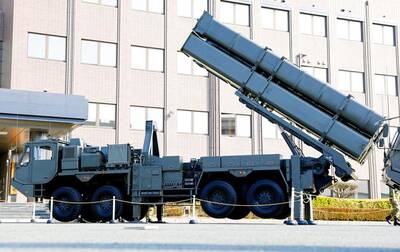
Japan has deployed long-range missiles in a southwestern region near China, the Japanese defense minister said yesterday, at a time when ties with Beijing are at their lowest in recent years. The missiles were installed in Kumamoto in the southern region of Kyushu, as Japan is attempting to shore up its military capacity as China steps up naval activity in the East China Sea. “Standoff defense capabilities enable us to counter the threat of enemy forces attempting to invade our country ... while ensuring the safety of our personnel,” Japanese Minister of Defense Shinjiro Koizumi said. “This is an extremely important initiative for
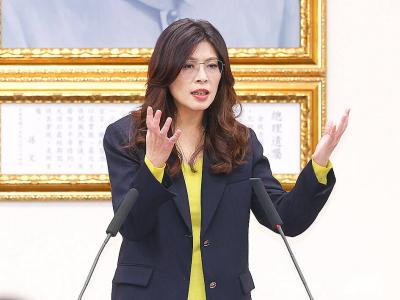
Chinese Nationalist Party (KMT) Chairwoman Cheng Li-wun (鄭麗文) today accepted an invitation from Chinese President Xi Jinping (習近平) to lead a delegation to China next month, saying she hopes to promote the peaceful development of cross-strait relations and bring stability to the Taiwan Strait. “I am grateful and happy to accept this invitation,” Cheng said in a statement from the KMT chairperson’s office. Cheng said she hopes both sides can work together to promote the peaceful development of cross-strait relations, enhance exchange and cooperation, bring stability to the Taiwan Strait and improve people’s livelihoods. At today's news conference, Cheng said any efforts to
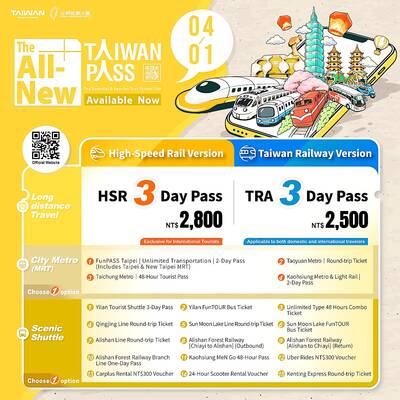
MORE POPULAR: Taiwan Pass sales increased by 59 percent during the first quarter compared with the same period last year, the Tourism Administration said The Tourism Administration yesterday said that it has streamlined the Taiwan Pass, with two versions available for purchase beginning today. The tourism agency has made the pass available to international tourists since 2024, allowing them to access the high-speed rail, Taiwan Railway Corp services, four MRT systems and four Taiwan Tourist Shuttles. Previously, five types of Taiwan Pass were available, but some tourists have said that the offerings were too complicated. The agency said only two types of Taiwan Pass would be available, starting from a three-day pass with the high-speed rail and a three-day pass with Taiwan Railway Corp. The former costs NT$2,800

The nation’s fastest supercomputer, Nano 4 (晶創26), is scheduled to be launched in the third quarter, and would be used to train large language models in finance and national defense sectors, the National Center for High-Performance Computing (NCHC) said. The supercomputer, which would operate at about 86.05 petaflops, is being tested at a new cloud computing center in the Southern Taiwan Science Park in Tainan. The exterior of the server cabinet features chip circuitry patterns overlaid with a map of Taiwan, highlighting the nation’s central position in the semiconductor industry. The center also houses Taiwania 2, Taiwania 3, Forerunner 1 and


 RSS
RSS