


Chinese Nationalist Party (KMT) Vice Chairman and former Taipei mayor Hau Lung-bin (郝龍斌) is to visit Nanjing, China, tomorrow just days before the KMT-Chinese Communist Party (CCP) forum and a meeting between KMT Chairman Eric Chu (朱立倫) and Chinese President Xi Jinping (習近平), which are scheduled to take place on May 3 and May 4 respectively.
Hau is to lead a group of KMT representatives to Nanjing tomorrow for a seminar celebrating the historical meeting of former vice president Lien Chan (連戰) and former Chinese president and CCP general secretary Hu Jintao (胡錦濤), which took place 10 years ago, the KMT said.
“The meeting in 2005 was the first KMT-CCP top-level summit after the Chinese Civil War, and Lien was the first top KMT leader to visit [China] after 1949. Lien’s trip altered the course of the cross-strait relationship over the past 10 years, and the seminar is not only to take a retrospective look, but also to look for a way to take the cross-strait relationship a step forward,” the KMT said.
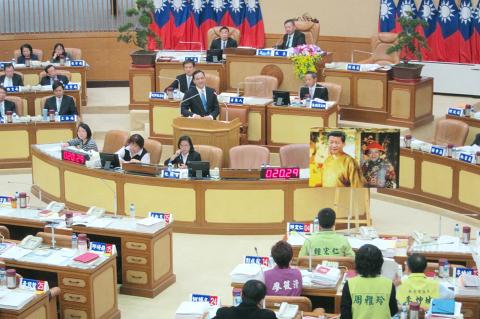
Photo: Ho Yu-hua, Taipei Times
The group is due to meet China’s Taiwan Affairs Office Minister Zhang Zhijun (張志軍), former Association for Relations Across the Taiwan Straits (ARATS) chairman Chen Yunlin (陳雲林) and ARATS Vice Chairman Sun Yafu (孫亞夫).
Hau’s trip was called a “warm-up” for the Chu-Xi meeting by local media.
The meeting between Chu and Xi is scheduled to take place on May 4, after the KMT-CCP forum — officially called the Cross-Strait Economic and Cultural Forum — on May 3.
Chu did not deny the report yesterday, adding that the schedule of the cross-party forum and the details of his meeting with Xi would be announced once they have been confirmed.
The Chinese-language United Daily News said that, as the two parties agreed to make public the news tomorrow, the KMT has refrained from discussing such details.
A report in the China Times saying that, aside from reiterating the so-called “1992 consensus,” Chu would also bring forward a new cross-strait policy that “transcends the 1992 consensus” during his visit to China, was played down by Chu, who said such speculation came “from the reporter’s mouth, not mine.”
The so-called “1992 consensus,” a term former Mainland Affairs Council chairman Su Chi (蘇起) admitted making up in 2000, refers to a tacitunderstanding between the KMT and the Chinese government that both sides of the Strait acknowledge there is “one China,” with each side having its own interpretation of what “China” means.
When questioned about Chu putting forward a framework that transcends the “1992 consensus,” Legislative Speaker Wang Jin-pyng (王金平) was skeptical.
“I don’t think [he would do such a thing]. The most constructive move for cross-strait peace would be following the principle upheld by Lien when he was the chairman,” Wang said, referring to the Hu-Lien communique, which was reached in 2005 after Lien’s meeting with Hu to promote cross-strait exchanges, and took the “1992 consensus” and rejection of Taiwanese independence as its foundation.
Meanwhile, Democratic Progressive Party leaders yesterday called on Chu to defend Taiwan’s interests when meeting with Xi.
“Cross-strait relations do not just involve the KMT and the CCP. The KMT should refrain from trying to make the meeting about its relationship with the CCP,” former premier Yu Shyi-kun (游錫堃) said yesterday. “When meeting with Xi, Chu should talk about the Republic of China, and make it clear to Xi that Taiwan’s future would be decided by all of its 23 million inhabitants, and that Taiwan is a sovereign nation.”
Former premier Frank Hsieh (謝長廷) said Chu’s meeting with Xi might not be in the nation’s best interests.
“The two major parties in Taiwan should try to reach some agreement on cross-strait relations so that the issue does not divide the nation,” Hsieh said.
Additional reporting by Loa Iok-sin
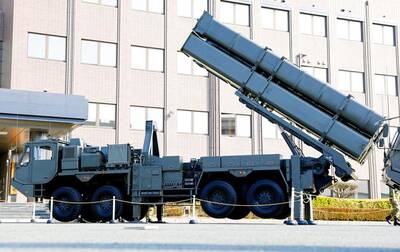
Japan has deployed long-range missiles in a southwestern region near China, the Japanese defense minister said yesterday, at a time when ties with Beijing are at their lowest in recent years. The missiles were installed in Kumamoto in the southern region of Kyushu, as Japan is attempting to shore up its military capacity as China steps up naval activity in the East China Sea. “Standoff defense capabilities enable us to counter the threat of enemy forces attempting to invade our country ... while ensuring the safety of our personnel,” Japanese Minister of Defense Shinjiro Koizumi said. “This is an extremely important initiative for
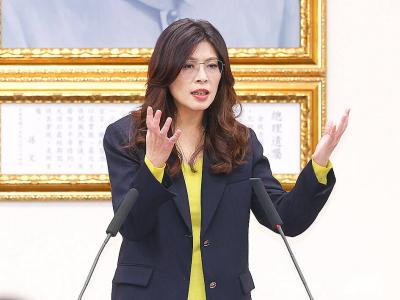
Chinese Nationalist Party (KMT) Chairwoman Cheng Li-wun (鄭麗文) today accepted an invitation from Chinese President Xi Jinping (習近平) to lead a delegation to China next month, saying she hopes to promote the peaceful development of cross-strait relations and bring stability to the Taiwan Strait. “I am grateful and happy to accept this invitation,” Cheng said in a statement from the KMT chairperson’s office. Cheng said she hopes both sides can work together to promote the peaceful development of cross-strait relations, enhance exchange and cooperation, bring stability to the Taiwan Strait and improve people’s livelihoods. At today's news conference, Cheng said any efforts to
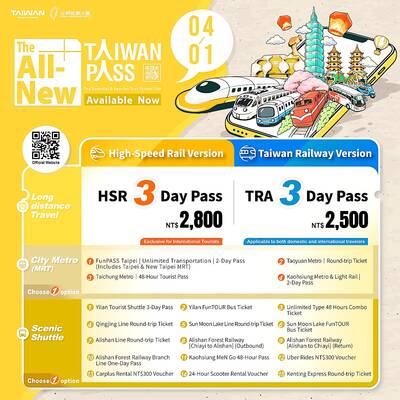
MORE POPULAR: Taiwan Pass sales increased by 59 percent during the first quarter compared with the same period last year, the Tourism Administration said The Tourism Administration yesterday said that it has streamlined the Taiwan Pass, with two versions available for purchase beginning today. The tourism agency has made the pass available to international tourists since 2024, allowing them to access the high-speed rail, Taiwan Railway Corp services, four MRT systems and four Taiwan Tourist Shuttles. Previously, five types of Taiwan Pass were available, but some tourists have said that the offerings were too complicated. The agency said only two types of Taiwan Pass would be available, starting from a three-day pass with the high-speed rail and a three-day pass with Taiwan Railway Corp. The former costs NT$2,800

The nation’s fastest supercomputer, Nano 4 (晶創26), is scheduled to be launched in the third quarter, and would be used to train large language models in finance and national defense sectors, the National Center for High-Performance Computing (NCHC) said. The supercomputer, which would operate at about 86.05 petaflops, is being tested at a new cloud computing center in the Southern Taiwan Science Park in Tainan. The exterior of the server cabinet features chip circuitry patterns overlaid with a map of Taiwan, highlighting the nation’s central position in the semiconductor industry. The center also houses Taiwania 2, Taiwania 3, Forerunner 1 and


 RSS
RSS