


The nation would face electricity shortages if six local governments in central and southern Taiwan ban the burning of petroleum coke and coal for power generation, the Ministry of Economic Affairs (MOEA) said yesterday.
The ministry’s remarks came after the local governments of Chiayi City, Chiayi County, Yunlin County, Chunghua County, Tainan and Taichung on Tuesday pledged to ban the use of the two fuels to reduce air pollution.
The ministry said that coal-fired power stations, including state-run Taiwan Power Co’s (Taipower, 台電) Taichung plant, contribute 22.8 percent of the nation’s total electricity supply.
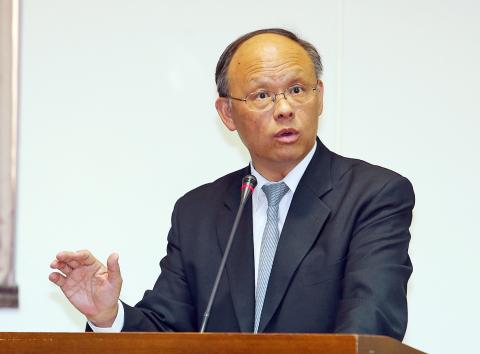
Photo: CNA
“Taiwan would encounter power shortages immediately without the supply from those coal-fired power stations,” Bureau of Energy Deputy Director-General Jennifer Wu (吳玉珍) told a press conference.
Industrial Development Bureau Deputy Director-General Hsiao Chen-jong (蕭振榮) said the proposed ban would have a great impact on the nation’s industries, especially the petrochemical industry.
Formosa Petrochemical Corp’s (台塑石化) naphtha cracker in Yulin County would have to suspend operations with immediate effect if the firm is not allowed to burn petroleum coke and coal, Hsiao said.
The company could lose NT$1.5 trillion (US$47.88 billion) per year, while 12,000 jobs would be affected, Hsiao said.
The suspension of the plant would further cost NT$3 trillion to the production value of its upstream and downstream firms, affecting at least 50,000 jobs, he said.
Citing Environmental Protection Administration data, Hsiao said that the ministry understands the reasons behind the local governments’ decision, but that the ban would not improve the air quality significantly because the gas and electricity industry only accounts for 4 percent of PM2.5 emissions.
PM2.5 is an indicator of airborne particles measuring 2.5 micrometers or less — small enough to penetrate deep into human lungs.
Hsiao said 30 percent of PM2.5 emissions come from outside of Taiwan, while the construction of buildings and roads accounts for 26 percent, and 17 percent comes from traffic.
Wu said that according to Article 20 of the Air Pollution Control Act (空氣汙染防制法), local governments must gain approval from the central government if they plan to enforce stricter emissions standards.
The six cities and counties could violate the regulations if they fail to report to the central government, Wu said.
In related news, Wu said the nation could already face power shortages as early as next month, as Taipower's reserve margin, or the ratio of spare power generation capacity, could dip to a 10-year low of 3.3 percent because of water shortages, as well as maintenance work at nuclear power plants and privately owned power stations.
The lack of water has affected coal-fired power stations because the power generation process requires it, Wu said.
The reserve margin was at its lowest at 8.89 percent in May last year, Taipower said.
There are five power stations undergoing annual maintenance work and the stations are set to resume operations by June, Taipower said.
“As long as the public can conserve more energy through June, we will not need to limit households’ electricity usage,” Taipower vice president Chung Bin-li (鍾炳利) said.

‘NO SECURITY RISK’: The Railway Bureau reassured the public that the technicians’ activities were limited to technical guidance and did not involve sensitive systems The Railway Bureau yesterday said it had invited eight Chinese technicians to assist with an airport MRT construction project. The bureau issued the confirmation after an Internet user said Chinese nationals had entered the construction zone of Taiwan Taoyuan International Airport’s Terminal 3 project. They asked why “individuals from an enemy state” were allowed access to such a major national infrastructure project, which raised serious concerns over Taiwan’s industrial safety, sensitive systems and information security. The bureau’s Northern Region Engineering Branch Office said subcontractor Taiwan Handle Industrial Co (台灣手把工業) of the Taoyuan airport MRT’s “Contract No. CU05 Project A14 Station Civil, MEP &

A US uncrewed surface vessel (USV) encountered multiple Chinese warships during an autonomous transit of the Taiwan Strait, US defense company Seasats said in a statement on Wednesday. Seasats announced that a Lightfish USV had completed the first autonomous transit of the Taiwan Strait. Over five days, the USV traversed the entire length of the Strait while constantly monitoring surface vessel traffic, the company said. The Lightfish encountered multiple Chinese warships, one of which was a Chinese People’s Liberation Army Navy (PLAN) Type 056 corvette, it said. The Chinese vessels were operating “well within Taiwan’s exclusive economic zone without transmitting their identity via the
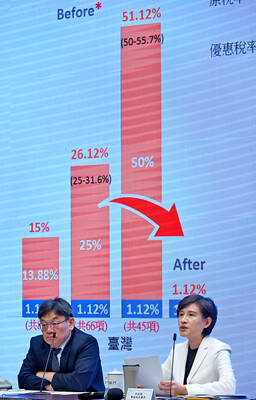
GREATER REACH? Auto parts and wood products would face tariffs of up to 15%, matching those targeting the EU, Japan and South Korea, Vice Premier said The US has announced that preferential tariff treatment for Taiwan’s non-semiconductor Section 232 goods would take effect retroactively from May 1, the Executive Yuan said yesterday. The US government yesterday posted a notice on the Federal Register’s public inspection Web site previewing tariff concessions for Taiwan under a memorandum of understanding (MOU) on Taiwan-US investment after two months of negotiations. The MOU signed on Jan. 15 stipulated three major preferential tariff arrangements: a 15 percent “reciprocal” tariff rate for Taiwan without stacking most-favored nation (MFN) rates; preferential Section 232 treatment for semiconductors and related products; and preferential Section 232 treatment for non-semiconductor

The National Chungshan Institute of Science and Technology yesterday showcased its locally developed variants of the Vision 60 robotic patrol dog, which it plans to deploy on the nation’s outlying territories in the South China Sea. The variants were produced under the Joint Lab project — created by the institute and domestic companies — and assembled with domestically produced motors, lenses and artificial intelligence (AI) systems alongside licensed tech from the US, Missile and Rocket Systems Research Division deputy director Jen Kuo-kang (任國光) told the media event at a military base in Taipei’s Dazhi (大直) area. Taiwan has built up its strengths


 RSS
RSS