


The highly criticized contract for Syntrend Creative Park (三創園區) was reciprocation for an alleged NT$300 million (US$9.58 million) donation made by Hon Hai Precision Industry Co (鴻海精密) chairman Terry Gou (郭台銘) to former Taipei mayor Hau Lung-bin’s (郝龍斌) administration, some city councilors said yesterday.
Both Hau and Hon Hai backed up a statement by Democratic Progressive Party (DPP) caucus whip Ker Chien-ming (柯建銘) on Monday that Gou contributed NT$300 million to the city government for the Taipei Pavilion at the 2010 Shanghai Expo, rejecting Taipei Mayor Ko Wen-je’s (柯文哲) suggestion during a TV interview earlier this year that the tycoon donated the money to Ko’s Chinese Nationalist Party (KMT) rival Sean Lien (連勝文) in the Taipei mayoral election in November last year.
Yesterday, at the first meeting of the Taipei City Council since Ko, an independent, assumed the mayoralty in December last year, Ko and other city government officials were questioned about the donation at a question-and-answer session, at which they were unable to provide any solid information.
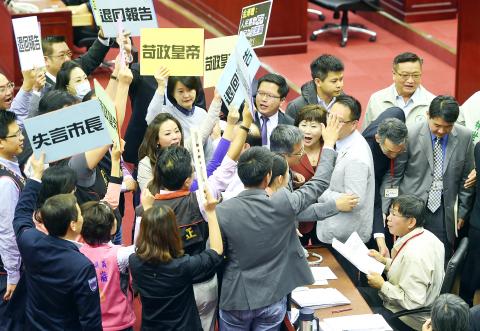
Photo: Fang Pin-chao, Taipei Times
Taipei Department of Information and Tourism Commissioner Chien Yu-yen (簡余晏) said all she had seen was a press release about the signing of a memorandum on the Taipei Pavilion between Hau and Hon Hai on June 22, 2008, in which Gou said the cost of the project was estimated to be about NT$300 million.
“There was no document about the memorandum kept in the department,” Chien said, referring DPP Taipei City Councilor Tung Chung-yan (童仲彥) to the Research, Development and Evaluation Commission.
Tung did not call on the commission’s chairman, Chen Ming-shiun (陳銘薰).
Tung said that Andy Chen (陳慶安), a city government adviser, knew the ins and outs of the project, but withheld information from Ko, adding that Andy Chen’s appointment as Taipei Pavilion director was agreed Upon by Gou and Hau.
Andy Chen dismissed the accusation, saying that he had no knowledge of the case.
Through the NT$300 million donation, Gou not only decided on the selection of city government officials for the Taipei pavilion, but also helped his son, Syntrend chairman Gou Shou-cheng (郭守正), secure the build-operate-transfer project, Tung said.
The Hau administration was “hijacked” by Hon Hai and forced to sign a contract with Syntrend that best serves the interests of the operator, as it stipulates that just the six floors of underground parking are under the jurisdiction of the Taipei City Government, as opposed to the 12 floors above ground, DPP Taipei City Councilor Chang Mao-nan (張茂楠) said, adding that it was to “the city government’s shame.”
Ko said he failed to understand why there were no detailed records kept of the donation and how it was spent, if a donation was actually even made to the city government.
“Bringing openness and transparency to the government is a must,” Ko said.
After Ker made the statement earlier on Monday, Hau said on Facebook that Hon Hai directly funded the construction of the Taipei Pavilion and that the funds did not pass through the city government’s accounts.
The session marked the first time Ko took questions from city councilors. Its start was delayed by two hours, as KMT city councilors were unhappy with a written policy report by Ko that left out the five major projects being investigated by the city’s Clean Government Commission and demanded that Ko take the copies back.
Additional reporting by Tsai Ya-hua and Yu Yuan-chien

‘NO SECURITY RISK’: The Railway Bureau reassured the public that the technicians’ activities were limited to technical guidance and did not involve sensitive systems The Railway Bureau yesterday said it had invited eight Chinese technicians to assist with an airport MRT construction project. The bureau issued the confirmation after an Internet user said Chinese nationals had entered the construction zone of Taiwan Taoyuan International Airport’s Terminal 3 project. They asked why “individuals from an enemy state” were allowed access to such a major national infrastructure project, which raised serious concerns over Taiwan’s industrial safety, sensitive systems and information security. The bureau’s Northern Region Engineering Branch Office said subcontractor Taiwan Handle Industrial Co (台灣手把工業) of the Taoyuan airport MRT’s “Contract No. CU05 Project A14 Station Civil, MEP &

The National Chungshan Institute of Science and Technology yesterday showcased its locally developed variants of the Vision 60 robotic patrol dog, which it plans to deploy on the nation’s outlying territories in the South China Sea. The variants were produced under the Joint Lab project — created by the institute and domestic companies — and assembled with domestically produced motors, lenses and artificial intelligence (AI) systems alongside licensed tech from the US, Missile and Rocket Systems Research Division deputy director Jen Kuo-kang (任國光) told the media event at a military base in Taipei’s Dazhi (大直) area. Taiwan has built up its strengths

NOT IMMEDIATE: Taiwan has a chance to appeal the proposed 10 percent tariff before it starts, while other countries face a 12.5 percent tariff from the trade office Taiwan is among 60 economies determined by the US to have failed to impose or enforce a ban on the importation of goods produced with forced labor, according to a notice released on Tuesday by the Office of the US Trade Representative (USTR), which proposed imposing an additional 10 percent or more tariff on them. The USTR in a statement said that following an investigation, it had determined under Section 301 of the Trade Act of 1974 that the failure of the 60 economies to impose and effectively enforce a prohibition on the importation of goods produced with forced labor is
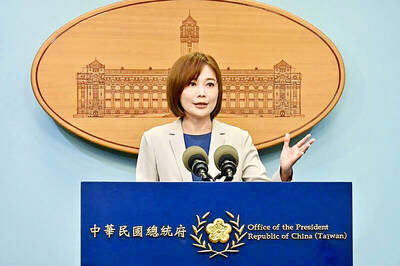
TIT-FOR-TAT: The US allegedly revoked the visa of a Chinese national working at Xinhua News Agency in the US in response to Beijing’s expulsion of Vivian Wang The Presidential Office yesterday condemned China for expelling a New York Times correspondent from Beijing following the newspaper’s interview with President William Lai (賴清德), saying the move highlighted Beijing’s suppression of press freedom and its threat to international news media. Taiwan has noted a series of recent incidents in which Beijing used similar tactics to “threaten and pressure international media outlets and journalists,” Presidential Office spokeswoman Karen Kuo (郭雅慧) said in a statement. “This concerns not only press freedom and freedom of expression, but also the safety of journalists, and Taiwan and relevant partners are paying close attention to the situation,” she


 RSS
RSS