


The Ministry of National Defense (MND) yesterday admitted to more security lapses at the army’s 601st Air Cavalry Brigade, after investigators uncovered at least two more instances of military officers giving civilian groups access to AH-64E Apache helicopters at the brigade’s restricted-access base earlier this year.
In addition to the much-publicized March 29 visit by 26 unauthorized civilians, officials said Lieutenant Colonel Lao Nai-cheng (勞乃成) also conducted another tour for 10 people on Feb. 22, while brigade commander Major General Chien Tsung-yuan (簡聰淵) led four people on a tour, all of whom entered the base in Taoyuan’s Longtan District (龍潭) to see the helicopters.
Ministry officials also announced further punishments for Lao and Chien at yesterday’s press conference, along with disciplinary measures for 19 other officers, most of them serving at the 601st Brigade, or at its authority body, the Army Special Forces Command’s Airborne Headquarters.
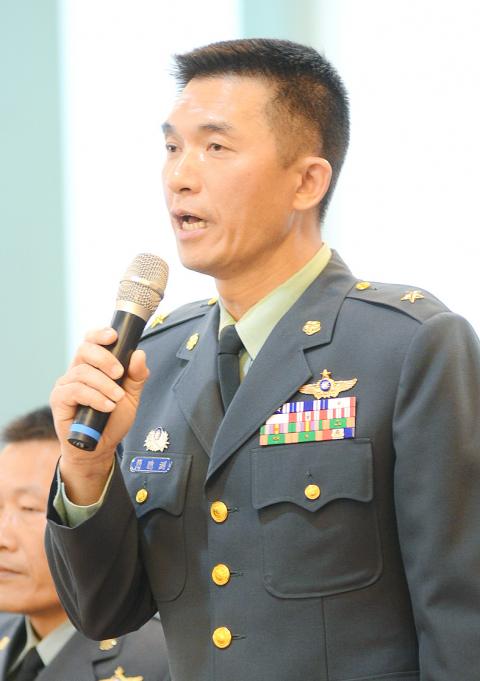
Photo: CNA
Lao was among the first class of six pilots sent to the US in 2013 for 18 months for training in operating the Apache attack helicopter.
Taiwan purchased a fleet of 30 of the helicopters from Washington for US$2.53 billion as part of an arms procurement package totaling US$6.4 billion.
Lao was found to have taken the helicopters’ integrated helmet and display sight system out of the base and worn it at a Halloween party in October last year, as well as for conducting the March 29 tour, headed by Lao’s wife, Chiu Ya-ching (邱雅靖), and showbiz personality Janet Lee (李蒨蓉).
The 26-member group included six foreign nationals.
MND spokesman Major General David Lo (羅紹和) said Chien was given three demerits, while Lao was given two major demerits, and both men were removed from their posts.
However, critics have called for Lao’s immediate dismissal, saying that his flouting of military regulations damaged the image of the armed forces, and demanded that he not be permitted to collect his full retirement pension if he is forced to retire.
At yesterday’s press conference, Minister of National Defense Kao Kuang-chi (高廣圻) apologized for officers having given privileged access to military installations to people perceived as wealthy and well-connected.
Kao promised the military would take stock of the matter and undertake broad reforms under a task force headed by Deputy Minister of National Defense Liu Chen-wu (劉震武), and would spare no effort to uncover problems and hold those involved accountable.
Separately yesterday, investigators from the Taoyuan District Prosecutors’ Office went to the 601st Air Cavalry Brigade base to conduct their probe into the security lapses.
Army Commander General Chiu Kuo-cheng (邱國正) yesterday said he would take responsibility for these security lapses and violations by officers under his charge by requesting Kao to punish his negligence.

‘NO SECURITY RISK’: The Railway Bureau reassured the public that the technicians’ activities were limited to technical guidance and did not involve sensitive systems The Railway Bureau yesterday said it had invited eight Chinese technicians to assist with an airport MRT construction project. The bureau issued the confirmation after an Internet user said Chinese nationals had entered the construction zone of Taiwan Taoyuan International Airport’s Terminal 3 project. They asked why “individuals from an enemy state” were allowed access to such a major national infrastructure project, which raised serious concerns over Taiwan’s industrial safety, sensitive systems and information security. The bureau’s Northern Region Engineering Branch Office said subcontractor Taiwan Handle Industrial Co (台灣手把工業) of the Taoyuan airport MRT’s “Contract No. CU05 Project A14 Station Civil, MEP &

The National Chungshan Institute of Science and Technology yesterday showcased its locally developed variants of the Vision 60 robotic patrol dog, which it plans to deploy on the nation’s outlying territories in the South China Sea. The variants were produced under the Joint Lab project — created by the institute and domestic companies — and assembled with domestically produced motors, lenses and artificial intelligence (AI) systems alongside licensed tech from the US, Missile and Rocket Systems Research Division deputy director Jen Kuo-kang (任國光) told the media event at a military base in Taipei’s Dazhi (大直) area. Taiwan has built up its strengths

TIT-FOR-TAT: The US allegedly revoked the visa of a Chinese national working at Xinhua News Agency in the US in response to Beijing’s expulsion of Vivian Wang The Presidential Office yesterday condemned China for expelling a New York Times correspondent from Beijing following the newspaper’s interview with President William Lai (賴清德), saying the move highlighted Beijing’s suppression of press freedom and its threat to international news media. Taiwan has noted a series of recent incidents in which Beijing used similar tactics to “threaten and pressure international media outlets and journalists,” Presidential Office spokeswoman Karen Kuo (郭雅慧) said in a statement. “This concerns not only press freedom and freedom of expression, but also the safety of journalists, and Taiwan and relevant partners are paying close attention to the situation,” she

NOT IMMEDIATE: Taiwan has a chance to appeal the proposed 10 percent tariff before it starts, while other countries face a 12.5 percent tariff from the trade office Taiwan is among 60 economies determined by the US to have failed to impose or enforce a ban on the importation of goods produced with forced labor, according to a notice released on Tuesday by the Office of the US Trade Representative (USTR), which proposed imposing an additional 10 percent or more tariff on them. The USTR in a statement said that following an investigation, it had determined under Section 301 of the Trade Act of 1974 that the failure of the 60 economies to impose and effectively enforce a prohibition on the importation of goods produced with forced labor is


 RSS
RSS