


Several traditional Taiwanese foods, including brown sugar and fried dough sticks (youtiao, 油條), were found to contain acrylamide, which researchers said could increase the risk of cancer and genetic disorders.
Commonly found in fried, starchy food, acrylamide is believed to be carcinogenic, and neurologically and genetically toxic to animals, said Yeh An-i (葉安義), a food science professor at National Taiwan University (NTU).
It is still not clear whether acrylamide consumption can induce cancer in people, but exposure to the substance might be detrimental, he said.
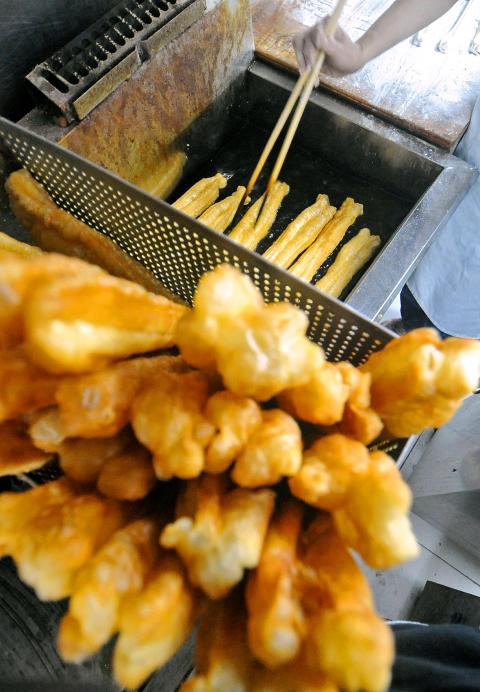
Photo: Liao Chen-huei, Taipei Times
There are methods to manufacture food with lowered acrylamide levels and the government has to familiarize the food industry with those methods and continue monitoring the public’s exposure to the substance, Yeh said.
Wu Kuen-yuh (吳焜裕), an industrial hygiene professor at NTU, said the presence of acrylamide in food is a serious issue, as the substance has been found to increase health risks in young mice more than in adult mice, meaning there might be a risk for infants.
Genetic damage caused by acrylamide might lead to cancer, Wu said, citing a report by the US Environmental Protection Agency that said an adult who weighs 60kg and consumes 75g of French fries daily — roughly equivalent to a small bag of McDonald’s fries — is 500 times more likely to develop cancer than people who do not.
The government should immediately standardize and regulate the manufacture of food products containing acrylamide, especially given that acrylamide levels found in urine from Taiwanese is slightly higher than the world average, he said.
According to a survey conducted by the Ministry of Health and Welfare, acrylamide levels are highest in potatoes, potato starch and taro, with 435 micrograms per kilogram on average, while flour, corn, rice and mixed-grain products have 299 micrograms per kilogram on average, and peas, green beans, red beans, soybeans and black beans have 101 micrograms per kilogram on average.
Chinese Nationalist Party (KMT) Legislator Alicia Wang (王育敏) said the government should disclose information on acrylamide levels in food, especially foods that are generally considered to be healthy, such as brown sugar, which is typically consumed as an iron supplement by women during menstruation.
Ministry of Health and Welfare Vice Minister Hsu Ming-neng (許銘能) said the ministry would redouble its effort to supervise the food industry to lower acrylamide levels, monitor high-risk products and educate the public.
The ministry plans to table a draft act on standardizing and monitoring acrylamide levels in food in three months, he said, adding that the act would set the acrylamide level in French fries at 600 parts per billion.
Chang Gung Memorial Hospital toxicologist Yen Tsung-hai (顏宗海) said that acrylamide is most common in starchy foods heated higher than 120?C.
NTU Hospital physician Su Ta-cheng (蘇大成) said that a brown color and pleasant smell in cooked food usually indicate high acrylamide levels.
It is recommended to soak potatoes in water to break down sugars before frying or baking and to avoid unprocessed flour, Yen said.
It is also recommended that foods refrigerated below 8?C be allowed to reach room temperature before cooking, as a sudden rise in temperature can lead to a surge in acrylamide levels, Yen said, adding that people should avoid eating reheated bread.
However, Yang Chen-chang (楊振昌), a toxicologist at Taipei Veterans General Hospital, said that although acrylamide is potentially carcinogenic, people who consume a low-sodium, low-fat and low-sugar diet should not be alarmed.

A signaling system malfunction disrupted high-speed rail (HSR) services beginning at 8am today, with trains temporarily reduced to three northbound and three southbound trains per hour as authorities conduct inspections. The malfunction occurred on a section of track in Miaoli County during pre-operation checks early this morning, forcing northbound and southbound trains to use a single track, the HSR operator said. The regular schedule has been replaced with three hourly trains offering only nonreserved seating in each direction, stopping at every station, it said, adding that business class cars would still have reserved seating. Departures from terminal stations are scheduled at the top

DRONE CENTRAL: Taiwan aims to become Asia’s democratic hub for drones, with most exports focused on high-quality military-grade models, an official said Taiwan’s drone industry is expected to expand significantly by 2030, producing 100,000 units per month and exporting half of them, the Ministry of Economic Affairs said yesterday. Current drone production capacity is about 15,000 units per month, but the industry can quickly scale up as demand increases, Industrial Development Administration Director-General Chiou Chyou-huey (邱求慧) told a news conference in Taipei. Taiwan’s drone output grew 2.5-fold last year to NT$12.9 billion (US$408.3 million) under a government program to develop the uncrewed vehicle sector, he said. The Executive Yuan in October last year approved plans to invest NT$44.2 billion into domestic production of uncrewed aerial

VERBOSE VESSELS: A CGA cutter and a China Coast Guard exchanged verbal barbs for more than a day in Taiwanese-controlled waters before the Chinese vessel left The Taiwanese and Chinese coast guards had a standoff near the strategically located Pratas Islands (Dongsha Islands, 東沙群島) in the north of the South China Sea, the Coast Guard Administration (CGA) said yesterday. The two sides engaged in intense radio exchanges over sovereignty claims during the 33-hour standoff. China Coast Guard vessel 3501 eventually left the restricted waters, 26.6 nautical miles (49.2km) west of the Pratas Islands, at 5pm yesterday, the CGA said. Lying approximately between southern Taiwan and Hong Kong, the Taiwan-controlled Pratas are seen by some security experts as vulnerable to Chinese attack due to their distance — more than
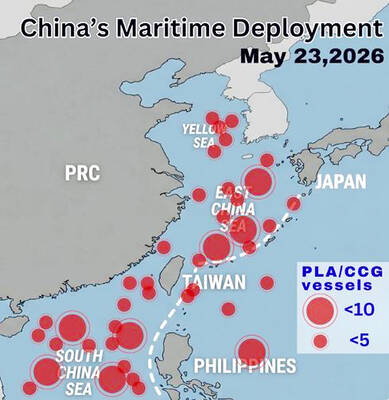
WARNING: China should stop engaging in actions that undermine regional peace and stability, as it would only build resentment among people across the Strait, the CGA said China has deployed more than 100 navy, coast guard and other vessels in waters from the Yellow Sea to the South China Sea and the western Pacific since US President Donald Trump and Chinese President Xi Jinping (習近平) met in Beijing, National Security Council Secretary-General Joseph Wu (吳釗燮) said yesterday. “In this part of the world, #China is the one & only PROBLEM wrecking the #StatusQuo & threatening regional peace & stability,” Wu wrote on X. In a separate post, he said Beijing was coercing Taiwan’s maritime domain, calling it illegal and provocative, after the Coast Guard Administration (CGA) expelled a


 RSS
RSS