


Vietnam and Australia yesterday called for “self-restraint” in the South China Sea and warned against the unilateral use of force, an obvious reference to China’s increasingly aggressive presence that has stirred concerns across the disputed region.
Vietnamese Prime Minister Nguyen Tan Dung met Australian counterpart Tony Abbott in Canberra, where they were due to sign a deal on issues including security and climate change.
Vietnam and other wary Southeast Asian nations have criticized China’s controversial policy of land reclamation on disputed isles in the South China Sea. Beijing in turn has said it is not seeking to overturn international order.
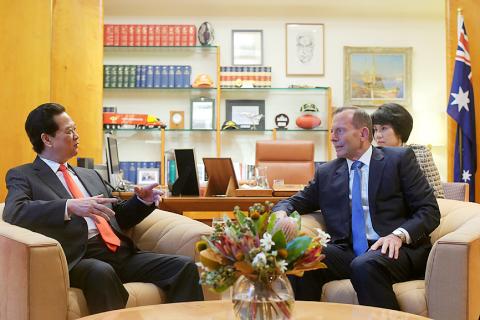
Photo: EPA
Dung told the Australian parliament there was an imperative need to draw up a code of conduct for the South China Sea.
“We agreed ... [to] exercise self-restraint and refrain from actions that may escalate the tension in the region, including the use of force to unilaterally change the status quo,” Dung said.
China claims about 90 percent of the South China Sea, displaying its reach on official maps with a so-called nine-dash dotted line that stretches deep into the maritime heart of Southeast Asia.
Taiwan, Vietnam, Malaysia, Brunei and the Philippines also have claims to parts of the potentially energy-rich waters that are crossed by key shipping lanes.
Beijing is committed to working toward regional stability, a Chinese Ministry of Foreign Affairs spokesman said when asked about the statement.
“We hope the relevant countries in the region can come together with China,” spokesman Hong Lei (洪磊) said at a regular briefing. “We hope that countries outside the region maintain a neutral position, particularly on the issue of sovereignty.”
Last week, China expressed its anger at the Vietnamese head of ASEAN for comments he made on the South China Sea, rejecting Chinese claims based on the nine-dash line.
Australia and China sealed a free-trade agreement in November last year that significantly expands ties between them.
Dung said Australia and Vietnam are also committed to working together closely and deepening their friendship.
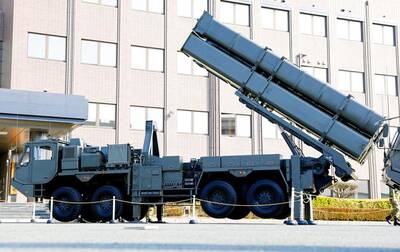
Japan has deployed long-range missiles in a southwestern region near China, the Japanese defense minister said yesterday, at a time when ties with Beijing are at their lowest in recent years. The missiles were installed in Kumamoto in the southern region of Kyushu, as Japan is attempting to shore up its military capacity as China steps up naval activity in the East China Sea. “Standoff defense capabilities enable us to counter the threat of enemy forces attempting to invade our country ... while ensuring the safety of our personnel,” Japanese Minister of Defense Shinjiro Koizumi said. “This is an extremely important initiative for
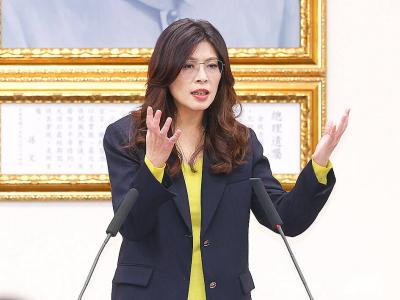
Chinese Nationalist Party (KMT) Chairwoman Cheng Li-wun (鄭麗文) today accepted an invitation from Chinese President Xi Jinping (習近平) to lead a delegation to China next month, saying she hopes to promote the peaceful development of cross-strait relations and bring stability to the Taiwan Strait. “I am grateful and happy to accept this invitation,” Cheng said in a statement from the KMT chairperson’s office. Cheng said she hopes both sides can work together to promote the peaceful development of cross-strait relations, enhance exchange and cooperation, bring stability to the Taiwan Strait and improve people’s livelihoods. At today's news conference, Cheng said any efforts to
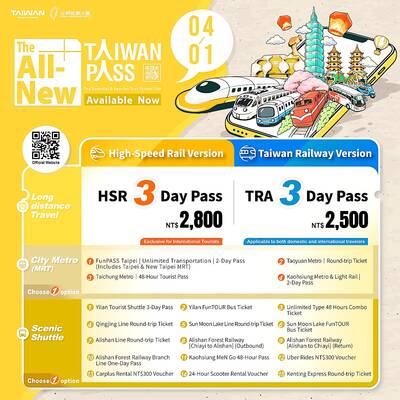
MORE POPULAR: Taiwan Pass sales increased by 59 percent during the first quarter compared with the same period last year, the Tourism Administration said The Tourism Administration yesterday said that it has streamlined the Taiwan Pass, with two versions available for purchase beginning today. The tourism agency has made the pass available to international tourists since 2024, allowing them to access the high-speed rail, Taiwan Railway Corp services, four MRT systems and four Taiwan Tourist Shuttles. Previously, five types of Taiwan Pass were available, but some tourists have said that the offerings were too complicated. The agency said only two types of Taiwan Pass would be available, starting from a three-day pass with the high-speed rail and a three-day pass with Taiwan Railway Corp. The former costs NT$2,800

The nation’s fastest supercomputer, Nano 4 (晶創26), is scheduled to be launched in the third quarter, and would be used to train large language models in finance and national defense sectors, the National Center for High-Performance Computing (NCHC) said. The supercomputer, which would operate at about 86.05 petaflops, is being tested at a new cloud computing center in the Southern Taiwan Science Park in Tainan. The exterior of the server cabinet features chip circuitry patterns overlaid with a map of Taiwan, highlighting the nation’s central position in the semiconductor industry. The center also houses Taiwania 2, Taiwania 3, Forerunner 1 and


 RSS
RSS