


A day before the anniversary of the Sunflower movement’s occupation of the legislature, the resignation of the director-general of the National Police Agency (NPA) was accepted and barricades were erected outside the Executive Yuan and the Presidential Office Building, with security forces guarding the latter carrying guns.
Minister of the Interior Chen Wei-zen (陳威仁) yesterday confirmed that NPA Director-General Wang Cho-chiun (王卓鈞), who muddled through the controversy caused by alleged police brutality during the Sunflower movement, had tendered his resignation on Monday, and that it has been approved.
Wang issued a statement on Friday last week saying that he had not yet handed in a “paper report” applying for retirement, after media outlets reported on the previous day that he had tendered his resignation to President Ma Ying-jeou (馬英九).
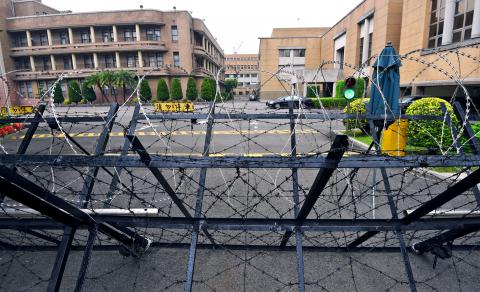
Photo: Lo Pei-der, Taipei Times
Wang said he would work until the end of the month, Chen said, and a new NPA chief would take office on April 1.
Chen denied Wang was forced to resign in order to make room for Central Police University principal Tiao Cheng-sheng (刁建生), who is thought to be the leading candidate to replace Wang.
There were also media reports which alleged Chen and Wang had personal differences and did not get along well, which was said to be the main reason Wang decided to quit.
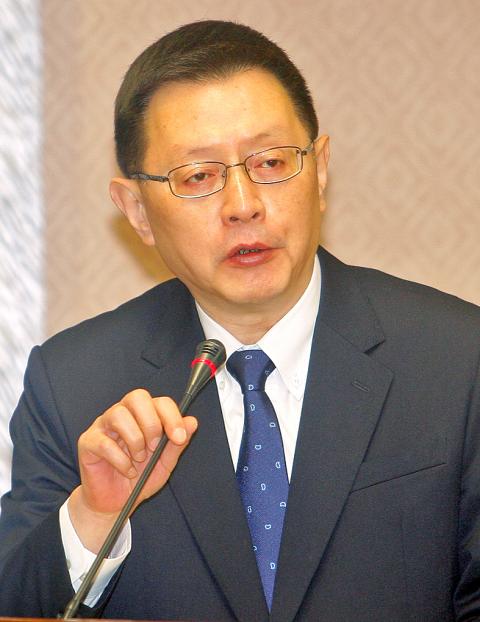
Photo: CNA
“There is no basis to those media reports,” Chen said. “Wang and I are old friends. We have no problem getting along.”
Chen was also questioned by lawmakers yesterday about the police deployment around central government buildings in Taipei on the eve of the anniversary of the beginning of the Sunflower movement.
“Netizens have ridiculed the scene as resembling that of China on the eve of the June Fourth Incident,” Democratic Progressive Party (DPP) Legislator Ho Hsin-chun (何欣純) said, referring to the Tiananmen Square massacre
The Sunflower movement refers to massive protests that activists — mostly college students — began in front of the Legislative Yuan in Taipei on March 18 last year in which they voiced their anger over the haste of the legislature’s review of the cross-strait service trade agreement. A number of civic groups have announced they plan to hold a rally at the Legislative Yuan today to mark the anniversary of the event.
Chen, whose purview includes the NPA, said he was “not clear” about the police deployment “as [Boai Special District (博愛特區)] is under the remit of the Taipei Police Department.”
“What is the government so afraid of?” asked Ho, urging Premier Mao Chi-kuo (毛治國) to face the public.
Mao cited Monday’s incident in which dozens of former freeway toll collectors stormed the Taipei apartment building where Mao lives and had violent scuffles with police, saying that “there should be a limit to how people express their different opinions.”
“[People in] Taiwanese society often do not know where the boundary between democracy and the rule of law lies when they express their views,” Mao said.
The premier did not answer Ho’s question as to whether, after all his calls for a change to the government’s attitude toward the younger generation, he still regards the Sunflower movement as simply an illegal event.
DPP Legislator Cheng Li-chun (鄭麗君) said the most effective way to show the government’s sincerity would be to drop the lawsuits against the activists who stormed the Executive Yuan compound in Taipei on March 24 last year.
Without responding directly, Mao said that while the Executive Yuan does not intend to interfere in judicial decisions, “we are calling for the greatest tolerance possible toward the [indicted] young activists.”
“However, we also have a responsibility to ensure the normal operation of the administrative system and to protect government buildings,” Mao added.
Cheng said Mao’s response “sent chills down her spine” as the Chinese Nationalist Party (KMT) authoritarian regime had uttered the same “tolerance rhetoric” before indicting pro-democracy activists involved in the Kaohsiung Incident in 1979 on sedition charges, which at that time could have led to executions.
Additional reporting by Jason Pan

‘NO SECURITY RISK’: The Railway Bureau reassured the public that the technicians’ activities were limited to technical guidance and did not involve sensitive systems The Railway Bureau yesterday said it had invited eight Chinese technicians to assist with an airport MRT construction project. The bureau issued the confirmation after an Internet user said Chinese nationals had entered the construction zone of Taiwan Taoyuan International Airport’s Terminal 3 project. They asked why “individuals from an enemy state” were allowed access to such a major national infrastructure project, which raised serious concerns over Taiwan’s industrial safety, sensitive systems and information security. The bureau’s Northern Region Engineering Branch Office said subcontractor Taiwan Handle Industrial Co (台灣手把工業) of the Taoyuan airport MRT’s “Contract No. CU05 Project A14 Station Civil, MEP &

A US uncrewed surface vessel (USV) encountered multiple Chinese warships during an autonomous transit of the Taiwan Strait, US defense company Seasats said in a statement on Wednesday. Seasats announced that a Lightfish USV had completed the first autonomous transit of the Taiwan Strait. Over five days, the USV traversed the entire length of the Strait while constantly monitoring surface vessel traffic, the company said. The Lightfish encountered multiple Chinese warships, one of which was a Chinese People’s Liberation Army Navy (PLAN) Type 056 corvette, it said. The Chinese vessels were operating “well within Taiwan’s exclusive economic zone without transmitting their identity via the
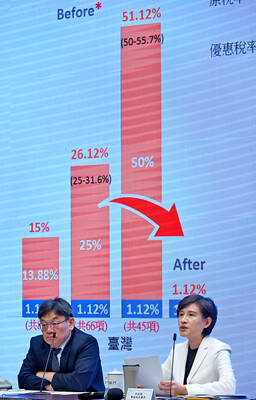
GREATER REACH? Auto parts and wood products would face tariffs of up to 15%, matching those targeting the EU, Japan and South Korea, Vice Premier said The US has announced that preferential tariff treatment for Taiwan’s non-semiconductor Section 232 goods would take effect retroactively from May 1, the Executive Yuan said yesterday. The US government yesterday posted a notice on the Federal Register’s public inspection Web site previewing tariff concessions for Taiwan under a memorandum of understanding (MOU) on Taiwan-US investment after two months of negotiations. The MOU signed on Jan. 15 stipulated three major preferential tariff arrangements: a 15 percent “reciprocal” tariff rate for Taiwan without stacking most-favored nation (MFN) rates; preferential Section 232 treatment for semiconductors and related products; and preferential Section 232 treatment for non-semiconductor

The National Chungshan Institute of Science and Technology yesterday showcased its locally developed variants of the Vision 60 robotic patrol dog, which it plans to deploy on the nation’s outlying territories in the South China Sea. The variants were produced under the Joint Lab project — created by the institute and domestic companies — and assembled with domestically produced motors, lenses and artificial intelligence (AI) systems alongside licensed tech from the US, Missile and Rocket Systems Research Division deputy director Jen Kuo-kang (任國光) told the media event at a military base in Taipei’s Dazhi (大直) area. Taiwan has built up its strengths


 RSS
RSS