


President Ma Ying-jeou (馬英九) will testify before court if he is summoned for questioning over allegations that he received illicit political donations, Presidential Office spokesman Charles Chen (陳以信) said yesterday.
Ma has repeatedly denied the allegations and said he is confident of withstanding even the closest scrutiny, Chen said.
“People are obliged to take the stand, if necessary, and of course President Ma would cooperate with the investigation,” he said.

Photo: Chien Jung-feng, Taipei Times
Supreme Court Prosecutors’ Office Prosecutor-General Yen Da-ho (顏大和) on Wednesday said the need to question Ma would be contingent on what prosecutors discover during their investigation.
The Special Investigation Division (SID) in December last year began to investigate allegations by radio host Clara Chou (周玉蔻) that Ma accepted an off-the-book donation of NT$200 million (US$6.3 million) from Ting Hsin International Group (頂新國際) during his re-election campaign in 2012 and separate allegations by political commentator Chen Min-feng (陳敏鳳) that at least 12 telecommunications and electronics magnates clandestinely donated a total of NT$200 million to Ma in 2007.
Pundits and opposition politicians accused Ma of being a “guardian angel” for Ting Hsin when the company was under fire following food scandals last year, because he had received large political donations from it.
“It’s not a problem of the possibility [of Ma being questioned] being excluded or not,” Yen said, in response to media inquiries, after Presidential Office Director Kang Bing-cheng (康炳政), Taiwan Lottery Co (台灣彩券) chairman Hsueh Hsiang-chuan (薛香川), Helm Technology (翰門企業) chairman Ni Chi-hsi (倪集熙) and former New Micropore (新長豐) chairman Wang Kung-chan (王公展) were questioned by the SID.
All four were released after questioning on Wednesday.
Political commentator Yao Li-ming (姚立明) alleged that illicit donations offered to Ma at a dinner in 2007 were handed to Kang. Yao described Kang, who he said has worked for Ma since 1984, as “a treasurer for Ma” and the president’s close confidant.
Several people have been questioned over the allegations, including Taiwan Memory Co (台灣記憶體公司) chairman John Hsuan (宣明智), senior Ting Hsin executive Wei Ying-chun (魏應充), Siliconware Precision Industries (矽品精密) chairman Bough Lin (林文伯), former People First Party legislator Liu Wen-hsiung (劉文雄), then-First International Telecom Corp (大眾電信) president Charlie Wu (吳清源) and former Chinese National Party (KMT) Taipei mayoral candidate Sean Lien (連勝文).
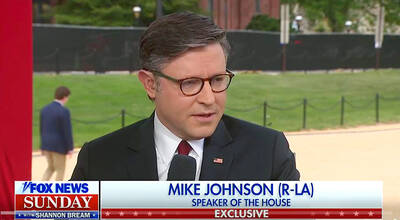
RESOLUTE BACKING: Two Republican senators are planning to introduce legislation that would impose immediate sanctions on China if it attempts to invade Taiwan US House of Representatives Speaker Mike Johnson on Sunday reaffirmed US congressional support for Taiwan, saying the US and “all freedom-loving people” have a stake in preventing China from seizing Taiwan by force. Johnson made the remarks in an interview with Fox News Sunday on US President Donald Trump’s summit with Chinese President Xi Jinping (習近平) last week. In an interview that aired on Friday on Fox News, just as Trump wrapped up a high-stakes visit to China, he said he has yet to green-light a new US$14 billion arms package to Taiwan and that it “depends on China.” “It’s a very good
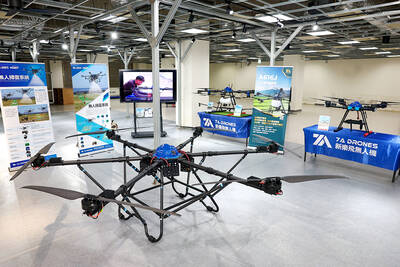
DRONE CENTRAL: Taiwan aims to become Asia’s democratic hub for drones, with most exports focused on high-quality military-grade models, an official said Taiwan’s drone industry is expected to expand significantly by 2030, producing 100,000 units per month and exporting half of them, the Ministry of Economic Affairs said yesterday. Current drone production capacity is about 15,000 units per month, but the industry can quickly scale up as demand increases, Industrial Development Administration Director-General Chiou Chyou-huey (邱求慧) told a news conference in Taipei. Taiwan’s drone output grew 2.5-fold last year to NT$12.9 billion (US$408.3 million) under a government program to develop the uncrewed vehicle sector, he said. The Executive Yuan in October last year approved plans to invest NT$44.2 billion into domestic production of uncrewed aerial
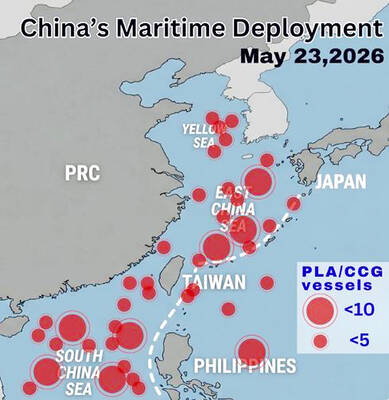
WARNING: China should stop engaging in actions that undermine regional peace and stability, as it would only build resentment among people across the Strait, the CGA said China has deployed more than 100 navy, coast guard and other vessels in waters from the Yellow Sea to the South China Sea and the western Pacific since US President Donald Trump and Chinese President Xi Jinping (習近平) met in Beijing, National Security Council Secretary-General Joseph Wu (吳釗燮) said yesterday. “In this part of the world, #China is the one & only PROBLEM wrecking the #StatusQuo & threatening regional peace & stability,” Wu wrote on X. In a separate post, he said Beijing was coercing Taiwan’s maritime domain, calling it illegal and provocative, after the Coast Guard Administration (CGA) expelled a
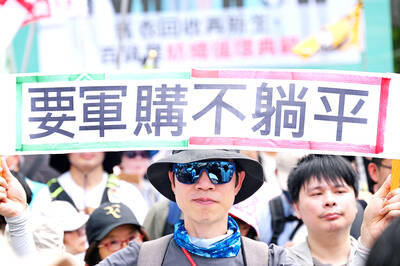
More than 8,000 people took part in a rally in Taipei yesterday to express support for more defense spending, after the opposition slashed the Cabinet’s proposed NT$1.25 trillion (US$39.6 billion) special defense budget and capped it at NT$780 billion. The demonstrators urged the Cabinet to propose another bill. Taiwan Economic Democracy Union convener Lai Chung-chiang (賴中強) said the main problem of the passed budget plan is the removal of funding for critical items, not just that the total amount is smaller. Critical budget items included purchasing or developing uncrewed vehicles, Strong Bow (強弓) missile systems, additional ammunition, artificial intelligence-powered combat systems and Taiwan-US


 RSS
RSS