


The High Court yesterday reversed a previous ruling that found Major General Shen Wei-chih (沈威志) guilty in the 2013 death of army corporal Hung Chung-chiu (洪仲丘), but delivered harsher sentences to several other military officials involved.
The ruling found 15 out of a total of 18 defendants guilty of abusing their power and sentenced them to between three months and three years in prison.
Among those found guilty, nine of the defendants saw their term behind bars increase, in contrast with an earlier ruling by the Taoyuan District Court in March last year, which sparked a public outcry because it was seen as too lenient.
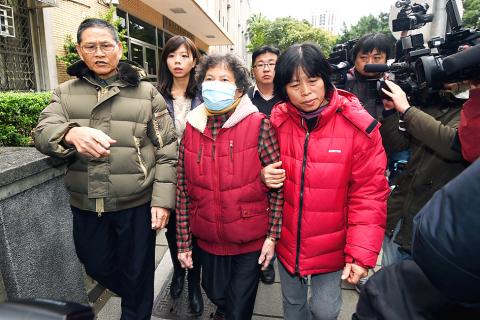
Photo: Lo Pei-der, Taipei Times
Hung collapsed from heatstroke after being forced to perform a series of strenuous exercises in a confinement facility on July 3, 2013, and died a day later in hospital.
The death of the 24-year-old conscript led to a string of protests demanding better protection of human rights within the military, including a rally in Taipei that drew more than 200,000 people.
Hung’s trial continued to receive close media scrutiny after the case was moved from military courts to the civilian judiciary system amid public pressure.
Members of Hung’s family — including his sister, Hung Tzu-yung (洪慈庸), his mother, Hu Su-chen (胡素真), and uncle, Hu Shih-ho (胡世和) — yesterday said that the verdict was mostly “acceptable” and expressed their hope for it to serve as a warning against people who abuse their power in public authority.
However, Hung’s family members said they were shocked to hear that the ruling on Shen was overturned, adding that they were considering an appeal.
Hu Shih-ho said that Shen should not be exonerated, because the brigade commander ignored Hung Chung-chiu’s pleas for help.
“He saw the text message crying for help, but still allowed Chung-chiu to remain locked up in the confinement facility,” Hu said.
In the verdict, Shen was said to have made only “administrative mistakes” and was cleared of all charges. He was originally sentenced to six months in prison on charges of abusing his powers to confine Hung Chung-chiu.
Former 542nd brigade deputy commander Colonel Ho Chiang-chung (何江中) and former company commander Major Hsu Shin-cheng (徐信正) received the harshest sentences, three years in prison, followed by Staff Sergeant Fan Tso-hsien (范佐憲), who received a sentence of two years and eight months.
Ho had been sentenced to eight months in the previous ruling, while both Hsu and Fan were previously sentenced to six months in prison.
Former vice company director Captain Liu Yen-chun (劉延俊) and First Sergeant Chen Yi-jen (陳以人) were both sentenced to two years in prison in yesterday’s verdict, in contrast with their previous six-month sentences.
First Lieutenant Kao Yu-lung’s (郭毓龍) sentence was extended from three months to eight.
Hu Su-chen said the Hung family was willing to forgive the defendants as long as they show remorse.
“Most of them are young people after all,” Hu Su-chen said.
Hung Tzu-yung said the increased sentences represented “delayed justice” for her brother’s death, adding that the rulings were in accordance with the expectations of the public.
The young corporal’s death led to the resignation of then-minister of national defense Kao Hua-chu (高華柱), and a series of reforms to the military’s judicial process.
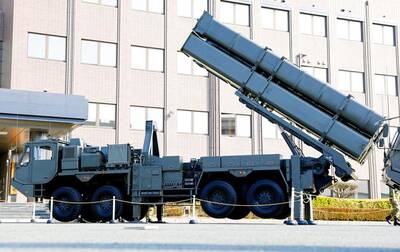
Japan has deployed long-range missiles in a southwestern region near China, the Japanese defense minister said yesterday, at a time when ties with Beijing are at their lowest in recent years. The missiles were installed in Kumamoto in the southern region of Kyushu, as Japan is attempting to shore up its military capacity as China steps up naval activity in the East China Sea. “Standoff defense capabilities enable us to counter the threat of enemy forces attempting to invade our country ... while ensuring the safety of our personnel,” Japanese Minister of Defense Shinjiro Koizumi said. “This is an extremely important initiative for
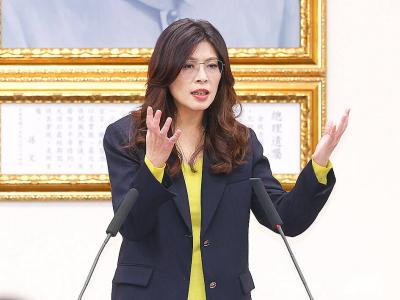
Chinese Nationalist Party (KMT) Chairwoman Cheng Li-wun (鄭麗文) today accepted an invitation from Chinese President Xi Jinping (習近平) to lead a delegation to China next month, saying she hopes to promote the peaceful development of cross-strait relations and bring stability to the Taiwan Strait. “I am grateful and happy to accept this invitation,” Cheng said in a statement from the KMT chairperson’s office. Cheng said she hopes both sides can work together to promote the peaceful development of cross-strait relations, enhance exchange and cooperation, bring stability to the Taiwan Strait and improve people’s livelihoods. At today's news conference, Cheng said any efforts to

MORE POPULAR: Taiwan Pass sales increased by 59 percent during the first quarter compared with the same period last year, the Tourism Administration said The Tourism Administration yesterday said that it has streamlined the Taiwan Pass, with two versions available for purchase beginning today. The tourism agency has made the pass available to international tourists since 2024, allowing them to access the high-speed rail, Taiwan Railway Corp services, four MRT systems and four Taiwan Tourist Shuttles. Previously, five types of Taiwan Pass were available, but some tourists have said that the offerings were too complicated. The agency said only two types of Taiwan Pass would be available, starting from a three-day pass with the high-speed rail and a three-day pass with Taiwan Railway Corp. The former costs NT$2,800

The nation’s fastest supercomputer, Nano 4 (晶創26), is scheduled to be launched in the third quarter, and would be used to train large language models in finance and national defense sectors, the National Center for High-Performance Computing (NCHC) said. The supercomputer, which would operate at about 86.05 petaflops, is being tested at a new cloud computing center in the Southern Taiwan Science Park in Tainan. The exterior of the server cabinet features chip circuitry patterns overlaid with a map of Taiwan, highlighting the nation’s central position in the semiconductor industry. The center also houses Taiwania 2, Taiwania 3, Forerunner 1 and


 RSS
RSS