


New Taipei City Mayor Eric Chu (朱立倫) was elected chairman of the Chinese Nationalist Party (KMT) yesterday with 196,830 votes, or 99.61 percent of all ballots cast, the highest in terms of percentage of votes obtained since the party first chose its leader by popular vote among party members in 2000.
The turnout from 349,374 party members eligible to vote was 56.34 percent, about the same as the six previous leadership polls, KMT headquarters said.
Chu — the only candidate — surpassed the 97.07 percent of votes former vice president Lien Chan (連戰) garnered in 2001 and 94.18 percent that President Ma Ying-jeou (馬英九) received in 2009.
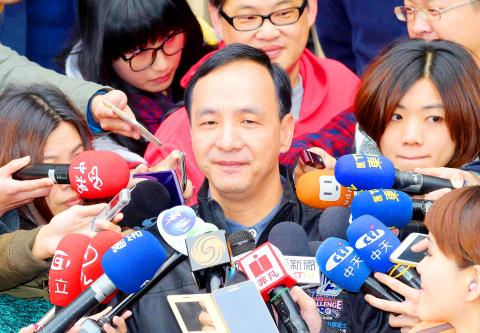
Photo: AFP
Ma and Lien were also unopposed in their respective elections.
The poll was held due to Ma having resigned from the post following the party’s rout in last year’s Nov. 29 nine-in-one elections.
Chu is to be sworn in tomorrow and announce his appointments for party officials, including up to seven vice chairmen.
After casting his ballot, Chu, was asked by a reporter whether his lack of leverage in the Executive Yuan and the legislature would put him in a less advantageous position than his predecessors.
Chu said he was fine with a weak chairmanship, but the party would have its heyday under his leadership.
Chu said he would elaborate on his platforms on issues of public concern tomorrow.
Former Taichung mayor Jason Hu (胡志強), who is to become vice president of Want Want China Times Group (旺旺中時) next month, declined to say whether he would continue to serve as vice chairman if Chu appoints him.
Vice President Wu Den-yih (吳敦義), also asked about the vice chairmanship, said: “No.”
According to data provided by KMT headquarters, voter turnout in Taipei was 38.91 percent, the lowest among the nation’s 22 cities and counties, while the highest voter turnout was in New Taipei City, with 71.61 percent.
KMT party members in Greater Kaohsiung were not as enthusiastic about the vote, with turnout at 48.47 percent — placing the municipality in the list of six cities and counties where turnout was lower than 50 percent. The remaining four were Taitung County at 40.45 percent, Miaoli County with 43.26 percent, Hualien County at 46.29 percent and Penghu County with 48.63 percent.
Late last night, Chinese President Xi Jinping (習近平), in his capacity as secretary-general of the Chinese Communist Party (CCP), sent a letter of congratulations to Chu, in which he expressed his wish for both sides to stick to the so-called “1992 consensus” and to a position against Taiwanese independence, to further the peaceful development of cross-strait relations.
In Chu’s reply, he praised the progress made in cross-strait relations over the past six years on the basis of the consensus, and said he hoped that the two parties could broaden exchanges to assist the sustainable development of peace and prosperity on both sides of the Taiwan Strait.
Chu reiterated a formula he proposed when meeting with China’s Taiwan Affairs Office Minister Zhang Zhijun (張志軍) during Zhang’s visit to Taiwan in June last year, which called for both sides to “seek common ground while respecting differences” (求同尊異), which he said revised the idea that both sides should “seek common ground while setting aside differences” (求同存異).
“Although people on both sides of the strait are Zhonghua minzu [中華民族, “Chinese ethnicity”], we should seek common ground and respect differences to reduce the psychological distance between the two sides,” Chu said.
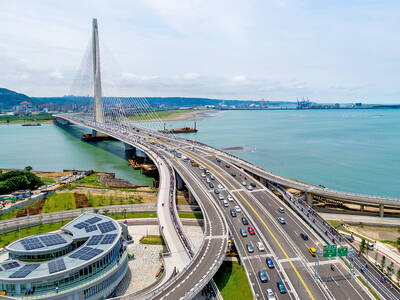
The Ministry of Transportation and Communications yesterday inaugurated the Danjiang Bridge across the Tamsui River in New Taipei City, saying that the structure would be an architectural icon and traffic artery for Taiwan. Feted as a major engineering achievement, the Danjiang Bridge is 920m long, 211m tall at the top of its pylon, and is the longest single-pylon asymmetric cable-stayed bridge in the world, the government’s Web site for the structure said. It was designed by late Iraqi-British architect Zaha Hadid. The structure, with a maximum deck of 70m, accommodates road and light rail traffic, and affords a 200m navigation channel for boats,
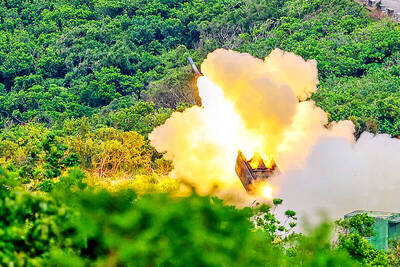
PRECISION STRIKES: The most significant reason to deploy HIMARS to outlying islands is to establish a ‘dead zone’ that the PLA would not dare enter, a source said A High Mobility Artillery Rocket System (HIMARS) would be deployed to Penghu County and Dongyin Island (東引) in Lienchiang County (Matsu) to force the Chinese military to retreat at least 100km from the coastline, a military source said yesterday. Taiwan has been procuring HIMARS and Army Tactical Missile Systems (ATACMS) from the US in batches. Once all batches have been delivered, Taiwan would possess 111 HIMARS units and 504 ATACMS, which have a range of 300km. Considering that “offense is the best defense,” the military plans to forward-deploy the systems to outlying islands such as Penghu and Dongyin so that
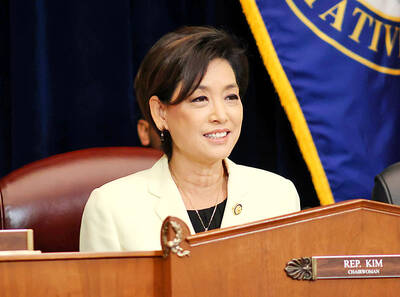
‘CLEAR MESSAGE’: The bill would set up an interagency ‘tiger team’ to review sanctions tools and other economic options to help deter any Chinese aggression toward Taiwan US Representative Young Kim has introduced a bill to deter Chinese aggression against Taiwan, calling for an interagency “tiger team” to preplan coordinated sanctions and economic measures in response to possible Chinese military or political action against Taiwan. “[Chinese President] Xi Jinping [習近平] has directed the People’s Liberation Army to be ready to invade Taiwan by 2027. China has a plan. America should have one too,” Kim said in a news release on Thursday last week. She introduced the “Deter PRC [People’s Republic of China] aggression against Taiwan act” to “ensure the US has a coordinated sanctions strategy ready should

TAIWAN ISSUE: US treasury secretary Scott Bessent said on the first day of meetings that ‘it wouldn’t be a US-China summit without the Taiwan issue coming up’ There were no surprises on the first day of the summit between US President Donald Trump and Chinese President Xi Jinping (習近平), the Mainland Affairs Council (MAC) said yesterday, as the government reiterated that cross-strait stability is crucial to the Asia-Pacific region, as well as the world. As the two presidents met for a highly anticipated summit yesterday, Chinese state media reported that Xi warned Trump that missteps regarding Taiwan could push their two countries into “conflict.” Trump arrived in China with accolades for his host, calling Xi a “great leader” and “friend,” and extending an invitation to visit the White House


 RSS
RSS