


Taiwan has taken its objection to China’s plan to open new flight routes in the Taiwan Strait to the International Civil Aviation Organization (ICAO), Minister of Foreign Affairs David Lin (林永樂) said yesterday.
The government has also conveyed its position on the matter to major countries and urged Beijing to continue negotiations on the issue with Taipei, Lin said.
“The mainland should not implement the new routes before the negotiations are completed,” Lin said at a meeting of the legislature’s Foreign Affairs and National Defense Committee.
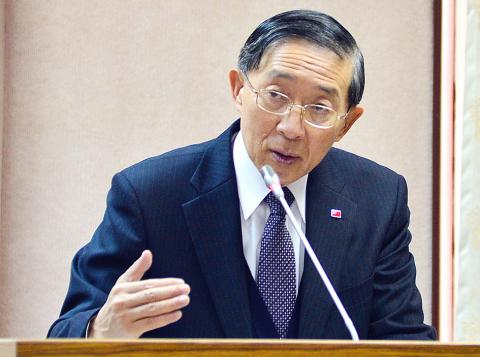
Photo: CNA
The unilateral move by China is totally unacceptable to Taiwan, he said, adding that since Beijing has yet to file a formal application with the UN agency, the plan can still be changed.
At a separate meeting of the legislature’s Transportation Committee, officials said that Taipei had conveyed to Beijing its position on the issue and Beijing had indicated that it was willing to communicate with the government.
According to the Civil Aeronautics Administration (CAA), Beijing announced an updated aviation safety bulletin on Monday morning that added four new air routes near China’s southeast coast. Among them, the north-south M503 route runs nearly parallel to the median line of the Taiwan Strait, coming as close as 7.8km. The three other routes — W121, W122 and W123 — run east-west and serve as feeder routes for the M503, with W122 and W123 potentially affecting flights to Taiwan’s outlying islands of Matsu and Kinmen.
Beijing has indicated that it plans to start using these new routes on March 5, the CAA said.
Lawmakers questioned the potential safety issues engendered by the establishment of these new routes.
Democratic Progressive Party (DPP) Legislator Yeh Yi-jin (葉宜津) said that a preliminary investigation into the Dec. 28 crash of AirAsia Flight QZ8501 showed that the pilot had asked for permission to fly at a higher altitude to avoid a major storm, but the request was denied because there were other aircraft above him.
Yeh said that flights to Kinmen and Matsu might be similarly at risk if the air routes of Taiwan and China overlap.
Chinese Nationalist Party (KMT) Legislator Lo Shu-lei (羅淑蕾) said that although Taiwan is not a member of the ICAO, it can still communicate with the Beijing government through the Mainland Affairs Council (MAC) and the Straits Exchange Foundation (SEF).
The new air routes would not only threaten aviation safety, but also national security, she said.
DPP Legislator Kuan Bi-ling (管碧玲) expressed her dissatisfaction with the way the government had reacted to Beijing’s unilateral move.
Kuan said that US Department of State deputy spokesperson Marie Harf had also urged China to communicate with all parties that would be affected by these new routes because the issues are important to Washington.
“The ministry only asked the CAA director-general [Jean Shen (沈啟)], who is to retire on Friday, to respond, while the MAC also indicated that cross-strait negotiations would continue as planned without any disruption,” Kuan said.
Top US officials cannot express concern over this matter if Taiwan does not take tougher action, she said, adding that the incident has exposed the government’s ignorance of political maneuvering.
“How can the US play an eagle if the government is as gentle as a dove?” Kuan asked.
CAA Deputy Director-General Fang Chih-wen (方志文) said in response that the agency had conducted two informal negotiations with Chinese government officials at the end of last month, in which the agency had clearly said that China should not interfere with Taiwan’s air routes.
“Both the MAC and the SEF had asked China to move further west from the M503 route, so that there would not be any safety issue when there is unstable weather,” Fang said.
Acting Minister of Transportation and Communications Chen Chien-yu (陳建宇) said that Taiwan still has time to negotiate with China, adding that China is willing to negotiate.
In Beijing, China said on Wednesday that Taiwan should not be so suspicious of its intentions on opening new commercial air routes.
Chinese state media outlets quoted China’s Taiwan Affairs Office as saying that Taipei must be “more understanding and less suspicious” about the four routes.
Additional reporting by Reuters

AGING: As of last month, people aged 65 or older accounted for 20.06 percent of the total population and the number of couples who got married fell by 18,685 from 2024 Taiwan has surpassed South Korea as the country least willing to have children, with an annual crude birthrate of 4.62 per 1,000 people, Ministry of the Interior data showed yesterday. The nation was previously ranked the second-lowest country in terms of total fertility rate, or the average number of children a woman has in her lifetime. However, South Korea’s fertility rate began to recover from 2023, with total fertility rate rising from 0.72 and estimated to reach 0.82 to 0.85 by last year, and the crude birthrate projected at 6.7 per 1,000 people. Japan’s crude birthrate was projected to fall below six,
US President Donald Trump in an interview with the New York Times published on Thursday said that “it’s up to” Chinese President Xi Jinping (習近平) what China does on Taiwan, but that he would be “very unhappy” with a change in the “status quo.” “He [Xi] considers it to be a part of China, and that’s up to him what he’s going to be doing, but I’ve expressed to him that I would be very unhappy if he did that, and I don’t think he’ll do that. I hope he doesn’t do that,” Trump said. Trump made the comments in the context
SELF-DEFENSE: Tokyo has accelerated its spending goal and its defense minister said the nation needs to discuss whether it should develop nuclear-powered submarines China is ramping up objections to what it sees as Japan’s desire to acquire nuclear weapons, despite Tokyo’s longstanding renunciation of such arms, deepening another fissure in the two neighbors’ increasingly tense ties. In what appears to be a concerted effort, China’s foreign and defense ministries issued statements on Thursday condemning alleged remilitarism efforts by Tokyo. The remarks came as two of the country’s top think tanks jointly issued a 29-page report framing actions by “right-wing forces” in Japan as posing a “serious threat” to world peace. While that report did not define “right-wing forces,” the Chinese Ministry of Foreign Affairs was

PREPAREDNESS: Given the difficulty of importing ammunition during wartime, the Ministry of National Defense said it would prioritize ‘coproduction’ partnerships A newly formed unit of the Marine Corps tasked with land-based security operations has recently replaced its aging, domestically produced rifles with more advanced, US-made M4A1 rifles, a source said yesterday. The unnamed source familiar with the matter said the First Security Battalion of the Marine Corps’ Air Defense and Base Guard Group has replaced its older T65K2 rifles, which have been in service since the late 1980s, with the newly received M4A1s. The source did not say exactly when the upgrade took place or how many M4A1s were issued to the battalion. The confirmation came after Chinese-language media reported


 RSS
RSS