


China yesterday demanded a review of crowd-safety procedures as dozens of people remain in Shanghai’s hospitals after a deadly stampede on New Year’s Eve killed 36 and caused the cancelation of celebrations across the city.
At least 49 people were injured, including 31 still serious enough to require hospitalization, the Shanghai government said on its Web site. The stampede — the city’s deadliest disaster since 2010 — started at about 11:35pm, as tens of thousands of people crowded into the historic Bund riverside district for a light show.
Chinese President Xi Jinping (習近平) ordered an investigation and told local governments to prioritize safety ahead of the mass celebrations for the Lunar New Year holidays next month.
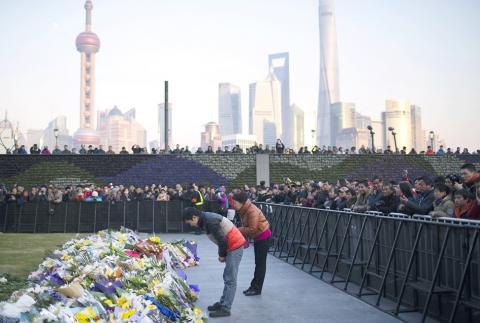
Photo: Reuters
The China National Tourism Administration issued an emergency notice on Thursday night requiring its local offices to establish procedures to control crowd flows at tourist spots.
While Shanghai authorities said they were still investigating the cause of the accident, eyewitnesses and family members of those injured described scenes where people were impeding the flow of traffic trying to escape the crowds, while others fell on top of each other at a pedestrian platform along the river.
Pictures posted on social media showed people that night packed tightly together in the Bund’s Chen Yi Square, where the incident occurred.
“This is a completely avoidable incident, as using today’s Internet and Big Data technologies’ early-warning mechanisms are completely feasible,” said Yi Peng, an urbanization researcher at Pangoal, a Beijing-based public policy research institute. “Doesn’t everyone in the area have a cellphone? Warnings could have been sent through Weibo, WeChat and all kinds of ways to avoid such a tragedy.”
The government blocked off an area at the Bund for people to lay flowers to mourn those who died in the tragedy.
It also made available a team of experts to provide psychological help to victims and families, according to its Web site and microblog.
The reason for the accident was still under investigation, according to staff at the Shanghai government media office who asked not to be named.
Four of the dead have yet to be identified, the person said.
Two-thirds of the fatalities were female, according to a name list posted by the government yesterday. Ages of the deceased ranged from 12 to 37, the list showed.
Shanghai party secretary Han Zheng (韓正) on Thursday said that the municipality would review the planning of large events, especially those in densely crowded places.
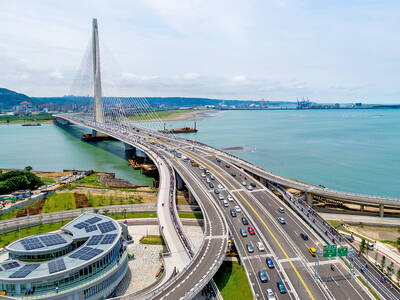
The Ministry of Transportation and Communications yesterday inaugurated the Danjiang Bridge across the Tamsui River in New Taipei City, saying that the structure would be an architectural icon and traffic artery for Taiwan. Feted as a major engineering achievement, the Danjiang Bridge is 920m long, 211m tall at the top of its pylon, and is the longest single-pylon asymmetric cable-stayed bridge in the world, the government’s Web site for the structure said. It was designed by late Iraqi-British architect Zaha Hadid. The structure, with a maximum deck of 70m, accommodates road and light rail traffic, and affords a 200m navigation channel for boats,
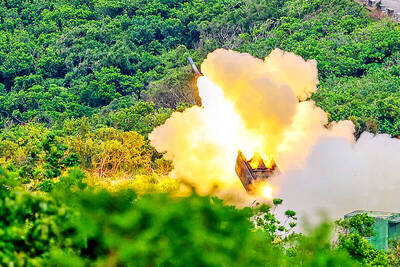
PRECISION STRIKES: The most significant reason to deploy HIMARS to outlying islands is to establish a ‘dead zone’ that the PLA would not dare enter, a source said A High Mobility Artillery Rocket System (HIMARS) would be deployed to Penghu County and Dongyin Island (東引) in Lienchiang County (Matsu) to force the Chinese military to retreat at least 100km from the coastline, a military source said yesterday. Taiwan has been procuring HIMARS and Army Tactical Missile Systems (ATACMS) from the US in batches. Once all batches have been delivered, Taiwan would possess 111 HIMARS units and 504 ATACMS, which have a range of 300km. Considering that “offense is the best defense,” the military plans to forward-deploy the systems to outlying islands such as Penghu and Dongyin so that

Taiwan Semiconductor Manufacturing Co (TSMC, 台積電), the world’s largest foundry service provider, yesterday said that global semiconductor revenue is projected to hit US$1.5 trillion in 2030, after the figure exceeds US$1 trillion this year, as artificial intelligence (AI) demand boosts consumption of token and compute power. “We are still at the beginning of the AI revolution, but we already see a significant impact across the whole semiconductor ecosystem,” TSMC deputy cochief operating officer Kevin Zhang (張曉強) said at the company’s annual technology symposium in Hsinchu City. “It is fair to say that in the past decade, smartphones and other mobile devices were

‘CLEAR MESSAGE’: The bill would set up an interagency ‘tiger team’ to review sanctions tools and other economic options to help deter any Chinese aggression toward Taiwan US Representative Young Kim has introduced a bill to deter Chinese aggression against Taiwan, calling for an interagency “tiger team” to preplan coordinated sanctions and economic measures in response to possible Chinese military or political action against Taiwan. “[Chinese President] Xi Jinping [習近平] has directed the People’s Liberation Army to be ready to invade Taiwan by 2027. China has a plan. America should have one too,” Kim said in a news release on Thursday last week. She introduced the “Deter PRC [People’s Republic of China] aggression against Taiwan act” to “ensure the US has a coordinated sanctions strategy ready should


 RSS
RSS