


Malaysia and the Philippines have been battered by heavy rain and flash floods in recent days, killing dozens, officials said on Tuesday.
The death toll from the flooding and landslides in the Philippines wrought by Tropical Storm Seniang rose to 53 yesterday, officials said, with some regions saying they were caught off guard by the deluge.
In Catbalogan in Samar province, 19 people died in a landslide that left homes and vehicles buried under rocks and mud, Catbalogan Mayor Stephany Uy-Tan said, adding that the town had been surprised by the landslide.
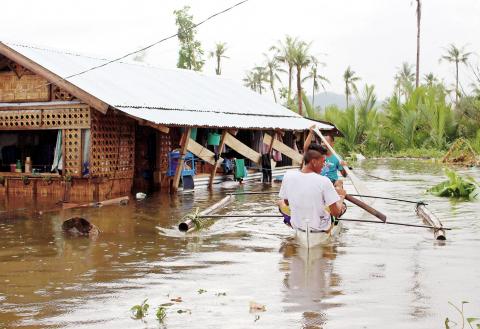
Photo: Reuters
Seniang affected 121,737 people, 80,186 of which are in evacuation centers, the National Disaster Monitoring Agency said.
The storm’s death toll was nearly triple that of the last major storm to hit the country, Super Typhoon Hagupit, earlier this month.
In Misamis Oriental province, floods flattened rice and corn fields resulting in an estimated 400 million pesos (US$9 million) in damages, Misamis Oriental Governor Yevgeny Emano told DZMM radio.
In Leyte, the rains brought landslides and floods that closed off major roads, Leyte Governor Leopoldo Domenico Petilla said on DZMM.
In Malaysia, the worst flooding in a decade forced nearly a quarter of a million people from their homes, officials said, with the government coming under renewed fire for its perceived slow response.
At least 21 people have been killed and eight others are missing in the country’s flooded northeast, police said yesterday.
They said 14 of the deaths were in the worst-hit state of Kelantan, where about 158,476 people were displaced, while four people died in Terengganu State and three in Pahang State. There are also reports of outbreaks of flu and diarrhea.
The number forced from their homes in the other affected states — Pahang, Perak, Terengganu and Johor — totaled 83,570.
Malaysian Prime Minister Najib Razak, who came under fire after being filmed playing golf with US President Barack Obama in Hawaii when the disaster happened, said he was saddened by the flooding.

DEFENDING DEMOCRACY: Taiwan shares the same values as those that fought in WWII, and nations must unite to halt the expansion of a new authoritarian bloc, Lai said The government yesterday held a commemoration ceremony for Victory in Europe (V-E) Day, joining the rest of the world for the first time to mark the anniversary of the end of World War II in Europe. Taiwan honoring V-E Day signifies “our growing connections with the international community,” President William Lai (賴清德) said at a reception in Taipei on the 80th anniversary of V-E Day. One of the major lessons of World War II is that “authoritarianism and aggression lead only to slaughter, tragedy and greater inequality,” Lai said. Even more importantly, the war also taught people that “those who cherish peace cannot

Taiwanese Olympic badminton men’s doubles gold medalist Wang Chi-lin (王齊麟) and his new partner, Chiu Hsiang-chieh (邱相榤), clinched the men’s doubles title at the Yonex Taipei Open yesterday, becoming the second Taiwanese team to win a title in the tournament. Ranked 19th in the world, the Taiwanese duo defeated Kang Min-hyuk and Ki Dong-ju of South Korea 21-18, 21-15 in a pulsating 43-minute final to clinch their first doubles title after teaming up last year. Wang, the men’s doubles gold medalist at the 2020 and 2024 Olympics, partnered with Chiu in August last year after the retirement of his teammate Lee Yang
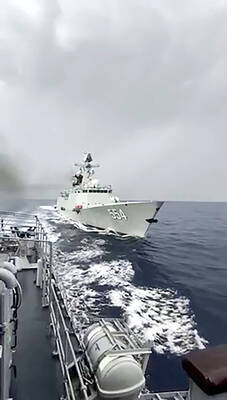
The Philippines yesterday criticized a “high-risk” maneuver by a Chinese vessel near the disputed Scarborough Shoal (Huangyan Island, 黃岩島) in a rare incident involving warships from the two navies. The Scarborough Shoal — a triangular chain of reefs and rocks in the contested South China Sea — has been a flash point between the countries since China seized it from the Philippines in 2012. Taiwan also claims the shoal. Monday’s encounter took place approximately 11.8 nautical miles (22km) southeast” of the Scarborough Shoal, the Philippine military said, during ongoing US-Philippine military exercises that Beijing has criticized as destabilizing. “The Chinese frigate BN 554 was

The number of births in Taiwan fell to an all-time monthly low last month, while the population declined for the 16th consecutive month, Ministry of the Interior data released on Friday showed. The number of newborns totaled 8,684, which is 704 births fewer than in March and the lowest monthly figure on record, the ministry said. That is equivalent to roughly one baby born every five minutes and an annual crude birthrate of 4.52 per 1,000 people, the ministry added. Meanwhile, 17,205 deaths were recorded, resulting in a natural population decrease of 8,521, the data showed. More people are also leaving Taiwan, with net


 RSS
RSS