


Hong Kong property tycoon Thomas Kwok (郭炳江) and the territory’s former deputy leader were jailed for corruption yesterday after a trial that shocked the territory and deepened anger at cosy ties between officialdom and big business.
Former Hong Kong chief secretary Rafael Hui (許仕仁), 66, was jailed for seven-and-a-half years on five graft charges, including misconduct in public office — making him the highest-ranking official in Hong Kong’s history to be found guilty of taking bribes.
Kwok, 63 — who was joint chairman of the territory’s biggest property company, Sun Hung Kai Properties Ltd (新鴻基地產) — was sentenced to five years after he was found guilty of conspiracy to commit misconduct in public office over a series of payments totaling HK$8.5 million (US$1.1 million) made to Hui.
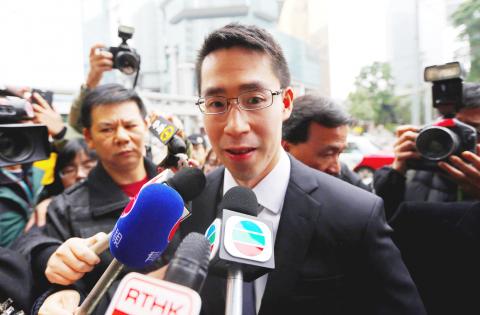
Photo: AFP
The seven-month trial centered around a total of HK$34 million in handouts, which the prosecution said were made to Hui by Kwok and his billionaire brother, Raymond Kwok (郭炳聯), to be their “eyes and ears” in government.
Raymond Kwok was cleared of all charges and Thomas Kwok cleared of two out of the three against him.
Hong Kong is seen as relatively graft-free — it was ranked the joint-15th cleanest country or territory last year by watchdog Transparency International.
“To know that the former No. 2 in government had received bribes must be a deep disappointment to many people in Hong Kong,” Judge Andrew Macrae said. “It is vitally important in these times that the Hong Kong government and business community remain — and are seen to remain — corruption-free, particularly when the mainland is taking obvious and positive steps to eradicate the cancer of corruption in their own jurisdiction.”
He said Hui was “blinded by the desire to sustain the high life.”
Prosecutors said Hui enjoyed an extravagant standard of living that far outstripped his official salary. He was also found guilty on charges relating to the use of luxury apartments rent-free and accepting unsecured loans.
Hui, who is married, admitted spending at least HK$7 million on a mistress in Shanghai, who he bought properties for as well as making investments on her behalf, according to local media reports. He also bought her bags, watches and other presents.
Hui was ordered to pay a fine of HK$11.182 million — the sum of one of the payments he was found guilty of receiving. He was given nine months less than the maximum sentence considered by the judge because of his good character and “lifetime” contribution to society.
In sentencing Thomas Kwok, Macrae said he had no doubt that he was “at heart a good man.”
He said he had considered a maximum sentence of six years, but handed down a year less to account for Kwok’s good character.
Kwok was fined HK$500,000 and disqualified from any company directorship for five years after resigning from Sun Hung Kai on Friday last week.
With soaring property prices and stagnant wages, there is rising anger at a lack of opportunity for ordinary Hong Kongers.
“Members of the public have had a perception of business-government collusion for some time,” Hong Kong Institute of Education political analyst Sonny Lo (盧兆興) said. “This case proves that such public perception has some validity.”

‘NO SECURITY RISK’: The Railway Bureau reassured the public that the technicians’ activities were limited to technical guidance and did not involve sensitive systems The Railway Bureau yesterday said it had invited eight Chinese technicians to assist with an airport MRT construction project. The bureau issued the confirmation after an Internet user said Chinese nationals had entered the construction zone of Taiwan Taoyuan International Airport’s Terminal 3 project. They asked why “individuals from an enemy state” were allowed access to such a major national infrastructure project, which raised serious concerns over Taiwan’s industrial safety, sensitive systems and information security. The bureau’s Northern Region Engineering Branch Office said subcontractor Taiwan Handle Industrial Co (台灣手把工業) of the Taoyuan airport MRT’s “Contract No. CU05 Project A14 Station Civil, MEP &

A US uncrewed surface vessel (USV) encountered multiple Chinese warships during an autonomous transit of the Taiwan Strait, US defense company Seasats said in a statement on Wednesday. Seasats announced that a Lightfish USV had completed the first autonomous transit of the Taiwan Strait. Over five days, the USV traversed the entire length of the Strait while constantly monitoring surface vessel traffic, the company said. The Lightfish encountered multiple Chinese warships, one of which was a Chinese People’s Liberation Army Navy (PLAN) Type 056 corvette, it said. The Chinese vessels were operating “well within Taiwan’s exclusive economic zone without transmitting their identity via the
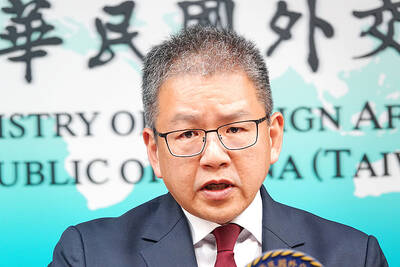
Taiwan is still in the process of assessing the possibility of recruiting workers from Eswatini, the Ministry of Foreign Affairs said yesterday, adding that its goal is to help Eswatini upgrade its vocational training centers. If there are plans to recruit workers from Eswatini, safeguarding national security, protecting public health and ensuring the employment rights of Taiwanese would be prerequisites, Department of West Asian and African Affairs Director-General Yen Chia-liang (顏嘉良) told a news conference. Key considerations would also include filling labor shortages in specific industries, and fostering bilateral professional and technical exchanges, he said. Yen was asked about the progress of labor
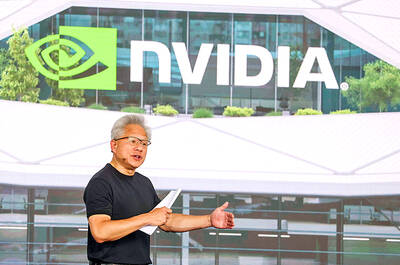
‘BOOMING’: ’ The number of partners we have here is incredible. You can see from their stock prices. They’re doing so well, they’re so happy,’ Jensen Huang said Nvidia Corp’s spending in Taiwan has ballooned to about US$150 billion a year, 10 times the US$10 billion to US$15 billion the company spent five years ago, Nvidia chief executive officer Jensen Huang (黃仁勳) said yesterday, suggesting Taiwan’s strategic importance in the global artificial intelligence (AI) supply chain. “Taiwan is the epicenter of the AI revolution. This is where the chips come, packaging comes. This is where the systems are made. This is where AI supercomputers were created,” Huang said at a meeting for the company’s employees in Beitou-Shilin Technology Park (北投士林科技園區) in Taipei, the planned site of Nvidia’s Taipei headquarters. “Taiwan


 RSS
RSS