


Hopes for a major Cabinet reshuffle were dashed yesterday as the newly appointed premier announced a team filled with many old, familiar faces.
Legislators panned the “micro-changes” in the Executive Yuan as the work of a government that has grown numb to public calls for reform.
While President Ma Ying-jeou (馬英九) promised major reforms after the Chinese Nationalist Party’s (KMT) massive defeat at the nine-in-elections last Saturday, the new appointments have turned out to be mainly major promotions instead of changes of personnel.
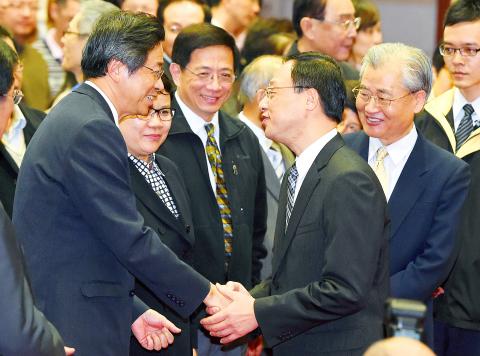
Photo: Liao Chen-huei, Taipei Times
Incoming premier Mao Chi-kuo (毛治國), who was appointed on Wednesday, served as vice premier under outgoing Premier Jiang Yi-huah (江宜樺). Mao’s new Cabinet includes: Minister of Science and Technology Simon Chang (張善政), who has been named the new vice premier; Minister Without Portfolio John Deng (鄧振中), who is to succeed Minister of Economic Affairs Woody Duh (杜紫軍); and Coast Guard Administration Deputy Minister Wang Chung-yi (王崇儀), who is to take over as head of the agency.
Other ministry heads are to remain in their posts, including Minister of Transportation and Communications Yeh Kuang-shih (葉匡時), who has been the target of unrelenting protests by former toll collectors and their supporters, and Minister of Justice Luo Ying-shay (羅瑩雪), who has been the target of criticism by various civic groups advocating legal reforms, abolition of the death penalty and marriage equality.
The vacancies left by the promotion of Chang and the resignation of Minister of Culture Lung Ying-tai (龍應台) are to be temporarily filled by their respective deputy ministers.
Environmental Protection Administration Deputy Minister Yeh Hsin-cheng (葉欣誠) has been named a minister without portfolio, as two former ministers without portfolio — Yang Chiu-hsing (楊秋興) and Chien Tai-lang (簡太郎) — had resigned to run as the KMT’s candidates for Greater Kaohsiung mayor and Pingtung County commissioner. Both lost in the polls. The other vacancy awaits future designation.
Duh, the outgoing minister of economic affairs, is stepping into the vacancy left by Deng. The two are, in effect, just swapping positions.
The much-touted en masse resignation of the Cabinet ended with only three members actually leaving: Jiang, Lung and outgoing Coast Guard Administration Minister Wang Ginn-wang (王進旺).
KMT Legislator Liao Kuo-tung (廖國棟) said people have become “numb” to the so-called new moves that the government is making in the wake of the party’s electoral defeat.
Democratic Progressive Party (DPP) Legislator Tsai Chi-chang (蔡其昌) said the minor changes made to the Cabinet showed that the KMT, despite its electoral rout, “has failed to respond to people’s calls for reforms.”
“President Ma Ying-jeou has not learned his lesson at all; he is completely at a loss on how to interpret the election results,” Tsai said.
DPP Legislator Tsai Huang-liang (蔡煌瑯) called the “old-wine-in-old-bottle” Cabinet “a caretaker Cabinet that is not blessed” and is “destined to fail.”
The new Cabinet is scheduled to take office on Monday.
Meanwhile, the legislature yesterday decided that Mao and his new Cabinet would make their policy address and reports on the central government’s general budget proposal to the legislature next Friday and on Dec. 15.
The three party caucuses will have 23 lawmakers participate in the question-and-answer session, 10 each for the KMT and the DPP and three for the Taiwan Solidarity Union.

The National Chungshan Institute of Science and Technology yesterday showcased its locally developed variants of the Vision 60 robotic patrol dog, which it plans to deploy on the nation’s outlying territories in the South China Sea. The variants were produced under the Joint Lab project — created by the institute and domestic companies — and assembled with domestically produced motors, lenses and artificial intelligence (AI) systems alongside licensed tech from the US, Missile and Rocket Systems Research Division deputy director Jen Kuo-kang (任國光) told the media event at a military base in Taipei’s Dazhi (大直) area. Taiwan has built up its strengths

RIGHT DIRECTION: Taiwan’s efforts to prevent forced labor include a proposal to ‘fully prohibit’ employers from withholding workers’ documents, an official said Taiwan is to establish a mechanism to restrict imports of goods linked to forced labor, the Executive Yuan said yesterday, after the US proposed imposing additional tariffs on Taiwanese goods over labor concerns. “The Ministry of Labor and the Ministry of Economic Affairs are to establish an interministerial review procedure,” Executive Yuan spokesperson Michelle Lee (李慧芝) said at a news briefing in Taipei. “The government is to use the Foreign Trade Act [貿易法] as the legal basis to restrict imports of goods produced with forced labor” and bring its supply chain governance more in line with international standards on human rights, resilience

NOT IMMEDIATE: Taiwan has a chance to appeal the proposed 10 percent tariff before it starts, while other countries face a 12.5 percent tariff from the trade office Taiwan is among 60 economies determined by the US to have failed to impose or enforce a ban on the importation of goods produced with forced labor, according to a notice released on Tuesday by the Office of the US Trade Representative (USTR), which proposed imposing an additional 10 percent or more tariff on them. The USTR in a statement said that following an investigation, it had determined under Section 301 of the Trade Act of 1974 that the failure of the 60 economies to impose and effectively enforce a prohibition on the importation of goods produced with forced labor is

TIT-FOR-TAT: The US allegedly revoked the visa of a Chinese national working at Xinhua News Agency in the US in response to Beijing’s expulsion of Vivian Wang The Presidential Office yesterday condemned China for expelling a New York Times correspondent from Beijing following the newspaper’s interview with President William Lai (賴清德), saying the move highlighted Beijing’s suppression of press freedom and its threat to international news media. Taiwan has noted a series of recent incidents in which Beijing used similar tactics to “threaten and pressure international media outlets and journalists,” Presidential Office spokeswoman Karen Kuo (郭雅慧) said in a statement. “This concerns not only press freedom and freedom of expression, but also the safety of journalists, and Taiwan and relevant partners are paying close attention to the situation,” she


 RSS
RSS