


Chinese Nationalist Party (KMT) Taipei mayoral candidate Sean Lien’s (連勝文) wife, Patty Tsai (蔡依珊), is in the process of renouncing her Canadian citizenship, according to a statement from the Taipei law firm LCS & Partners.
Tsai signed a contract with the law firm on April 23 authorizing it to contact Canadian attorneys about Canada’s regulations relating to the renounciation of citizenship, the statement said.
The relevant procedures are under way, the firm said.
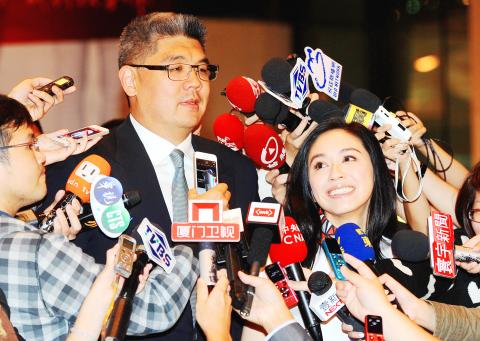
Photo: Chang Chia-ming, Taipei Times
Attorney Lin Ching-fe (林進富) said in the statement that the processing of Tsai’s application was not complete.
Lien’s campaign office issued the statement on behalf of the firm in response to a report in the latest edition of the Chinese-language weekly, Next Magazine that said it had received a tip from a person at an airline that Tsai presented a Canadian passport while transiting through Hong Kong last year, as did the couple’s two children.
Asked to verify the report yesterday, Lien said he felt sorry that his wife had to give up her Canadian citizenship because of his political career.
“She did not have to do this. She is not running in the election. I really appreciate that she is willing to make a sacrifice because of the need to accommodate the sentiment [against politicians holding dual citizenship] in Taiwan’s electoral culture. I feel sad in my heart and really sorry,” Lien said.
“I am the one running for election. What is important is that I have never acquired a foreign nationality by applying for one,” he said.
Lien won the KMT mayoral primary on April 19.
Under the Nationality Act (國籍法), Taiwanese may hold dual citizenships, but those holding public office must surrender their foreign citizenship.
Dual nationality has been a sensitive topic in recent years, with some people saying that public servants or elected officials holding dual citizenship could undercut their allegiance to this nation.
Tsai, daughter of the owner of Shanghai Shanghai (紅豆食府), a famous restaurant in Taiwan, immigrated to Canada with her family when she was 14 and eventually obtained citizenship, Lien said.
Next Magazine said Lien could gain Canadian citizenship as Tsai’s spouse if Tsai continued to hold Canadian nationality.
However, the Canadian government’s Web site states that marriage to a Canadian citizen does not provide their spouse with citizenship.
If a Canadian’s spouse wants to acquire Canadian citizenship, they must follow the same steps as any other applicant.
In related news, independent Taipei mayoral candidate Ko Wen-je (柯文哲) yesterday said his father had once applied for a US green card for him. However, Ko said he had given the green card up years ago.
“My uncles left Taiwan to live in the US because of the 228 Massacre. My father was the only one among his siblings to stay in Taiwan,” the physician-turned-candidate said. “At the time, my father had a green card, and he applied for one for me, thinking it would be better for me to move to the US later on.”
However, after he graduated from National Taiwan University’s medical school, he decided he did not want a green card, Ko said.
“I told my father that I wanted to become a doctor in Taiwan, not in the US, so I went to the American Institute in Taiwan to fill out forms to give up the green card myself,” Ko said.
Asked about the Next Magazine story about Tsai’s Canadian citizenship, Ko said it was not a big deal since Tsai lived in Canada for a long time. Election laws do not prohibit a candidate’s spouse from having foreign citizenship, he said.

Japan has deployed long-range missiles in a southwestern region near China, the Japanese defense minister said yesterday, at a time when ties with Beijing are at their lowest in recent years. The missiles were installed in Kumamoto in the southern region of Kyushu, as Japan is attempting to shore up its military capacity as China steps up naval activity in the East China Sea. “Standoff defense capabilities enable us to counter the threat of enemy forces attempting to invade our country ... while ensuring the safety of our personnel,” Japanese Minister of Defense Shinjiro Koizumi said. “This is an extremely important initiative for
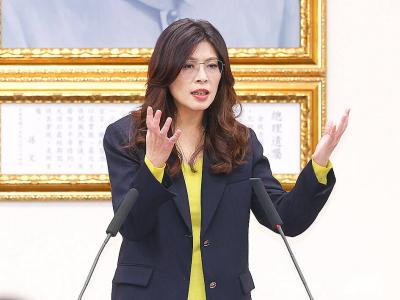
Chinese Nationalist Party (KMT) Chairwoman Cheng Li-wun (鄭麗文) today accepted an invitation from Chinese President Xi Jinping (習近平) to lead a delegation to China next month, saying she hopes to promote the peaceful development of cross-strait relations and bring stability to the Taiwan Strait. “I am grateful and happy to accept this invitation,” Cheng said in a statement from the KMT chairperson’s office. Cheng said she hopes both sides can work together to promote the peaceful development of cross-strait relations, enhance exchange and cooperation, bring stability to the Taiwan Strait and improve people’s livelihoods. At today's news conference, Cheng said any efforts to

MORE POPULAR: Taiwan Pass sales increased by 59 percent during the first quarter compared with the same period last year, the Tourism Administration said The Tourism Administration yesterday said that it has streamlined the Taiwan Pass, with two versions available for purchase beginning today. The tourism agency has made the pass available to international tourists since 2024, allowing them to access the high-speed rail, Taiwan Railway Corp services, four MRT systems and four Taiwan Tourist Shuttles. Previously, five types of Taiwan Pass were available, but some tourists have said that the offerings were too complicated. The agency said only two types of Taiwan Pass would be available, starting from a three-day pass with the high-speed rail and a three-day pass with Taiwan Railway Corp. The former costs NT$2,800

The nation’s fastest supercomputer, Nano 4 (晶創26), is scheduled to be launched in the third quarter, and would be used to train large language models in finance and national defense sectors, the National Center for High-Performance Computing (NCHC) said. The supercomputer, which would operate at about 86.05 petaflops, is being tested at a new cloud computing center in the Southern Taiwan Science Park in Tainan. The exterior of the server cabinet features chip circuitry patterns overlaid with a map of Taiwan, highlighting the nation’s central position in the semiconductor industry. The center also houses Taiwania 2, Taiwania 3, Forerunner 1 and


 RSS
RSS