


The Taipei City Police Department yesterday took the lead in the official investigation into the alleged wiretapping of one of independent Taipei mayoral candidate Ko Wen-je’s (柯文哲) offices, and called in one suspect for further questioning.
Staff working at the office had discovered several connectors on the building’s main switchboard connecting to the office after Chinese Nationalist Party (KMT) Legislator Alex Tsai (蔡正元), executive director of KMT Taipei mayoral candidate Sean Lien’s (連勝文) campaign, on Tuesday released a list of Ko’s advisers before the list had been made public by Ko’s office.
According to the Taipei District Prosecutors’ Office, the Daan District (大安) precinct had requested taking the lead in the investigation, which had been approved.
Whether the prosecutors’ office would step in to take the lead in the investigation in the future remains to be seen, the office said.
Internet Gazette Law Paper (法治時報社) president Huang Yueh-hung (黃越宏) yesterday filed a suit against Tsai accusing him of violating Clause 2 of Article 315 of the Criminal Code and Article 104 of the Civil Servants Election and Recall Act (公職人員選舉罷免法).
Clause 2 states that recording via audio, photographic, videotape or electromagnetic means without good reason of other’s non-public activities, speeches, talks or the private bodily part is an offense against privacy.
Article 104 of the act states that violators face up to five years in prison for disseminating rumors or spreading falsities by text, picture, audio tape, video tape, speech or any other method to cause a candidate to lose an election.
Huang said information regarding a candidate’s future team or personnel arrangements are secrets of the candidate and are protected under both the Criminal Code and the Constitution.
Tsai should not make such documents public no matter how he obtained them, Huang said.
Huang also said that Tsai’s comments on his Facebook page constituted disseminating false information and attempting to prevent Ko from being elected.
Ko denied accusations by Tsai that he created the suspected bugging incident himself, saying that he supported a thorough investigation.
“Of course I wasn’t behind the suspected telephone tapping. That is just not my style of doing things,” Ko said when questioned on the issue by the media during a campaign event. “I’m leading in the polls; I have no reason to do so.”
“Instead of questioning me, an investigation should start with Tsai, since he was the one who made public the list,” Ko said. “Otherwise, should I be blamed for leaks of other classified information in the past?”
Separately, Lien said he hoped that the police could bring the truth to light before the election and urged voters not to vote for the camp that designed the “electoral deception.”

The National Chungshan Institute of Science and Technology yesterday showcased its locally developed variants of the Vision 60 robotic patrol dog, which it plans to deploy on the nation’s outlying territories in the South China Sea. The variants were produced under the Joint Lab project — created by the institute and domestic companies — and assembled with domestically produced motors, lenses and artificial intelligence (AI) systems alongside licensed tech from the US, Missile and Rocket Systems Research Division deputy director Jen Kuo-kang (任國光) told the media event at a military base in Taipei’s Dazhi (大直) area. Taiwan has built up its strengths

RIGHT DIRECTION: Taiwan’s efforts to prevent forced labor include a proposal to ‘fully prohibit’ employers from withholding workers’ documents, an official said Taiwan is to establish a mechanism to restrict imports of goods linked to forced labor, the Executive Yuan said yesterday, after the US proposed imposing additional tariffs on Taiwanese goods over labor concerns. “The Ministry of Labor and the Ministry of Economic Affairs are to establish an interministerial review procedure,” Executive Yuan spokesperson Michelle Lee (李慧芝) said at a news briefing in Taipei. “The government is to use the Foreign Trade Act [貿易法] as the legal basis to restrict imports of goods produced with forced labor” and bring its supply chain governance more in line with international standards on human rights, resilience

NOT IMMEDIATE: Taiwan has a chance to appeal the proposed 10 percent tariff before it starts, while other countries face a 12.5 percent tariff from the trade office Taiwan is among 60 economies determined by the US to have failed to impose or enforce a ban on the importation of goods produced with forced labor, according to a notice released on Tuesday by the Office of the US Trade Representative (USTR), which proposed imposing an additional 10 percent or more tariff on them. The USTR in a statement said that following an investigation, it had determined under Section 301 of the Trade Act of 1974 that the failure of the 60 economies to impose and effectively enforce a prohibition on the importation of goods produced with forced labor is
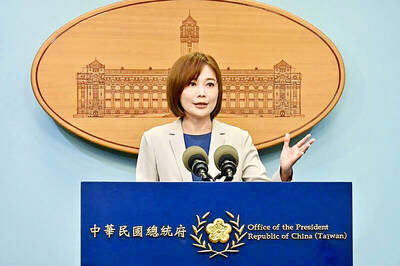
TIT-FOR-TAT: The US allegedly revoked the visa of a Chinese national working at Xinhua News Agency in the US in response to Beijing’s expulsion of Vivian Wang The Presidential Office yesterday condemned China for expelling a New York Times correspondent from Beijing following the newspaper’s interview with President William Lai (賴清德), saying the move highlighted Beijing’s suppression of press freedom and its threat to international news media. Taiwan has noted a series of recent incidents in which Beijing used similar tactics to “threaten and pressure international media outlets and journalists,” Presidential Office spokeswoman Karen Kuo (郭雅慧) said in a statement. “This concerns not only press freedom and freedom of expression, but also the safety of journalists, and Taiwan and relevant partners are paying close attention to the situation,” she


 RSS
RSS