


Taiwan’s Huang Yun-wen (黃韻文) defeated Yoon Jeong-yeon of South Korea in the women’s 53kg division to win an Asian Games gold medal in taekwondo yesterday, while Taiwanese No. 1 Lu Yen-hsun (盧彥勳) had to settle for silver in the men’s singles tennis and Sun Huei-ning (孫穗檸) picked up a bronze, also in taekwondo.
Teenager Huang held on to defeat her slightly more experienced opponent 4-2, a three-point kick to the face in the first round the difference in the three-round bout.
Down 3-0 after the first round, Yoon responded with one-point kicks in the second round and early in the third, but the 19-year-old Taiwanese scored a point of her own midway through the final round to give herself a two-point cushion, before adeptly keeping the South Korean at bay in the final minute and a half to secure the gold, Taiwan’s eighth at the Games in Incheon, South Korea.
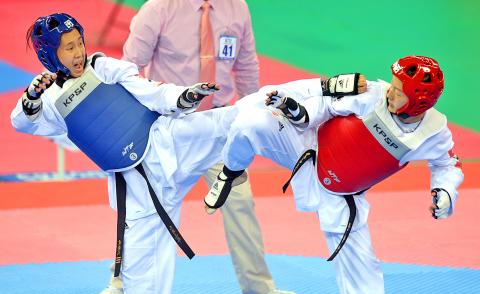
Photo: Lin Cheng-kung, Taipei Times
Earlier, Sun captured the bronze in the women’s 49kg division after being edged out by Chanatip Sonkham of Thailand 4-3 in the semi-finals.
Sun held a 3-0 lead heading into the final round, but lost when she was tagged with a three-point kick to the head and handed a penalty point.
Sonkham went on to defeat China’s Li Zhaoyi (李照藝) 10-3 in the gold-medal bout.
Unable to overcome physical and mental fatigue, Lu had his dream of a men’s singles gold medal shattered when he was upset by a Japanese upstart.
Nineteen-year-old Yoshihito Nishioka, ranked 168th in the world and seeded fifth at the Games, was more consistent and quicker to the ball than the Taiwanese veteran in a comprehensive 6-2, 6-2 win.
“I really treasured this opportunity with the national team, but I wasn’t able to complete my mission. I am very sorry,” Lu said.
Lu had struggled throughout the tournament, both on and off the court, and those ordeals seemed to finally catch up with him in the final.
Suffering from a nagging groin injury, the 31-year-old was not nearly as agile around the court as his Japanese opponent, who consistently returned everything and rallied patiently from the baseline, waiting for Lu to make a mistake.
Needing some momentum after faltering in the first set, Lu served two consecutive double faults in the first game of the second set and then he double-faulted on break point at 2-4, a point that essentially sealed the match for Nishioka.
Lu refused to use the injury as an excuse and praised the teenager.
“To talk about the injury now serves no purpose,” Lu said. “My opponent probably had less pressure on him, but he did play at a higher level than I did. I congratulate him on having such a good result in his first Asian Games.”
Lu admitted to being weighed down by the mental strain of an ongoing dispute with the ATP and the pressure of living up to his billing as heavy favorite at the Games.
Lu, who was entered in the China Open that began on Monday, was threatened by the ATP last week with a three-year ban and a US$100,000 fine if he competed in the Asian Games and did not show up for the ATP Tour tournament in Beijing.
Lu eventually pulled out of the China Open and his team said it had worked out a compromise with the ATP whereby the Taiwanese player would be fined, but not banned for any length of time.
In the softball, Taiwan’s women’s team completed their matches by defeating hosts South Korea 6-0 to finish second in Group A behind Japan with a 4-1 record.
In the volleyball, the women’s team beat Hong Kong 25-18, 25-14, 25-9 to set up a clash with Kazakhstan for fifth place, while the men’s team defeated Pakistan 25-19, 26-24, 25-19 to set up a game for ninth place, also with Kazakhstan.
In the rugby, Taiwan’s men lost both their Group C matches, falling to a 24-7 defeat to Sri Lanka and being then being beaten 35-12 by South Korea.
Additional reporting by Dave Carroll
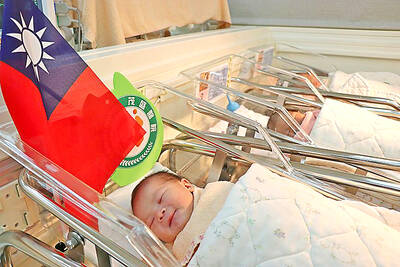
AGING: As of last month, people aged 65 or older accounted for 20.06 percent of the total population and the number of couples who got married fell by 18,685 from 2024 Taiwan has surpassed South Korea as the country least willing to have children, with an annual crude birthrate of 4.62 per 1,000 people, Ministry of the Interior data showed yesterday. The nation was previously ranked the second-lowest country in terms of total fertility rate, or the average number of children a woman has in her lifetime. However, South Korea’s fertility rate began to recover from 2023, with total fertility rate rising from 0.72 and estimated to reach 0.82 to 0.85 by last year, and the crude birthrate projected at 6.7 per 1,000 people. Japan’s crude birthrate was projected to fall below six,
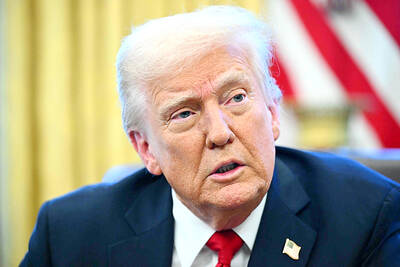
US President Donald Trump in an interview with the New York Times published on Thursday said that “it’s up to” Chinese President Xi Jinping (習近平) what China does on Taiwan, but that he would be “very unhappy” with a change in the “status quo.” “He [Xi] considers it to be a part of China, and that’s up to him what he’s going to be doing, but I’ve expressed to him that I would be very unhappy if he did that, and I don’t think he’ll do that. I hope he doesn’t do that,” Trump said. Trump made the comments in the context
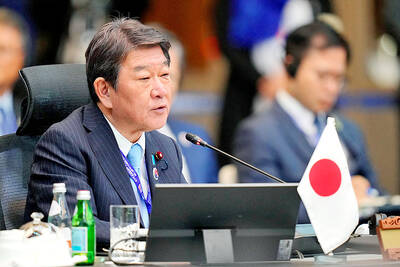
SELF-DEFENSE: Tokyo has accelerated its spending goal and its defense minister said the nation needs to discuss whether it should develop nuclear-powered submarines China is ramping up objections to what it sees as Japan’s desire to acquire nuclear weapons, despite Tokyo’s longstanding renunciation of such arms, deepening another fissure in the two neighbors’ increasingly tense ties. In what appears to be a concerted effort, China’s foreign and defense ministries issued statements on Thursday condemning alleged remilitarism efforts by Tokyo. The remarks came as two of the country’s top think tanks jointly issued a 29-page report framing actions by “right-wing forces” in Japan as posing a “serious threat” to world peace. While that report did not define “right-wing forces,” the Chinese Ministry of Foreign Affairs was
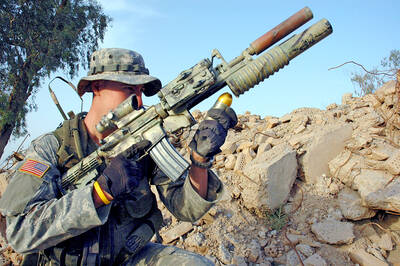
PREPAREDNESS: Given the difficulty of importing ammunition during wartime, the Ministry of National Defense said it would prioritize ‘coproduction’ partnerships A newly formed unit of the Marine Corps tasked with land-based security operations has recently replaced its aging, domestically produced rifles with more advanced, US-made M4A1 rifles, a source said yesterday. The unnamed source familiar with the matter said the First Security Battalion of the Marine Corps’ Air Defense and Base Guard Group has replaced its older T65K2 rifles, which have been in service since the late 1980s, with the newly received M4A1s. The source did not say exactly when the upgrade took place or how many M4A1s were issued to the battalion. The confirmation came after Chinese-language media reported


 RSS
RSS