


Former New Party legislator Yao Li-ming (姚立明) has given his nod to independent Taipei mayoral candidate Ko Wen-je’s (柯文哲) invitation to join his election campaign team, saying he hopes the move can help usher in change between the opposing pan-blue and pan-green camps.
Now a political commentator, Yao was once a key figure in the anti-corruption movement, or the so-called “red-shirt army,” in 2006 against then-president Chen Shui-bian (陳水扁).
Yao is also a member of the pan-blue, pro-unification New Party.
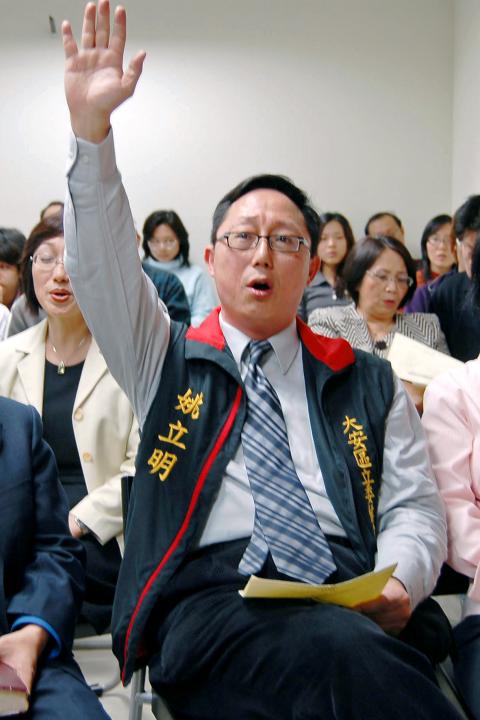
Photo: CNA
Ko’s recruitment of Yao is widely viewed as an effort to broaden his electoral base.
Yao said in a statement posted on Facebook early yesterday morning that before making the final decision, he had taken time to ponder and weigh different factors, “but the determining factor is my wish to prove with this move that the deep-seated blue-green opposition can be changed.”
“Ko came from a family that had suffered from the 228 Massacre, while my parents came from China. Ko is green-leaning and I was once a New Party member. He was Chen Shui-bian’s physician and medical adviser, while I was the deputy commander-in-chief of the red-shirt army,” Yao said.
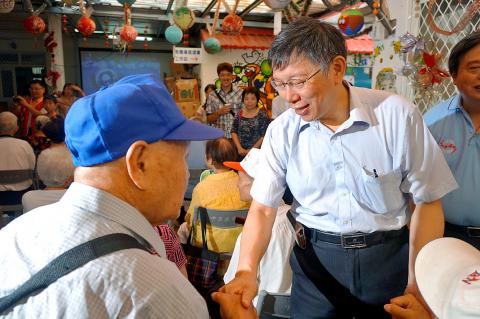
Photo: Tu Chu-min, Taipei Times
Out of all these differences, “there is something that we have in common,” he said.
“Neither of us wants to sit idly while witnessing Taiwan get drained away by the endless vicious blue-green infighting,” he said.
Yao underscored the consensus he had reached with Ko to look beyond political colors and focus on “black and white, and right and wrong,” saying that he expected the year-end mayoral election to be “not only an election, but also a civic movement that stops Taiwanese politics from descending into depravity.”
Former Democratic Progressive Party chairperson Frank Hsieh (謝長廷) lauded Yao’s decision and said on Facebook that Yao’s joining the campaign has made the goal of “transcending blue and green” one step closer.
However, given Yao’s background and past comments, there will no doubt be plenty of noise about his teaming up with Ko, Hsieh said.
Taipei Veterans General Hospital physician Kuo Cheng-deng (郭正典), a supporter of the former president and a member of his all-volunteer medicall team, said that Ko’s move might put off Chen supporters.
Janice Chen (陳昭姿), also a member of the medical team, agreed, saying that it would be even stranger if no one protests against Yao joining Ko’s campaign team.
However, “for the time being, [I] believe that as Yao has accepted Ko’s offer, he is willing to understand and assist what Ko has done so far to rescue the former president, whom Ko believes has suffered from political persecution,” she said.
A report by the Chinese-language Apple Daily yesterday said that Yao supports medical parole or home-based medical care for Chen if that is what the hospital suggests.
However, if the hospital says he can be treated behind bars, Chen should remain in prison to serve his sentence, he was reported as saying.
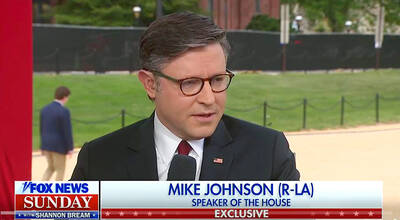
RESOLUTE BACKING: Two Republican senators are planning to introduce legislation that would impose immediate sanctions on China if it attempts to invade Taiwan US House of Representatives Speaker Mike Johnson on Sunday reaffirmed US congressional support for Taiwan, saying the US and “all freedom-loving people” have a stake in preventing China from seizing Taiwan by force. Johnson made the remarks in an interview with Fox News Sunday on US President Donald Trump’s summit with Chinese President Xi Jinping (習近平) last week. In an interview that aired on Friday on Fox News, just as Trump wrapped up a high-stakes visit to China, he said he has yet to green-light a new US$14 billion arms package to Taiwan and that it “depends on China.” “It’s a very good

DRONE CENTRAL: Taiwan aims to become Asia’s democratic hub for drones, with most exports focused on high-quality military-grade models, an official said Taiwan’s drone industry is expected to expand significantly by 2030, producing 100,000 units per month and exporting half of them, the Ministry of Economic Affairs said yesterday. Current drone production capacity is about 15,000 units per month, but the industry can quickly scale up as demand increases, Industrial Development Administration Director-General Chiou Chyou-huey (邱求慧) told a news conference in Taipei. Taiwan’s drone output grew 2.5-fold last year to NT$12.9 billion (US$408.3 million) under a government program to develop the uncrewed vehicle sector, he said. The Executive Yuan in October last year approved plans to invest NT$44.2 billion into domestic production of uncrewed aerial
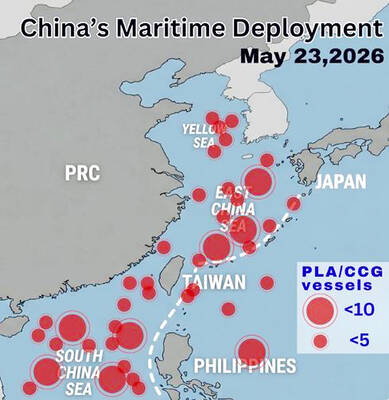
WARNING: China should stop engaging in actions that undermine regional peace and stability, as it would only build resentment among people across the Strait, the CGA said China has deployed more than 100 navy, coast guard and other vessels in waters from the Yellow Sea to the South China Sea and the western Pacific since US President Donald Trump and Chinese President Xi Jinping (習近平) met in Beijing, National Security Council Secretary-General Joseph Wu (吳釗燮) said yesterday. “In this part of the world, #China is the one & only PROBLEM wrecking the #StatusQuo & threatening regional peace & stability,” Wu wrote on X. In a separate post, he said Beijing was coercing Taiwan’s maritime domain, calling it illegal and provocative, after the Coast Guard Administration (CGA) expelled a
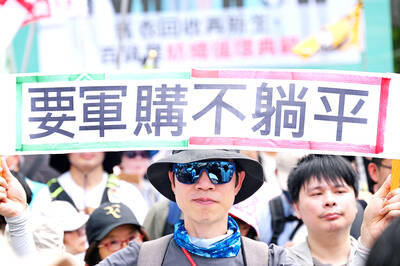
More than 8,000 people took part in a rally in Taipei yesterday to express support for more defense spending, after the opposition slashed the Cabinet’s proposed NT$1.25 trillion (US$39.6 billion) special defense budget and capped it at NT$780 billion. The demonstrators urged the Cabinet to propose another bill. Taiwan Economic Democracy Union convener Lai Chung-chiang (賴中強) said the main problem of the passed budget plan is the removal of funding for critical items, not just that the total amount is smaller. Critical budget items included purchasing or developing uncrewed vehicles, Strong Bow (強弓) missile systems, additional ammunition, artificial intelligence-powered combat systems and Taiwan-US


 RSS
RSS