


An investigation has shown that former minister of national defense Chen Chao-min (陳肇敏) intervened in a courtmartial ruling in a sexual assault incident at the Air Force Command Headquarters, leading to the execution of air force serviceman Chiang Kuo-ching (江國慶) 18 years ago, Control Yuan members said yesterday.
Although knowing that another serviceman, Hsu Jung-chou (許榮洲), had admitted to the rape and murder of a five-year-old girl, Chen, the then-deputy commander of the air force, ordered the military court not to suspend the charges against Chiang, a report released by the Control Yuan yesterday said.
The report said Lu Te-yi (呂德義), the military judge in charge of the case, told Control Yuan member Shen Mei-chen (沈美真) in an interview that an “independent military judiciary did not exist at the time” and “there was no independent military court” because he had to follow orders from his superior.
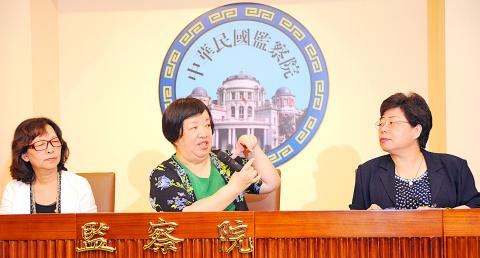
Photo: Liu Hsin-de, Taipei Times
Lu told Shen that he had to have consent of then-Air Force Command Headquarters’ legal affairs director Tsao Chia-sheng (曹嘉生) before he was able to summon witnesses or deliver official documents, and thus he had no choice but to listen to his superiors, according to the report.
Control Yuan member Ma Yi-kung (馬以工), who also took part in the probe, said that when looking at original documents provided by the Ministry of National Defense, she found eight notes written by Chen.
On one note, Chen wrote he was aware that Hsu had confessed to the rape and murder, but that it would cause too much trouble to high-ranking officers if medical examinations proved that Hsu had a mental disorder, Ma said.
In another note, Chen asked the military court to negotiate with the political warfare department to find the “lowest acceptable standards” so that charges against Chiang would not have to be withdrawn and the military could show that it was fair, Ma said.
According to the normal judicial procedures, the military court should have suspended the case against Chiang upon learning of Hsu’s confession, but the court did not do so, Shen said.
It is very clear that the military court was not operating independently and was pressured by senior officers.
Control Yuan members Yu Teng-fang (余騰芳) and Yang Mei-ling (楊美鈴) also took part in the investigation.
In response to media queries on whether Chen should be held responsible for Chiang’s wrongful execution, Ma said Chen could not have done it alone, and it was a structural issue within the military.
While the Control Yuan was unable to impeach anyone involved in the case, since the impeachment period of 10 years had expired long ago, Yang said the four members still wanted to publicize their investigation report to remind the government to be more cautious in handling legal cases.
The Military Northern District Court acquitted Chiang on Sept. 13, 2011, of the rape and murder, 14 years after he was executed at the age of 21.
A Control Yuan investigation in 2010 found that Chiang had been tortured into confessing by military investigators.
On March 19, the Supreme Court upheld the Taiwan High Court’s ruling in April last year that Hsu, who is mentally challenged, was not guilty of the rape and murder either. He had originally been convicted in December 2011 by the Taipei District Court.
Additional reporting by staff writer
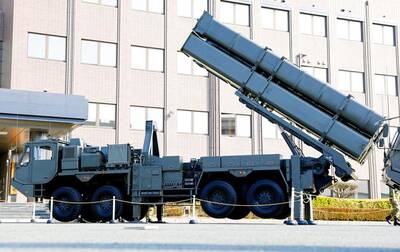
Japan has deployed long-range missiles in a southwestern region near China, the Japanese defense minister said yesterday, at a time when ties with Beijing are at their lowest in recent years. The missiles were installed in Kumamoto in the southern region of Kyushu, as Japan is attempting to shore up its military capacity as China steps up naval activity in the East China Sea. “Standoff defense capabilities enable us to counter the threat of enemy forces attempting to invade our country ... while ensuring the safety of our personnel,” Japanese Minister of Defense Shinjiro Koizumi said. “This is an extremely important initiative for
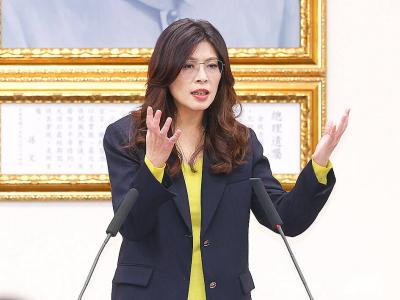
Chinese Nationalist Party (KMT) Chairwoman Cheng Li-wun (鄭麗文) today accepted an invitation from Chinese President Xi Jinping (習近平) to lead a delegation to China next month, saying she hopes to promote the peaceful development of cross-strait relations and bring stability to the Taiwan Strait. “I am grateful and happy to accept this invitation,” Cheng said in a statement from the KMT chairperson’s office. Cheng said she hopes both sides can work together to promote the peaceful development of cross-strait relations, enhance exchange and cooperation, bring stability to the Taiwan Strait and improve people’s livelihoods. At today's news conference, Cheng said any efforts to

MORE POPULAR: Taiwan Pass sales increased by 59 percent during the first quarter compared with the same period last year, the Tourism Administration said The Tourism Administration yesterday said that it has streamlined the Taiwan Pass, with two versions available for purchase beginning today. The tourism agency has made the pass available to international tourists since 2024, allowing them to access the high-speed rail, Taiwan Railway Corp services, four MRT systems and four Taiwan Tourist Shuttles. Previously, five types of Taiwan Pass were available, but some tourists have said that the offerings were too complicated. The agency said only two types of Taiwan Pass would be available, starting from a three-day pass with the high-speed rail and a three-day pass with Taiwan Railway Corp. The former costs NT$2,800

The nation’s fastest supercomputer, Nano 4 (晶創26), is scheduled to be launched in the third quarter, and would be used to train large language models in finance and national defense sectors, the National Center for High-Performance Computing (NCHC) said. The supercomputer, which would operate at about 86.05 petaflops, is being tested at a new cloud computing center in the Southern Taiwan Science Park in Tainan. The exterior of the server cabinet features chip circuitry patterns overlaid with a map of Taiwan, highlighting the nation’s central position in the semiconductor industry. The center also houses Taiwania 2, Taiwania 3, Forerunner 1 and


 RSS
RSS