


Survivors of a landslide that entombed a village in northern Afghanistan mourned hundreds of dead relatives yesterday as aid teams rushed to care for 700 families left homeless in the mountains.
Much of Aab Bareek village in Badakhshan Province was swallowed on Friday by a fast-moving tide of mud and rock that swept down the hillside and left almost no trace of 300 homes.
Afghan officials have put the death toll at 300 people and said that it could rise by hundreds more, after initial reports suggested that as many as 2,500 people may have died.
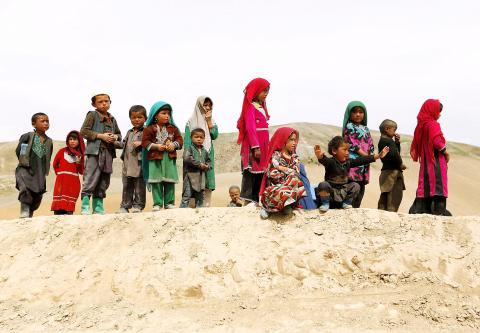
Photo: Reuters
Large crowds gathered at the remote disaster site, where the volume of deep mud covering houses made rescue efforts hopeless.
Only a few dead bodies have been pulled from the debris.
Local people and emergency workers used shovels to try to dig out survivors, but without success and relief work turned to caring for about 700 displaced families.
Tents, food and water began arriving on Saturday as Afghan and international aid groups worked to get supplies through to the village.
Many families spent another night in the open, with residents and visiting officials fearing that the unstable hillside could unleash more deadly landslides in the coming days.
“We have a list of about 300 people confirmed dead,” Badakhshan Governor Shah Waliullah Adeeb told reporters at the scene on Saturday.
“We cannot continue the search and rescue operation anymore, as the houses are under meters of mud. We will offer prayers for the victims and make the area a mass grave,” he added.
Many villagers were at Friday prayers in two mosques when they were buried by the torrent of mud, and a second landslide hit people who had rushed to assist those in need.
Afghanistan held a national day of mourning yesterday after Afghan President Hamid Karzai expressed his condolences to those who had lost loved ones.
The UN Assistance Mission in Afghanistan (UNAMA) said its staff was in the area, along with the Afghan Red Crescent and other aid groups.
“The immediate focus is on approximately 700 families displaced either directly as a result of this slide or as a precautionary measure from villages assessed to be at further risk,” UNAMA said.
It added that more water, medical support, food and emergency shelters were needed.
Badakhshan is a mountainous province in northeast Afghanistan bordering Tajikistan, China and Pakistan.
It has been relatively peaceful since the US-led military intervention began in 2001, but has seen increasing Taliban activity in recent years.
The landslides follow recent severe flooding in other parts of northern Afghanistan, with 150 people dead and 67,000 people affected by floods in Jowzjan, Faryab and Sar-e-Pol provinces.
Flooding and landslides often occur during the spring rainy season in northern Afghanistan, with flimsy mud houses offering little protection against rising water levels and torrents of mud.
Afghanistan is in the middle of presidential elections, with former Afghan foreign minister Abdullah Abdullah and ex-World Bank economist Ashraf Ghani due to compete in a head-to-head vote on June 7.
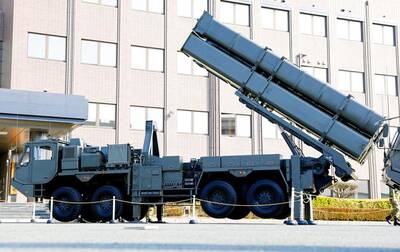
Japan has deployed long-range missiles in a southwestern region near China, the Japanese defense minister said yesterday, at a time when ties with Beijing are at their lowest in recent years. The missiles were installed in Kumamoto in the southern region of Kyushu, as Japan is attempting to shore up its military capacity as China steps up naval activity in the East China Sea. “Standoff defense capabilities enable us to counter the threat of enemy forces attempting to invade our country ... while ensuring the safety of our personnel,” Japanese Minister of Defense Shinjiro Koizumi said. “This is an extremely important initiative for

Chinese Nationalist Party (KMT) Chairwoman Cheng Li-wun (鄭麗文) today accepted an invitation from Chinese President Xi Jinping (習近平) to lead a delegation to China next month, saying she hopes to promote the peaceful development of cross-strait relations and bring stability to the Taiwan Strait. “I am grateful and happy to accept this invitation,” Cheng said in a statement from the KMT chairperson’s office. Cheng said she hopes both sides can work together to promote the peaceful development of cross-strait relations, enhance exchange and cooperation, bring stability to the Taiwan Strait and improve people’s livelihoods. At today's news conference, Cheng said any efforts to

MORE POPULAR: Taiwan Pass sales increased by 59 percent during the first quarter compared with the same period last year, the Tourism Administration said The Tourism Administration yesterday said that it has streamlined the Taiwan Pass, with two versions available for purchase beginning today. The tourism agency has made the pass available to international tourists since 2024, allowing them to access the high-speed rail, Taiwan Railway Corp services, four MRT systems and four Taiwan Tourist Shuttles. Previously, five types of Taiwan Pass were available, but some tourists have said that the offerings were too complicated. The agency said only two types of Taiwan Pass would be available, starting from a three-day pass with the high-speed rail and a three-day pass with Taiwan Railway Corp. The former costs NT$2,800

The nation’s fastest supercomputer, Nano 4 (晶創26), is scheduled to be launched in the third quarter, and would be used to train large language models in finance and national defense sectors, the National Center for High-Performance Computing (NCHC) said. The supercomputer, which would operate at about 86.05 petaflops, is being tested at a new cloud computing center in the Southern Taiwan Science Park in Tainan. The exterior of the server cabinet features chip circuitry patterns overlaid with a map of Taiwan, highlighting the nation’s central position in the semiconductor industry. The center also houses Taiwania 2, Taiwania 3, Forerunner 1 and


 RSS
RSS