


Student protesters who have occupied the Legislative Yuan’s main chamber since March 18 will vacate the room at 6pm on Thursday, student leader Chen Wei-ting (陳為廷) said yesterday evening after long debates among the participating students and other groups.
Saying their 21-day occupation of the chamber to protest against the government’s handling of the cross-strait service trade pact “has demonstrated that we do not have to be restrained by the past political model and establishments or to have our fate determined by international powers,” Chen said the students have gathered enough support and strength to expand into a movement that incorporates everyone.
“We have shown how the ‘sovereignty of the people’ promised by the Constitution can be realized and become a real-life experience for our generation. And now we, the young, will be making strides from the legislature to the entire nation,” he said. “We will shift our strategy from the defensive to one that is ready to attack.”
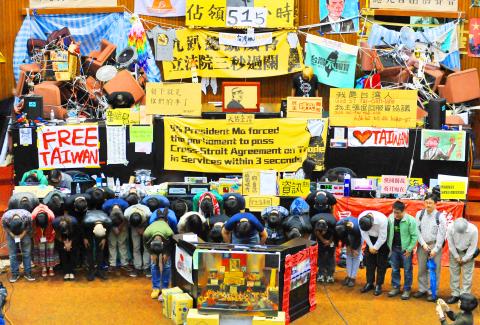
Photo: AFP, Mandy Cheng
Chen said progress has been made on all four of the students’ major demand: the institutionalization of a cross-strait agreement oversight mechanism, the completion of such legislation before the review of the service trade agreement, the launching of a citizens’ constitutional conference and the retraction of the service trade agreement.
“The non-government version of a draft proposal for the institutionalization of an oversight mechanism, based on the principles of civic participation, legislative supervision, human rights protection, transparency and government accountability, has been proposed to the legislature,” Chen said.
The demand to “legislate first, review second” has met with a positive response from Legislative Speaker Wang Jin-pyng (王金平), who promised not to convene inter-party negotiations on service trade pact before oversight mechanism has been legislated, he said.
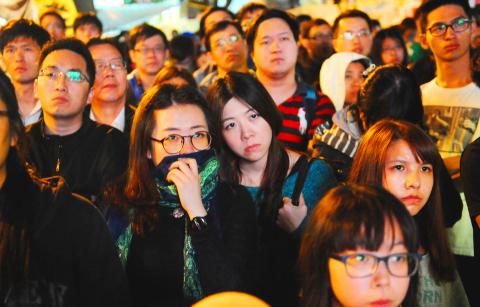
Photo: Chang Chia-ming, Taipei Times
The idea of a citizens’ constitutional conference has also been widely discussed in forums both outside and inside the Legislative Yuan over the past week, Chen said.
The demand that the controversial service trade pact be retracted was answered by a resolution of the legislature’s Joint Committee meeting on March 24, which requested the Executive Yuan retract the agreement and reopen negotiations with China.
“The final decision relies on the handling of the floor meeting,” Chen said.
The Sunflower movement’s achievements are not restricted to the above-mentioned results, he said.
“The students and civil groups have halted the forced passage of the agreement and demonstrated that [President] Ma [Ying-jeou’s (馬英九)] administration’s has lost legitimacy, because since 2008, it has been abusing power, making arbitrary decisions, breaching the rule of law, violating human rights and causing democracy to retreat,” he said.
“The movement has revealed how the current cross-strait interaction has been dominated by the clandestine, under-the-table trading between the Chinese Nationalist Party [KMT] and the Chinese Communist Party, a model that only helps the cross-strait political elite and capitalist corporations amass their fortunes and sacrifices the rights and benefits of most of the public,” he said.
“From this moment on, no behind closed doors negotiation is allowed; no regime can be permitted to make brazen moves to sell out Taiwan,” Chen said. “We Taiwanese, not anybody else, are the masters of this island.”
Internationally and geopolitically, “we have made our will clear,” he said. “We have declared that we Taiwanese are not willing to stay under the sway of China. We have also interrupted the private arrangement of international powers, including China, the US and Japan, and attracted global attention by our peaceful, non-violent resistance to the establishment.”
The protesters’ next step will be turning from a passive occupation to an active movement nationwide by organizing talks, grassroot forums, online civic movements and overseeing the legislature, just as the “Kuroshio democracy has been doing outside the occupied legislature over the past weeks,” he said.
“We are not naive. We do not believe that all of our demands will be fully answered. That is why we need to shift our strategy from ‘defense’ to ‘attack’ and continue to supervise the government,” he said.
Lin Fei-fan (林飛帆), another student leader, said the decision to leave the Legislative Yuan had not been a unanimous one.
“However, we are not afraid to lose the chamber floor, and leaving here is not the end of the movement, because the movement has become a comprehensive one that will continue to bloom across the country,” Lin said.
A Tamkang University student surnamed Lai (賴), one of the Sunflower movement supporters outside the Legislative Yuan last night, was very emotional upon hearing Chen Wei-ting’s announcement.
"I am very tired. All of us here at the Legislative Yuan — all of us who feel we have been abandoned by the government — we all want to go home. We have been keeping up the protest through sheer strength of will because we need to oppose governmental violence," he said.
A National Tsing Hua University student surnamed Chen (陳) said that with all that has happened: "I do not and cannot trust the KMT caucus."
He said the students will continue to emphasize their concerns about the service trade pact by supporting efforts to recall KMT lawmakers who follow the party line instead of listening to the public’s voices.
Additional reporting by Lin Chia-chi
This story has been updated since it was first published.

In his National Day Rally speech on Sunday, Singaporean Prime Minister Lawrence Wong (黃循財) quoted the Taiwanese song One Small Umbrella (一支小雨傘) to describe his nation’s situation. Wong’s use of such a song shows Singapore’s familiarity with Taiwan’s culture and is a perfect reflection of exchanges between the two nations, Representative to Singapore Tung Chen-yuan (童振源) said yesterday in a post on Facebook. Wong quoted the song, saying: “As the rain gets heavier, I will take care of you, and you,” in Mandarin, using it as a metaphor for Singaporeans coming together to face challenges. Other Singaporean politicians have also used Taiwanese songs

NORTHERN STRIKE: Taiwanese military personnel have been training ‘in strategic and tactical battle operations’ in Michigan, a former US diplomat said More than 500 Taiwanese troops participated in this year’s Northern Strike military exercise held at Lake Michigan by the US, a Pentagon-run news outlet reported yesterday. The Michigan National Guard-sponsored drill involved 7,500 military personnel from 36 nations and territories around the world, the Stars and Stripes said. This year’s edition of Northern Strike, which concluded on Sunday, simulated a war in the Indo-Pacific region in a departure from its traditional European focus, it said. The change indicated a greater shift in the US armed forces’ attention to a potential conflict in Asia, it added. Citing a briefing by a Michigan National Guard senior
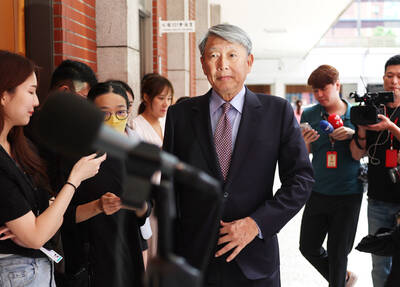
CHIPMAKING INVESTMENT: J.W. Kuo told legislators that Department of Investment Review approval would be needed were Washington to seek a TSMC board seat Minister of Economic Affairs J.W. Kuo (郭智輝) yesterday said he received information about a possible US government investment in Taiwan Semiconductor Manufacturing Co (TSMC, 台積電) and an assessment of the possible effect on the firm requires further discussion. If the US were to invest in TSMC, the plan would need to be reviewed by the Department of Investment Review, Kuo told reporters ahead of a hearing of the legislature’s Economics Committee. Kuo’s remarks came after US Secretary of Commerce Howard Lutnick on Tuesday said that the US government is looking into the federal government taking equity stakes in computer chip manufacturers that
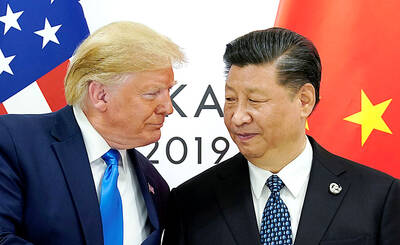
US President Donald Trump on Friday said that Chinese President Xi Jinping (習近平) told him China would not invade Taiwan while Trump is in office. Trump made the remarks in an interview with Fox News, ahead of talks with Russian President Vladimir Putin over Moscow’s invasion of Ukraine. “I will tell you, you know, you have a very similar thing with President Xi of China and Taiwan, but I don’t believe there’s any way it’s going to happen as long as I’m here. We’ll see,” Trump said during an interview on Fox News’ Special Report. “He told me: ‘I will never do


 RSS
RSS