


Premier Jiang Yi-huah (江宜樺) met with the protesters occupying the legislature to protest the controversial cross-strait service trade pact yesterday — the fifth day of the student-led sit-in — but declined to agree to withdraw the deal or table a law monitoring future cross-strait agreements, saying that these two issues require the Executive Yuan’s and President Ma Ying-jeou’s (馬英九) involvement.
With the number of protesters surrounding the Legislative Yuan complex in Taipei in support of the student-led activists who seized the legislative chamer on Tuesday growing by the thousands each day, the premier yesterday met with protest leader Lin Fei-fan (林飛帆), a graduate student of political science at National Taiwan University, and attorney Lai Chung-chiang (賴中強).
Prior to Jiang’s arrival, Lin told the crowd that the preconditions for dialogue with the premier would be his agreeing to withdraw the service pact — which the Executive Yuan has forwarded to lawmakers for review — from the Legislative Yuan and to draft legislation on monitoring future cross-strait talks and agreements.
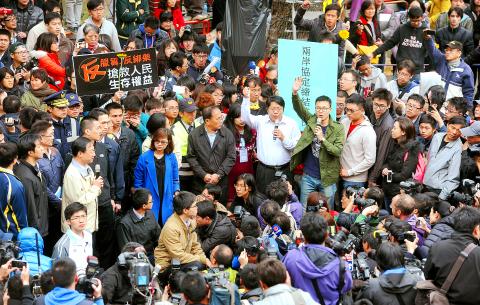
Photo: Liu Hsin-de, Taipei Times
“Withdraw the service trade agreement, pass the monitoring legislation,” demonstrators chanted as Jiang walked through the crowd escorted by police officers to reach the side gate of the Legislative Yuan building, where Lin and Lai were waiting.
Jiang began by dismissing rumors that the Executive Yuan has asked National Taiwan University Hospital — which is close to the legislature building — to make preparations to take in a large number of wounded as it is planning to clear the legislative floor by force.
“I’m saddened to hear these rumors, because they are baseless,” Jiang said. “The Executive Yuan has no plan to remove anyone by force and will fully respect the legislature’s prerogative to handle the situation in its own way.”
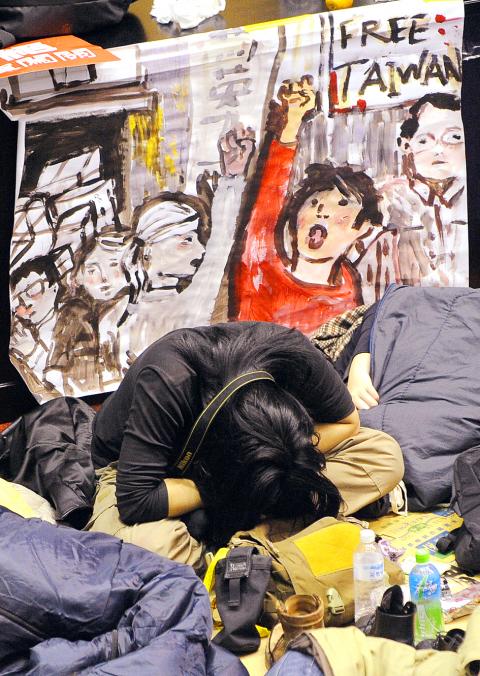
Photo: Chen Chih-chu, Taipei Times
However, the crowd was dismayed when Jiang said that the Cabinet supports the legislature’s article-by-article review of the agreement, but will not take withdraw the pact because it is “beneficial for the liberalization of the economy.”
He said there is no need to enact new laws to monitor cross-strait agreements since “the governing party [the Chinese Nationalist Party (KMT)] has already proposed measures pertaining to the monitoring of such agreements by the legislature and the public that are supported by Legislative Yuan Speaker Wang Jin-pyng (王金平). Therefore, there is no need for new legislation.”
The crowd of demonstrators voiced its displeasure at the premier’s remarks by reiterating the demands, but Jiang responded that this was not a decision he could take unilaterally.
“The last thing I want to say is that the two issues you [the protesters] are concerned about not only involve the Executive Yuan, but also President Ma Ying-jeou,” Jiang said.
“We’ve all heard what the premier said, so let’s unite to call on the president to take care of the issue,” Lin replied, as the crowd started chanting for Ma to “come forward and face the matter.”
After Jiang declined to agree to the two preconditions for dialogue with Lin and Lai, the crowd thanked the premier for his time and clapped to ask him to leave.
Later yesterday, Jiang called a press conference at the Executive Yuan and read out a statement addressed to the students.
He said he was happy to see young people voicing their views on issues concerning the nation’s future, but felt sad about and could not agree with their occupying the legislative chamber and behaving in a disorderly manner.
Jiang added that his visit to the site of the protest had been approved by Ma in advance and said he regretted that the students had not given him a chance to discuss with them what he said were their “misunderstandings” of the service trade pact based on “misleading information and rumors” just because he had not agreed to the preconditions.
“There should be no premise or preconditions for talks so we can have some space for rational communication,” Jiang said.
The premier again dismissed concerns over the potential negative impacts the trade pact would have on the nation and the lack of consultations with concerned parties before it was signed.
The movement against the trade pact was attributed to opponents’ “anti-China mindsets” that made them “oppose everything related to China,” Jiang added.
“It’s not because there was anything wrong with the agreement itself or the negotiations [with China], but because of the ‘anti-China mindset,’” Jiang said, adding that this stance would render “Taiwan incapable of reaching out to the world,” as well as “cause huge damage to the country’s future.”
He called on the students to disoccupy the legislative chamber as quickly as possible since it is a “sacred and solemn” place, the law-making supremacy of which has been established by the efforts of the countless people who fought for Taiwan’s democratization.

SILENCING CRITICS: In addition to blocking Taiwan, China aimed to prevent rights activists from speaking out against authoritarian states, a Cabinet department said The Ministry of Foreign Affairs (MOFA) yesterday condemned transnational repression by Beijing after RightsCon, a major digital human rights conference scheduled to be held in Zambia this week, was abruptly canceled due to Chinese pressure over Taiwanese participation. This year’s RightsCon, the world’s largest conference discussing issues “at the intersection of human rights and technology,” was scheduled to take place from tomorrow to Friday in Lusaka, and expected to draw 2,600 in-person attendees from 150 countries, along with 1,100 online participants. However, organizers were forced to cancel the event due to behind-the-scenes pressure from China, the ministry said, expressing its “strongest condemnation”
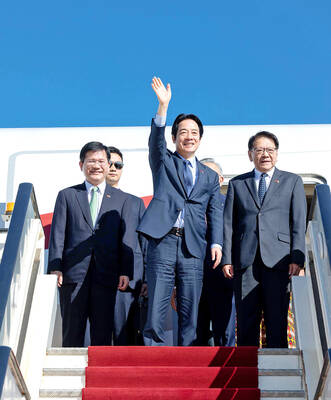
DELAYED BUT DETERMINED: The president’s visit highlights Taiwan’s right to international engagement amid regional pressure from China President Willaim Lai (賴清德) yesterday arrived in Eswatini, more than a week after his planned visit to Taiwan’s sole African ally was suspended because of revoked overflight permits. “The visit, originally scheduled for April 22, was postponed due to unforeseen external factors,” Lai wrote on social media. “After several days of careful arrangements by our diplomatic and national security teams, we successfully arrived today.” Lai said he looked forward to further deepening Taiwan-Eswatini relations through closer cooperation in the economy, agriculture, culture and education, as well as advancing the nation’s international partnerships. The president was initially scheduled to arrive in time to celebrate
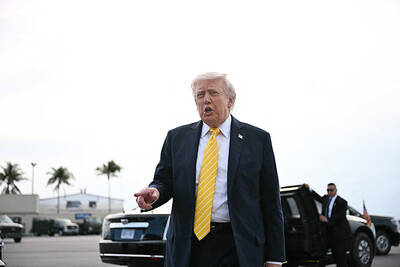
Iran’s Islamic Revolutionary Guard Corp (IRGC) yesterday said the US faced a choice between an “impossible” military operation or a “bad deal” with Tehran, after US President Donald Trump disparaged Iran’s latest peace proposal. Negotiations between the two countries have been deadlocked since a ceasefire came into effect on April 8, with only one round of direct peace talks held so far. Iran’s Tasnim and Fars news agencies reported that Tehran had submitted a 14-point proposal to mediator Pakistan, but Trump was quick to cast doubt on it. “I will soon be reviewing the plan that Iran has just sent to us, but

A group affiliated with indicted Chinese immigrant Xu Chunying (徐春鶯) is to be dissolved for monitoring Chinese immigrants in Taiwan, a source said yesterday. Xu, the secretary-general of the Cross-Strait Marriage and Family Service Alliance, was indicted on March 24 on charges of violating the Anti-Infiltration Act (反滲透法). The alliance “illegally monitored" Chinese immigrants living in Taiwan on behalf of the Chinese Communist Party (CCP) and the Ministry of the Interior is expected to dissolve the organization in the coming days under provisions of the Civil Associations Act (人民團體法), the source said. Xu, who married a Taiwanese in 1993 and became a Republic


 RSS
RSS