


Following a public outcry and condemnations by activists this week, officials at a temple in Greater Tainan yesterday made a public apology for the temple’s ritual of stuffing live birds into sealed statues of deities.
The ritual took place at Kaisianjhen Temple (開仙真宮) in Greater Tainan’s Sigang District (西港), in effect making the birds sacrificial offerings, for the consecration and empowerment of statues of deity the Baosheng Emperor (保生大帝), the god of medicine.
Cheng Teng-feng (鄭登峰), head of Kaisianjhen Temple’s management committee, said that following the public outcry, the committee convened a meeting on Tuesday night and decided to make a public apology.
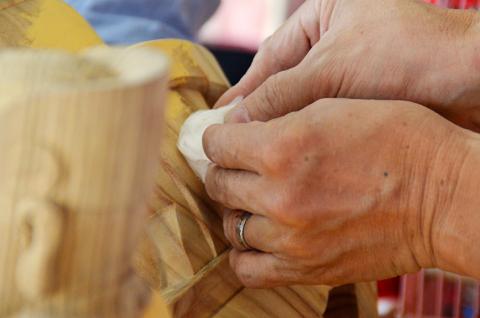
Photo courtesy of Kaisianjhen Temple, Greater Tainan
The practice came to light after someone posted a video online showing the ceremony.
In the video a temple official grabs a white Java sparrow from a bird cage and stuffs it into a round hole in the back of a wooden statue of the Baosheng Emperor. The opening is then sealed up and the bird left inside to die.
“This ritual has been practiced for several centuries. It came from a divine mandate by the gods. It is not a deliberate act to abuse animals,” Cheng said. “We will respect the adjudication by the Greater Tainan Animal Health Inspection and Protection Office.”
In the future we shall seek the guidance of deities and will respect the views of the public. Times have changed and we shall endeavor to make appropriate adjustments,” he said.
Greater Tainan Animal Health Inspection and Protection Office deputy director Wu Ming-pin (吳名彬) said the office would collaborate with other agencies and talk to all local temples to end the practice of stuffing live animals inside statues, leaving the creatures to die by suffocation or starvation.
Wu added that his office is now investigating whether the temple’s action violated Article 6 of the Animal Protection Act (動物保護法), which prohibits the maltreatment and abuse of animals.
When the video was posted on the Web, many netizens were in uproar, with some calling it a cruel, inhumane practice that should be stopped and calling for the lives of the unfortunate birds to be saved.
Wild Bird Society of Tainan secretary-general Kuo Tung-hui (郭東輝) said stuffing birds inside statues of deities by temples, for “illlumination” and to imbue “magical power,” is nothing but superstition.
Hsieh Chu-yi (謝主義), a master carver of statues of deities in Greater Tainan, said stuffing animals inside as “treasures” to imbue divine power had long been practiced at some temples as part of traditional worship.
Hsieh said when the statues of deities are encased in gold foil, certain deities will instruct a spirit-possessed medium (乩童) to place “treasures” inside them. Most of the time, the “treasures” are hornets, but other creatures, such as snakes and centipedes, are also used as they represent the animal embodiment of certain deities.
“As well as the Java sparrow, some temples use the yellow warbler and the crested minah bird for this purpose,” Hsieh said.

PREPAREDNESS: Given the difficulty of importing ammunition during wartime, the Ministry of National Defense said it would prioritize ‘coproduction’ partnerships A newly formed unit of the Marine Corps tasked with land-based security operations has recently replaced its aging, domestically produced rifles with more advanced, US-made M4A1 rifles, a source said yesterday. The unnamed source familiar with the matter said the First Security Battalion of the Marine Corps’ Air Defense and Base Guard Group has replaced its older T65K2 rifles, which have been in service since the late 1980s, with the newly received M4A1s. The source did not say exactly when the upgrade took place or how many M4A1s were issued to the battalion. The confirmation came after Chinese-language media reported
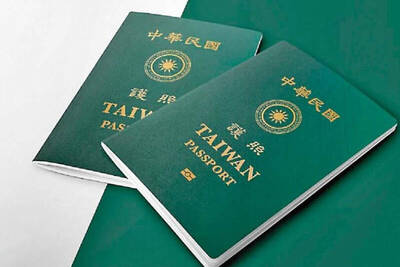
The Taiwanese passport ranked 33rd in a global listing of passports by convenience this month, rising three places from last month’s ranking, but matching its position in January last year. The Henley Passport Index, an international ranking of passports by the number of designations its holder can travel to without a visa, showed that the Taiwan passport enables holders to travel to 139 countries and territories without a visa. Singapore’s passport was ranked the most powerful with visa-free access to 192 destinations out of 227, according to the index published on Tuesday by UK-based migration investment consultancy firm Henley and Partners. Japan’s and
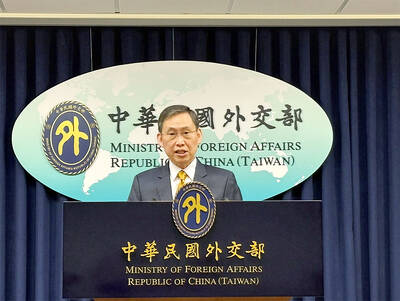
A Ministry of Foreign Affairs official yesterday said that a delegation that visited China for an APEC meeting did not receive any kind of treatment that downgraded Taiwan’s sovereignty. Department of International Organizations Director-General Jonathan Sun (孫儉元) said that he and a group of ministry officials visited Shenzhen, China, to attend the APEC Informal Senior Officials’ Meeting last month. The trip went “smoothly and safely” for all Taiwanese delegates, as the Chinese side arranged the trip in accordance with long-standing practices, Sun said at the ministry’s weekly briefing. The Taiwanese group did not encounter any political suppression, he said. Sun made the remarks when
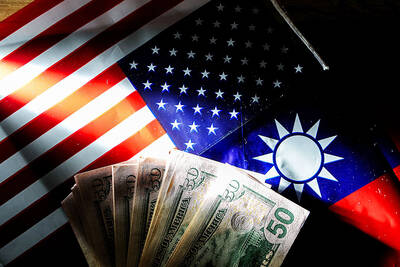
BROAD AGREEMENT: The two are nearing a trade deal to reduce Taiwan’s tariff to 15% and a commitment for TSMC to build five more fabs, a ‘New York Times’ report said Taiwan and the US have reached a broad consensus on a trade deal, the Executive Yuan’s Office of Trade Negotiations said yesterday, after a report said that Washington is set to reduce Taiwan’s tariff rate to 15 percent. The New York Times on Monday reported that the two nations are nearing a trade deal to reduce Taiwan’s tariff rate to 15 percent and commit Taiwan Semiconductor Manufacturing Co (TSMC, 台積電) to building at least five more facilities in the US. “The agreement, which has been under negotiation for months, is being legally scrubbed and could be announced this month,” the paper said,


 RSS
RSS