


On his first full day in Taiwan yesterday, the Taiwanese-Brazilian teenager Iruan Ergui Wu (吳憶樺) rode the Taipei MRT to attend a wedding banquet at a hotel in Taipei City.
The 18-year-old arrived in Taiwan on Friday evening from Rio Grande Do Sul, Brazil, accompanied by his adoptive mother, Etna Borkert, and adoptive brother Cassio Borkert.
Iruan was invited by the Rotary Club of Taipei to attend a wedding banquet held at the Grand Victoria Hotel yesterday morning and turned up in dapper style, dressed in a gray dress shirt, black slacks and a necktie.
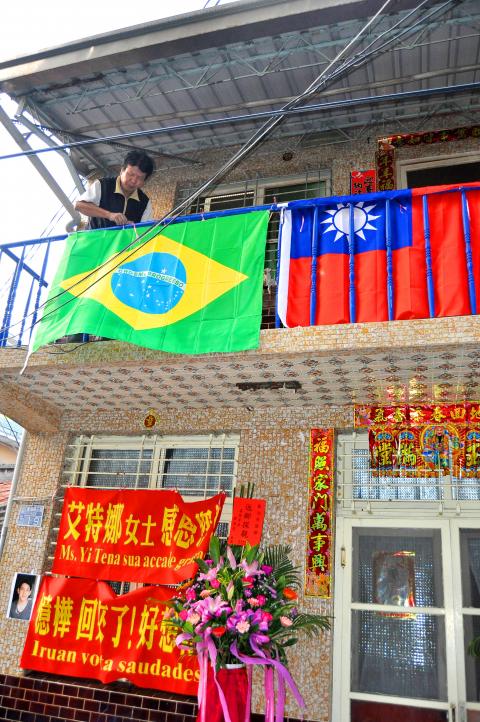
Photo: CNA
Crowded by the press, Iruan spoke in Portuguese, saying he was happy to experience a Taiwanese-style wedding.
He said taking the MRT to the Grand Victoria Hotel was wonderful, adding that “everything I encountered here is excellent and the food is delicious. I really like Taiwanese noodles and dumplings.”
He is heading to Greater Kaohsiung today, where his uncle and Taiwanese relatives, as well as old school friends, are eagerly awaiting him.
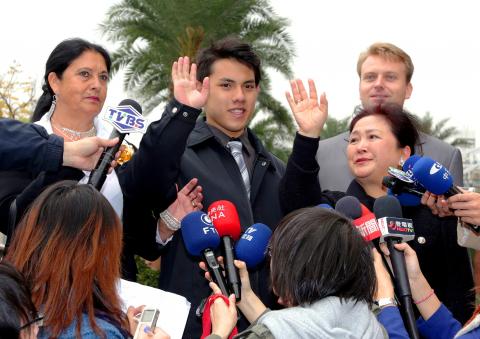
Photo: Su Fu-nan, Taipei Times
His uncle, Wu Huo-yen (吳火眼), who traveled back to Greater Kaohsiung overnight from Taoyuan after welcoming Iruan at the Taiwan Taoyuan International Airport, was seen making preparations and decorating his house yesterday with the national flags of Brazil and the Republic of China to celebrate his return.
Meanwhile, students and former teachers at his school, Jiading Elementary School in Greater Kaohsiung, have also been busy planning a welcome party for him, thought to be planned for Friday.
Iruan’s father, Wu Teng-shu (吳登樹), was a fishing boat captain from Cie-ding District (茄萣) who went to Brazil and met a Brazilian woman, Marisa Ergui Tavares, and had a son there. He set sail again after Iruan was born in May 1995.
In 2001, Wu Teng-shu brought the young boy to Taiwan to visit his family, but when the father died two weeks later of a heart attack, Wu Huo-yen decided to keep the boy in Kaohsiung.
Tavares' mother, Rosa Leocadia DaSilva Ergui, later came to Taiwan to take the boy back to Brazil, setting off lengthy court proceedings that lasted more than two years before the Taiwan High Court ruled in her favor.
When the boy was taken from his uncle’s home on Feb. 10, 2004, clashes erupted as the then-eight-year-old’s relatives tried to stop police from entering their home.
During Iruan’s time in Taiwan from 2001 to 2004, he attended grades one and two at the Jiading Primary School.
“For Iruan’s welcome, we have students from our social clubs giving a performance, which will then be followed by a tour around the school,” school principal Liang Cheng-hung (梁正宏) said.
“Knowing that soccer is popular in Brazil, we have gathered his former classmates to make up a team to play against the local community in a friendly match. After that, we will have a welcome tea party in the school auditorium,” he added.
“Everyone in the local community is welcome. We hope our school can contribute to Taiwan’s citizen diplomacy,” Liang added.
A poster of Iruan’s school days and activities 10 years ago was organized by the school’s director of academic affairs, Kuo Chih-hsiung (郭志雄).
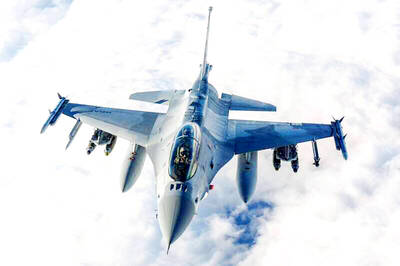
LONG FLIGHT: The jets would be flown by US pilots, with Taiwanese copilots in the two-seat F-16D variant to help familiarize them with the aircraft, the source said The US is expected to fly 10 Lockheed Martin F-16C/D Block 70/72 jets to Taiwan over the coming months to fulfill a long-awaited order of 66 aircraft, a defense official said yesterday. Word that the first batch of the jets would be delivered soon was welcome news to Taiwan, which has become concerned about delays in the delivery of US arms amid rising military tensions with China. Speaking on condition of anonymity, the official said the initial tranche of the nation’s F-16s are rolling off assembly lines in the US and would be flown under their own power to Taiwan by way
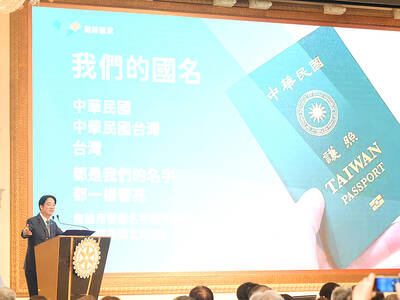
‘OF COURSE A COUNTRY’: The president outlined that Taiwan has all the necessary features of a nation, including citizens, land, government and sovereignty President William Lai (賴清德) discussed the meaning of “nation” during a speech in New Taipei City last night, emphasizing that Taiwan is a country as he condemned China’s misinterpretation of UN Resolution 2758. The speech was the first in a series of 10 that Lai is scheduled to give across Taiwan. It is the responsibility of Taiwanese citizens to stand united to defend their national sovereignty, democracy, liberty, way of life and the future of the next generation, Lai said. This is the most important legacy the people of this era could pass on to future generations, he said. Lai went on to discuss
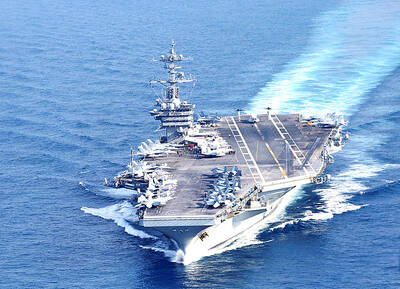
MISSION: The Indo-Pacific region is ‘the priority theater,’ where the task of deterrence extends across the entire region, including Taiwan, the US Pacific Fleet commander said The US Navy’s “mission of deterrence” in the Indo-Pacific theater applies to Taiwan, Pacific Fleet Commander Admiral Stephen Koehler told the South China Sea Conference on Tuesday. The conference, organized by the Center for Strategic and International Studies (CSIS), is an international platform for senior officials and experts from countries with security interests in the region. “The Pacific Fleet’s mission is to deter aggression across the Western Pacific, together with our allies and partners, and to prevail in combat if necessary, Koehler said in the event’s keynote speech. “That mission of deterrence applies regionwide — including the South China Sea and Taiwan,” he
UNPRECEDENTED: In addition to the approved recall motions, cases such as Ma Wen-chun’s in Nantou are still under review, while others lack enough signatures The Central Election Commission (CEC) announced yesterday that a recall vote would take place on July 26, after it approved the first batch of recall motions targeting 24 Chinese Nationalist Party (KMT) lawmakers and Hsinchu Mayor Ann Kao (高虹安). Taiwan is in the midst of an unprecedented wave of mass recall campaigns, following a civil society push that echoed a call made by Democratic Progressive Party (DPP) caucus whip Ker Chien-ming (柯建銘) in January to initiate signature drives aimed at unseating KMT legislators. Under the Civil Servants Election and Recall Act (公職人員選舉罷免法), Taiwanese can initiate a recall of district-elected lawmakers by collecting


 RSS
RSS