


A long line of people formed in front of Taipei’s Longshan Temple yesterday, as worshipers jostled for the chance to register to light a good-luck luminary, a traditional ritual supposed to bring good fortune for the Lunar New Year.
Known in Mandarin as guangmingdeng (光明燈), the Taoist ritual, taking place at local temples before the Lunar New Year holidays, sees worshipers write down information about family members before temple staff put the information inside luminaries they help to light.
The service at Longshan Temple, one of the city’s oldest temples, has long been popular among worshipers, and people wait in line every year to register.
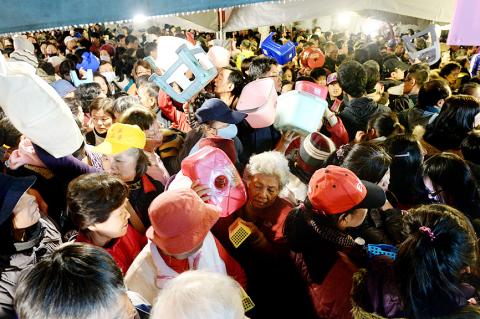
Photo: CNA
This year, the temple has increased the number of guangmingdeng from 12,000 to 18,000 to meet demand and avoid long lines.
However, worshipers still formed a line days before registration opened, with the first 1,000 slots filled before 7am yesterday.
A Taipei resident surnamed Shen (沈) who secured a slot said he and members of his family had taken turns to line up in front of the temple since last month because of the great competition for places in the service each year.
“Guangmingdeng is a important ritual that will give us a smooth year ahead and I think it’s worth the wait,” Sheng said.
The vice chairman of the temple, Huang Shu-wei (黃書瑋), said the temple had increased its number of luminaries this year and urged people not to line up in front of the temple.
The temple is accepting 1,000 registrations a day until the 18,000 slots have been filled.
However, some worshipers shouted at temple workers yesterday, urging the temple to increase the daily allocation of registration slots available after it was announced that the quota of 1,000 had been reached.
The temple agreed to accept another 200 registrations later that day.
Huang said the temple also offers online guangmingdeng and an tai sui services, and he encouraged people to complete the ritual online.
An online guangmingdeng service is also available at Taipei’s Bao An Temple. Xingtien Temple does not offer an online guangmingdeng service.
Lighting a luminary can cost from NT$600 to more than NT$2,000 depending on its size.
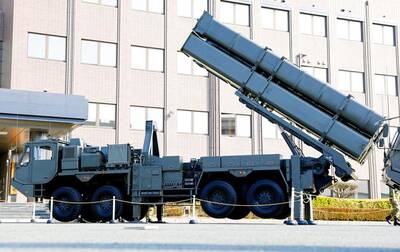
Japan has deployed long-range missiles in a southwestern region near China, the Japanese defense minister said yesterday, at a time when ties with Beijing are at their lowest in recent years. The missiles were installed in Kumamoto in the southern region of Kyushu, as Japan is attempting to shore up its military capacity as China steps up naval activity in the East China Sea. “Standoff defense capabilities enable us to counter the threat of enemy forces attempting to invade our country ... while ensuring the safety of our personnel,” Japanese Minister of Defense Shinjiro Koizumi said. “This is an extremely important initiative for

Chinese Nationalist Party (KMT) Chairwoman Cheng Li-wun (鄭麗文) today accepted an invitation from Chinese President Xi Jinping (習近平) to lead a delegation to China next month, saying she hopes to promote the peaceful development of cross-strait relations and bring stability to the Taiwan Strait. “I am grateful and happy to accept this invitation,” Cheng said in a statement from the KMT chairperson’s office. Cheng said she hopes both sides can work together to promote the peaceful development of cross-strait relations, enhance exchange and cooperation, bring stability to the Taiwan Strait and improve people’s livelihoods. At today's news conference, Cheng said any efforts to
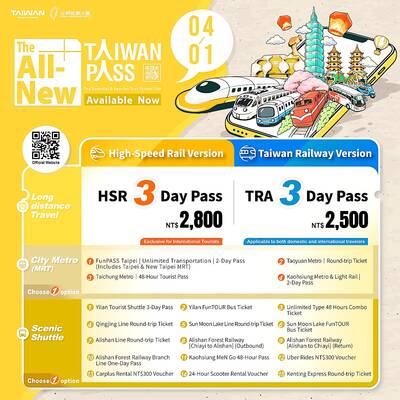
MORE POPULAR: Taiwan Pass sales increased by 59 percent during the first quarter compared with the same period last year, the Tourism Administration said The Tourism Administration yesterday said that it has streamlined the Taiwan Pass, with two versions available for purchase beginning today. The tourism agency has made the pass available to international tourists since 2024, allowing them to access the high-speed rail, Taiwan Railway Corp services, four MRT systems and four Taiwan Tourist Shuttles. Previously, five types of Taiwan Pass were available, but some tourists have said that the offerings were too complicated. The agency said only two types of Taiwan Pass would be available, starting from a three-day pass with the high-speed rail and a three-day pass with Taiwan Railway Corp. The former costs NT$2,800

The nation’s fastest supercomputer, Nano 4 (晶創26), is scheduled to be launched in the third quarter, and would be used to train large language models in finance and national defense sectors, the National Center for High-Performance Computing (NCHC) said. The supercomputer, which would operate at about 86.05 petaflops, is being tested at a new cloud computing center in the Southern Taiwan Science Park in Tainan. The exterior of the server cabinet features chip circuitry patterns overlaid with a map of Taiwan, highlighting the nation’s central position in the semiconductor industry. The center also houses Taiwania 2, Taiwania 3, Forerunner 1 and


 RSS
RSS