


Taiwan’s annual economic growth in the third quarter came in at a weaker-than-expected 1.58 percent, making it more challenging for full-year GDP growth to reach 2 percent, the Directorate-General of Budget, Accounting and Statistics (DGBAS) said yesterday.
The figure in the third quarter was 0.89 percentage points lower than the 2.47 percent year-on-year growth forecast by the DGBAS in August.
Sequentially, the economy only expanded 0.09 percent in the third quarter, following a 0.64 percent contraction and 0.58 percent growth in the first and second quarters respectively.
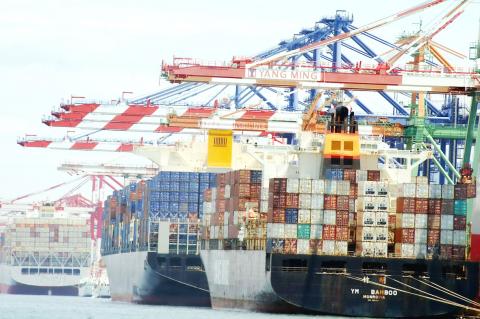
Photo: Huang Liang-chieh, Taipei Times
DGBAS senior executive officer Jasmine Mei (梅家瑗) said economic sentiment maintained its tone of a soft expansion in the third quarter.
“The market had thought Taiwan’s economic sentiment would show significant improvement in the second half of this year, but this did not happen in the third quarter,” Mei told a press conference.
The output, consumption and investment sectors all grew at a slower-than-expected pace in the third quarter, she said.
Exports in the third quarter decreased 0.78 percent from a year earlier due to sluggish demand for optical instruments and mineral products made by Taiwanese manufacturers, the DGBAS said in its quarterly report.
Output posted 1.68 percent growth in the third quarter from a year earlier, compared with the 3.66 percent growth forecast by the DGBAS in August.
In addition, private consumption rose 1.56 percent last quarter from a year earlier, down by 0.88 percentage points from the August forecast due to stagnant average salaries, DGBAS said.
Fixed capital formation surged 1.04 percent in the third quarter year-on-year, showing a decrease of 1.98 percentage points from the DGBAS’ forecast in August, as businesses’ willingness to invest was not as strong amid a slowing economy.
With the DGBAS’ current forecast that GDP in the fourth quarter will be 2.61 percent higher than the previous year, full-year economic growth may still hit the 2 percent mark.
However, ongoing food safety issues, as well as the earlier issue of a federal government partial shutdown in the US, would be major uncertainties for the nation’s economy in the near future, the DGBAS said.
The weaker-than-expected economic expansion in the third quarter has further made various foreign banks lower their forecasts for full-year growth.
Hong Kong-based ANZ Research senior economist Raymond Yeung (楊宇霆) said he has revised his full-year GDP forecast downward to 2.18 percent from 2.36 percent.
ANZ Research also revised its interest rate forecast, saying it now expects the central bank to keep its policy rates on hold next month as in the short-term Taiwan’s economy faces strong headwinds.
Leong Wai Ho (梁偉豪), senior regional economist with Barclays Capital based in Singapore, said the unexpected loss of momentum in Taiwan’s economy has led to the group lowering its growth forecast for this year by 0.6 percentage points to 1.6 percent.
However, Leong said economic momentum in the fourth quarter may accelerate to 1 percent sequentially, from the 0.09 percent sequential growth recorded in the third quarter.
HSBC economist Ronald Man (文略韜) said weaker-than-expected GDP growth in the third quarter poses downside risks to the group’s full-year growth forecast of 2.4 percent.
“If economic activity continues to decelerate in the fourth quarter, the full-year GDP growth may fall below 2 percent,” Man said in a research note.

Japan has deployed long-range missiles in a southwestern region near China, the Japanese defense minister said yesterday, at a time when ties with Beijing are at their lowest in recent years. The missiles were installed in Kumamoto in the southern region of Kyushu, as Japan is attempting to shore up its military capacity as China steps up naval activity in the East China Sea. “Standoff defense capabilities enable us to counter the threat of enemy forces attempting to invade our country ... while ensuring the safety of our personnel,” Japanese Minister of Defense Shinjiro Koizumi said. “This is an extremely important initiative for
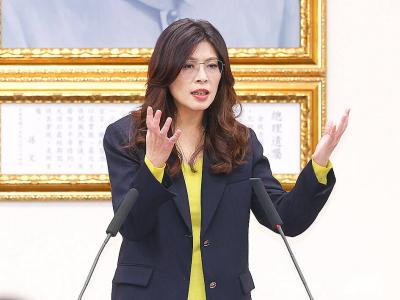
Chinese Nationalist Party (KMT) Chairwoman Cheng Li-wun (鄭麗文) today accepted an invitation from Chinese President Xi Jinping (習近平) to lead a delegation to China next month, saying she hopes to promote the peaceful development of cross-strait relations and bring stability to the Taiwan Strait. “I am grateful and happy to accept this invitation,” Cheng said in a statement from the KMT chairperson’s office. Cheng said she hopes both sides can work together to promote the peaceful development of cross-strait relations, enhance exchange and cooperation, bring stability to the Taiwan Strait and improve people’s livelihoods. At today's news conference, Cheng said any efforts to

MORE POPULAR: Taiwan Pass sales increased by 59 percent during the first quarter compared with the same period last year, the Tourism Administration said The Tourism Administration yesterday said that it has streamlined the Taiwan Pass, with two versions available for purchase beginning today. The tourism agency has made the pass available to international tourists since 2024, allowing them to access the high-speed rail, Taiwan Railway Corp services, four MRT systems and four Taiwan Tourist Shuttles. Previously, five types of Taiwan Pass were available, but some tourists have said that the offerings were too complicated. The agency said only two types of Taiwan Pass would be available, starting from a three-day pass with the high-speed rail and a three-day pass with Taiwan Railway Corp. The former costs NT$2,800

The nation’s fastest supercomputer, Nano 4 (晶創26), is scheduled to be launched in the third quarter, and would be used to train large language models in finance and national defense sectors, the National Center for High-Performance Computing (NCHC) said. The supercomputer, which would operate at about 86.05 petaflops, is being tested at a new cloud computing center in the Southern Taiwan Science Park in Tainan. The exterior of the server cabinet features chip circuitry patterns overlaid with a map of Taiwan, highlighting the nation’s central position in the semiconductor industry. The center also houses Taiwania 2, Taiwania 3, Forerunner 1 and


 RSS
RSS