


Two British teenage girls were being treated for burns at a London hospital yesterday after acid was hurled in their faces in the Indian Ocean island of Zanzibar.
Doctors said Kirstie Trup and Katie Gee, both 18, were doing “well” after Wednesday’s attack, and Gee took to Twitter to thank supporters for their good wishes.
The girls, close friends who were working for three weeks as volunteer teachers on Zanzibar, were attacked by two men on a motorbike as they strolled through the island’s historic center, Stone Town.
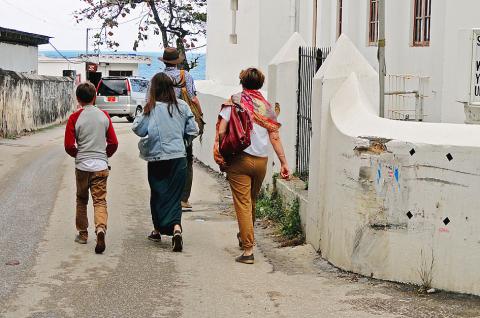
Photo: AFP
Zanzibar authorities have offered a reward for the capture of those responsible and police said on Friday that seven people had been questioned.
The girls’ families released a photograph of one of the victims’ injuries, showing dark burns seared across her jaw, neck and chest, without identifying her.
Trup’s father, Marc Trup, told the Times newspaper that efforts to help one of the girls after the attack had actually made her injuries worse.
One was immersed in the sea, where the salt water soothed the wounds, but the other was doused with dirty water which only made things worse, he said.
Gee’s father, Jeremy Gee, earlier described the burns as “horrendous,” telling the Daily Telegraph: “We are absolutely devastated. The level of the burns are beyond imagination.”
The girls, who are due to start university in the coming weeks, were flown to Tanzania’s economic capital, Dar es Salaam, for treatment before being taken to London on Friday.
In a Twitter message from the Chelsea and Westminster Hospital, which has a specialist burns unit, Gee wrote: “Thank you for all your support x.”
Andy Williams, burns consultant and plastic surgeon, on Friday said the team was still assessing the girls’ injuries.
“Both girls are well and their families are with them,” he said. “Both families would like to thank everyone that’s helped to bring the girls back. The families now wish to have time with the girls.”
Hospital staff in Dar es Salaam said their injuries were relatively minor and suggested the liquid thrown at them may have been diluted acid.
Zanzibar Minister of Tourism Said Ali Mbarouk offered a reward of 10 million Tanzanian shillings (US$6,200) for information leading to the arrest of the suspects, describing the attack as “a shame on the people of Zanzibar.”
Tourism is the lifeblood of the semi-autonomous Tanzanian island, which is famed for its pristine white-sand beaches.
“We have to work harder to make sure that Zanzibar is safe for visitors and citizens,” Mbarouk said.
Tanzanian President Jakaya Kikwete, who visited the two girls in hospital in Dar es Salaam, said the attack had “tarnished the image” of the country.
Tanzania is predominantly Muslim and the attack happened at the end of the Islamic holy month of Ramadan as people were beginning to celebrate the Eid al-Fitr holiday.
Some of the island’s more conservative Muslims object to foreign tourists who wear revealing clothes, as well as bars selling alcohol.
One of the girls had posted on her Twitter page that she had been hit by a Muslim woman in the street earlier in the trip, apparently for singing during Ramadan. There were also reports that the pair had argued with a local shopkeeper.
Yet their families insist they had been careful to dress modestly while out on the streets and, being from Jewish families, they also avoided any prominent displays of their faith.
“Both families are extremely upset and distressed at this completely unprovoked attack on their lovely daughters, who had only gone to Zanzibar with good intention,” a spokesman for the girls’ mothers said on Thursday.
The girls had been coming to the end of a three-week placement teaching at a local school, organized through i-to-i Travel, a British company that organizes gap-year work.
Acid has been used in several recent attacks in Zanzibar, although this is the first assault of its kind targeting foreigners on the holiday island.
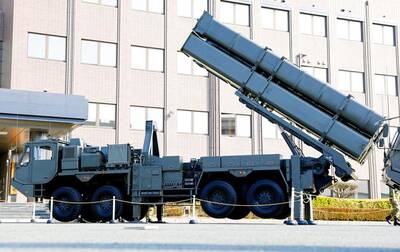
Japan has deployed long-range missiles in a southwestern region near China, the Japanese defense minister said yesterday, at a time when ties with Beijing are at their lowest in recent years. The missiles were installed in Kumamoto in the southern region of Kyushu, as Japan is attempting to shore up its military capacity as China steps up naval activity in the East China Sea. “Standoff defense capabilities enable us to counter the threat of enemy forces attempting to invade our country ... while ensuring the safety of our personnel,” Japanese Minister of Defense Shinjiro Koizumi said. “This is an extremely important initiative for

Chinese Nationalist Party (KMT) Chairwoman Cheng Li-wun (鄭麗文) today accepted an invitation from Chinese President Xi Jinping (習近平) to lead a delegation to China next month, saying she hopes to promote the peaceful development of cross-strait relations and bring stability to the Taiwan Strait. “I am grateful and happy to accept this invitation,” Cheng said in a statement from the KMT chairperson’s office. Cheng said she hopes both sides can work together to promote the peaceful development of cross-strait relations, enhance exchange and cooperation, bring stability to the Taiwan Strait and improve people’s livelihoods. At today's news conference, Cheng said any efforts to

MORE POPULAR: Taiwan Pass sales increased by 59 percent during the first quarter compared with the same period last year, the Tourism Administration said The Tourism Administration yesterday said that it has streamlined the Taiwan Pass, with two versions available for purchase beginning today. The tourism agency has made the pass available to international tourists since 2024, allowing them to access the high-speed rail, Taiwan Railway Corp services, four MRT systems and four Taiwan Tourist Shuttles. Previously, five types of Taiwan Pass were available, but some tourists have said that the offerings were too complicated. The agency said only two types of Taiwan Pass would be available, starting from a three-day pass with the high-speed rail and a three-day pass with Taiwan Railway Corp. The former costs NT$2,800

The nation’s fastest supercomputer, Nano 4 (晶創26), is scheduled to be launched in the third quarter, and would be used to train large language models in finance and national defense sectors, the National Center for High-Performance Computing (NCHC) said. The supercomputer, which would operate at about 86.05 petaflops, is being tested at a new cloud computing center in the Southern Taiwan Science Park in Tainan. The exterior of the server cabinet features chip circuitry patterns overlaid with a map of Taiwan, highlighting the nation’s central position in the semiconductor industry. The center also houses Taiwania 2, Taiwania 3, Forerunner 1 and


 RSS
RSS