


After two years of negotiation, Taiwan and New Zealand yesterday inked an economic cooperation agreement (ECA) to foster bilateral trade and investment. The signing ceremony took place at Victoria University of Wellington in New Zealand, and was broadcast nationwide in Taiwan.
Taipei Economic and Cultural Office in Wellington Representative Elliot Charng (常以立) and New Zealand Commerce and Industry Office Director Stephen Payton signed the agreement on behalf of their governments.
Under the Agreement Between New Zealand and the Separate Customs Territory of Taiwan, Penghu, Kinmen and Matsu on Economic Cooperation (ANZTEC), Taiwan will reduce tariffs on nearly 99.88 percent of New Zealand imports to zero, and phase out all tariffs over the next 12 years, while New Zealand will reduce its tariffs to zero on almost 100 percent of Taiwanese imports.
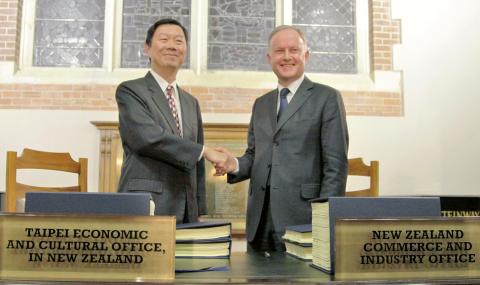
Photo: CNA
“The ANZTEC is a high-quality, comprehensive and very good agreement for both Taiwan and New Zealand,” Charng said at the ceremony.
The move is also a “breakthrough” for Taiwan because it is the first time the nation has inked an economic cooperation agreement with a developed country like New Zealand, he said.
Given that Taiwan was New Zealand’s 12th-largest trading partner and New Zealand was Taiwan’s 40th-largest trading partner last year, the agreement is expected to liberalize trade between the two countries, enhance exports of goods and services, and boost foreign investment in the Taiwanese and New Zealand markets, Payton said.
According to the Chung-Hua Institution for Economic Research (CIER), the agreement is expected to increase Taiwan’s GDP by 0.008 percent as a result of initial tariff reductions, a figure that could rise to 0.394 percent after the agreement is fully implemented.
The institute also said Taiwan could see its exports rise by US$144 million and imports increase by US$139 million under the agreement.
However, ANZ Bank economist Raymond Yeung (楊宇霆) was more pessimistic, saying that with bilateral trade totaling just US$1.2 billion, the direct economic benefits of the agreement are likely to be small.
“It was projected that the pact will increase gross output of US$605 million and create 6,256 jobs in Taiwan,” Yeung said in a note.
After witnesses the signing ceremony via a video linkup at a Taipei press conference, Minister of Economic Affairs Chang Chia-juh (張家祝) said the agreement will have little adverse impact on the nation’s economy, but even if there were any, contingency measures have been prepared.
To protect local farmers, the government will reduce tariffs on up to 470 imported agricultural products to zero over a 12-year period, so that the nation’s agricultural market will not suffer negative shocks from intensified market competition under the agreement, Chang said.
The rice market will remain closed to New Zealand rice products, he said.
Yeung said the agreement has high strategic value to Taiwan.
“The special access to the Chinese market through the Economic Cooperation Framework Agreement [ECFA] platform may attract New Zealand businesses to establish a presence in Taiwan,” Yeung said.
“Meanwhile, the first deal with a Trans-Pacific Partnership [TPP] member state will set a precedent for Taiwan to establish similar agreements with other TPP economies, although the progress will continue to be contingent on the state of political affairs,” he said.
After watching the signing ceremony in Taipei, Minister of Foreign Affairs David Lin (林永樂) said that the ANZTEC is part of the government’s efforts to have Taiwan join the global market, instead of being marginalized.
Becoming a member of the TPP is the government’s ultimate goal in its negotiations on trade agreements with other countries, he said, adding that Taiwan might seek New Zealand’s support when negotiating with others to join the TPP.

‘NO SECURITY RISK’: The Railway Bureau reassured the public that the technicians’ activities were limited to technical guidance and did not involve sensitive systems The Railway Bureau yesterday said it had invited eight Chinese technicians to assist with an airport MRT construction project. The bureau issued the confirmation after an Internet user said Chinese nationals had entered the construction zone of Taiwan Taoyuan International Airport’s Terminal 3 project. They asked why “individuals from an enemy state” were allowed access to such a major national infrastructure project, which raised serious concerns over Taiwan’s industrial safety, sensitive systems and information security. The bureau’s Northern Region Engineering Branch Office said subcontractor Taiwan Handle Industrial Co (台灣手把工業) of the Taoyuan airport MRT’s “Contract No. CU05 Project A14 Station Civil, MEP &

The National Chungshan Institute of Science and Technology yesterday showcased its locally developed variants of the Vision 60 robotic patrol dog, which it plans to deploy on the nation’s outlying territories in the South China Sea. The variants were produced under the Joint Lab project — created by the institute and domestic companies — and assembled with domestically produced motors, lenses and artificial intelligence (AI) systems alongside licensed tech from the US, Missile and Rocket Systems Research Division deputy director Jen Kuo-kang (任國光) told the media event at a military base in Taipei’s Dazhi (大直) area. Taiwan has built up its strengths

NOT IMMEDIATE: Taiwan has a chance to appeal the proposed 10 percent tariff before it starts, while other countries face a 12.5 percent tariff from the trade office Taiwan is among 60 economies determined by the US to have failed to impose or enforce a ban on the importation of goods produced with forced labor, according to a notice released on Tuesday by the Office of the US Trade Representative (USTR), which proposed imposing an additional 10 percent or more tariff on them. The USTR in a statement said that following an investigation, it had determined under Section 301 of the Trade Act of 1974 that the failure of the 60 economies to impose and effectively enforce a prohibition on the importation of goods produced with forced labor is

TIT-FOR-TAT: The US allegedly revoked the visa of a Chinese national working at Xinhua News Agency in the US in response to Beijing’s expulsion of Vivian Wang The Presidential Office yesterday condemned China for expelling a New York Times correspondent from Beijing following the newspaper’s interview with President William Lai (賴清德), saying the move highlighted Beijing’s suppression of press freedom and its threat to international news media. Taiwan has noted a series of recent incidents in which Beijing used similar tactics to “threaten and pressure international media outlets and journalists,” Presidential Office spokeswoman Karen Kuo (郭雅慧) said in a statement. “This concerns not only press freedom and freedom of expression, but also the safety of journalists, and Taiwan and relevant partners are paying close attention to the situation,” she


 RSS
RSS