


Heckled during a speech delivered at National Taiwan University yesterday, former premier Hau Pei-tsun (郝柏村) told the audience that the interruptions staged by students amounted to “suppression of freedom of expression.”
The government-funded Taiwan Foundation for Democracy (TFD), the host of the event, later took steps to prevent an audience member’s video footage of the incident from being shown in public or uploaded to the Web.
A few minutes after Hau began his speech on his experiences of Taiwan’s democratic transition, students shouted through prepared speakers, disrupting his speech for seven minutes.
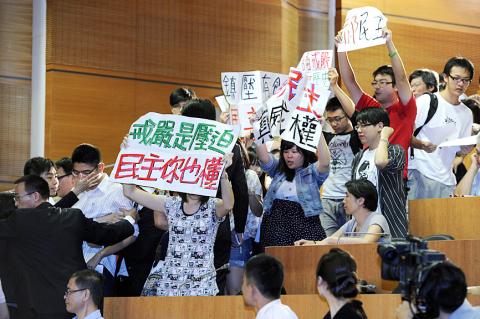
Photo: George Tsorng, Taipei Times
“Shame on [Hau]” for giving the speech, the students shouted.
Hau, the most powerful man in Taiwan’s military during late president Chiang Ching-kuo’s (蔣經國) rule in the Martial Law period, served as chief of the general staff, defense minister and premier after the lifting of martial law.
Under Hau’s authoritarian rule, there was outright political repression and he did nothing to promote democracy, the students said.
“He opposed direct presidential elections,” the students said, adding that “he said Taiwan’s future is jointly decided by Chinese people and Taiwanese people, not just by the Taiwanese.”
“He ordered military police to arrest students and crack down on student movements on campuses,” they said.
Chang Lung-chiao (張龍僑), executive-general of the Chen Wen-chen Memorial Foundation, was told by four people led by TFD chief executive Huang Teh-fu (黃德福) to stop filming and asked to leave.
Chang was only able to return to the hall to film after he agreed to sign a written pledge not to upload the video and not to display it in public, otherwise he would have to take legal responsibility for infringing of the rights of the host.
A student at NTU’s College of Law, surnamed Chen (陳), said he felt “indignant” at Hau delivering a speech on democracy at NTU.
At Hau’s order, the movement led by the late professor Lin Shan-tien (林山田) calling for abolition of Article 100 of the Criminal Code, a remnant of martial law, at NTU was dispersed by military police, Chen said.
Another student, surnamed Chu (朱), stayed after Hau finished his speech, waiting to ask him a question, but he was not given a chance.
“I would like to ask him if he feels regret for what he had done wrong before. He should at least apologize for his anti-democracy statements and behavior that committed an infringement on human rights to implement transitional justice,” Chu said.
Legislative Speaker Wang Jin-pyng (王金平), who is also TFD president, however, praised Hau for his “tremendous contributions” to democracy.
Hau could have exerted his influence in the military to intervene in democratic development, like many military strongmen had done in countries in Latin America, Africa, and Southeast Asia during their democratization process, but he did not, said Wang, adding that Hau, instead, assisted Chiang in his plan to push for democracy.
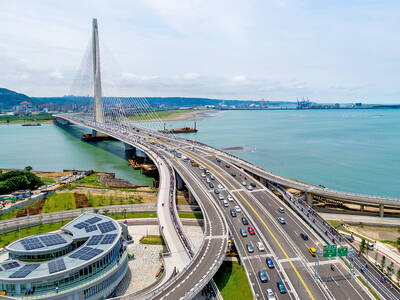
The Ministry of Transportation and Communications yesterday inaugurated the Danjiang Bridge across the Tamsui River in New Taipei City, saying that the structure would be an architectural icon and traffic artery for Taiwan. Feted as a major engineering achievement, the Danjiang Bridge is 920m long, 211m tall at the top of its pylon, and is the longest single-pylon asymmetric cable-stayed bridge in the world, the government’s Web site for the structure said. It was designed by late Iraqi-British architect Zaha Hadid. The structure, with a maximum deck of 70m, accommodates road and light rail traffic, and affords a 200m navigation channel for boats,
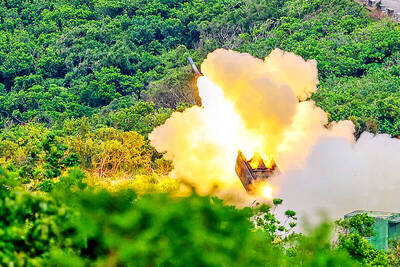
PRECISION STRIKES: The most significant reason to deploy HIMARS to outlying islands is to establish a ‘dead zone’ that the PLA would not dare enter, a source said A High Mobility Artillery Rocket System (HIMARS) would be deployed to Penghu County and Dongyin Island (東引) in Lienchiang County (Matsu) to force the Chinese military to retreat at least 100km from the coastline, a military source said yesterday. Taiwan has been procuring HIMARS and Army Tactical Missile Systems (ATACMS) from the US in batches. Once all batches have been delivered, Taiwan would possess 111 HIMARS units and 504 ATACMS, which have a range of 300km. Considering that “offense is the best defense,” the military plans to forward-deploy the systems to outlying islands such as Penghu and Dongyin so that
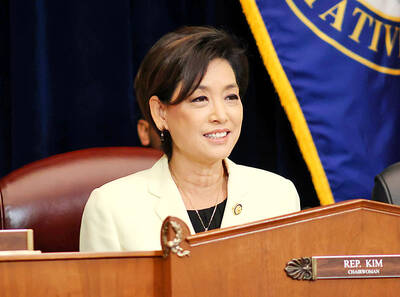
‘CLEAR MESSAGE’: The bill would set up an interagency ‘tiger team’ to review sanctions tools and other economic options to help deter any Chinese aggression toward Taiwan US Representative Young Kim has introduced a bill to deter Chinese aggression against Taiwan, calling for an interagency “tiger team” to preplan coordinated sanctions and economic measures in response to possible Chinese military or political action against Taiwan. “[Chinese President] Xi Jinping [習近平] has directed the People’s Liberation Army to be ready to invade Taiwan by 2027. China has a plan. America should have one too,” Kim said in a news release on Thursday last week. She introduced the “Deter PRC [People’s Republic of China] aggression against Taiwan act” to “ensure the US has a coordinated sanctions strategy ready should

TAIWAN ISSUE: US treasury secretary Scott Bessent said on the first day of meetings that ‘it wouldn’t be a US-China summit without the Taiwan issue coming up’ There were no surprises on the first day of the summit between US President Donald Trump and Chinese President Xi Jinping (習近平), the Mainland Affairs Council (MAC) said yesterday, as the government reiterated that cross-strait stability is crucial to the Asia-Pacific region, as well as the world. As the two presidents met for a highly anticipated summit yesterday, Chinese state media reported that Xi warned Trump that missteps regarding Taiwan could push their two countries into “conflict.” Trump arrived in China with accolades for his host, calling Xi a “great leader” and “friend,” and extending an invitation to visit the White House


 RSS
RSS