


Rejecting the term “Taiwan” as the nation’s name, former premier Hau Pei-tsun (郝柏村) said yesterday that Taiwan is not an independent, sovereign nation and that unification between Taiwan and China would eventually happen.
The assertions “Taiwan is already an independent country named the Republic of China (ROC)” and “the ROC is Taiwan” are both forms of “self-depreciation,” Hau said when addressing a forum organized by the government-funded Taiwan Foundation for Democracy (TFD).
Hau said this kind of rhetoric was a “politically motivated tactic” aimed at “fooling voters.”
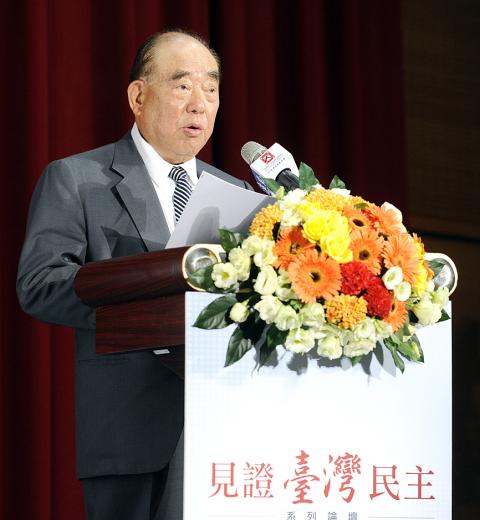
Photo: George Tsorng, Taipei Times
“They represented a step backward for democracy and have become major obstacles to the quality of the nation’s democracy,” he said.
“Former US secretary of state Colin Powell had made it clear [when he was] in China that Taiwan is not an independent, sovereign country,” Hsu said.
However, no one in the world would say that the ROC is not a sovereign country, he added.
Hau was referring to a statement made by Powell during an interview with Phoenix TV on Oct. 25, 2004, in Beijing saying that “Our [the US’] policy is clear. There is only one China. Taiwan is not independent. It does not enjoy sovereignty as a nation, and that remains our policy, our firm policy.”
The state department later explained that Powell had misspoken and said that there had been no change in US policy toward Taiwan.
Hau was the fourth speaker invited to address the “Witness Taiwan Democracy” series forum, following former president Lee Teng-hui (李登輝), former vice president Vincent Siew (蕭萬長) and vice president Annette Lu (呂秀蓮).
In his speech, the 95-year-old Hau expressed his wish that leaders of younger generations will devote themselves to improving the quality of democracy in Taiwan, saying that democracy gives Taiwan an advantage over China to advance the peace process with China and to bring about cross-strait unification.
“There is no democratic country in the world that has two different democratic systems. When people of both sides of the Strait have a consensus on their political system, unification will come to fruition naturally,” he said.
When China stopped shelling Kinmen in 1979, the tragedy of war among Chinese people was brought to an end, while the lifting of martial law in Taiwan in 1987 marked the end of an era when “political power came from the barrel of a gun,” Hau said.
When political power does not come from the barrel of a gun and a consensus on a political system is reached among people on both sides of the Strait, “we will certainly attain unification,” Hau said.
Taiwan could have become a base for fostering democracy in China, but the division among Taiwanese on the issue of national identity has impeded Taiwan’s democratic development, Hau said.
In response to his speech, Control Yuan President Wang Chien-shien (王建煊), who also attended the forum, said he has been thinking about the state of Taiwan’s democracy.
When Taiwan was ruled by former presidents Chiang Kai-shek (蔣介石) and Chiang Ching-kuo (蔣經國), democracy did not thrive as it does now, but the country achieved an economic miracle, Wang said.
In the following 25 years, since the nation’s leaders were selected by the public, the country “has been living off its last reserves” and no one knows whether the worst is yet to come, Wang said.
Wang said he did not mean that people lived a better life under the rule of Chiang Kai-shek and Chiang Ching-kuo than they did now.
Soviet leader Joseph Stalin once asked a soldier how the October Revolution has changed his life and the soldier replied that he used to have two suits of clothes and then he had just one, Wang said.
“Will there be a day in the future when we [Taiwanese] won’t even have a full suit of clothes but just a pair of pants left?” Wang said.
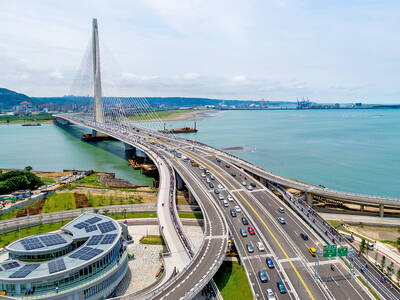
The Ministry of Transportation and Communications yesterday inaugurated the Danjiang Bridge across the Tamsui River in New Taipei City, saying that the structure would be an architectural icon and traffic artery for Taiwan. Feted as a major engineering achievement, the Danjiang Bridge is 920m long, 211m tall at the top of its pylon, and is the longest single-pylon asymmetric cable-stayed bridge in the world, the government’s Web site for the structure said. It was designed by late Iraqi-British architect Zaha Hadid. The structure, with a maximum deck of 70m, accommodates road and light rail traffic, and affords a 200m navigation channel for boats,
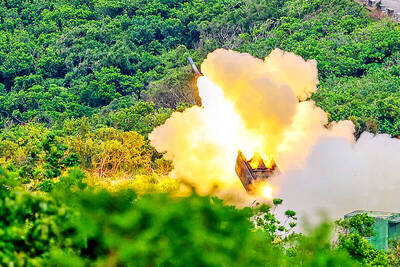
PRECISION STRIKES: The most significant reason to deploy HIMARS to outlying islands is to establish a ‘dead zone’ that the PLA would not dare enter, a source said A High Mobility Artillery Rocket System (HIMARS) would be deployed to Penghu County and Dongyin Island (東引) in Lienchiang County (Matsu) to force the Chinese military to retreat at least 100km from the coastline, a military source said yesterday. Taiwan has been procuring HIMARS and Army Tactical Missile Systems (ATACMS) from the US in batches. Once all batches have been delivered, Taiwan would possess 111 HIMARS units and 504 ATACMS, which have a range of 300km. Considering that “offense is the best defense,” the military plans to forward-deploy the systems to outlying islands such as Penghu and Dongyin so that
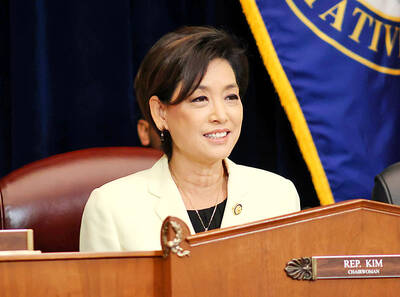
‘CLEAR MESSAGE’: The bill would set up an interagency ‘tiger team’ to review sanctions tools and other economic options to help deter any Chinese aggression toward Taiwan US Representative Young Kim has introduced a bill to deter Chinese aggression against Taiwan, calling for an interagency “tiger team” to preplan coordinated sanctions and economic measures in response to possible Chinese military or political action against Taiwan. “[Chinese President] Xi Jinping [習近平] has directed the People’s Liberation Army to be ready to invade Taiwan by 2027. China has a plan. America should have one too,” Kim said in a news release on Thursday last week. She introduced the “Deter PRC [People’s Republic of China] aggression against Taiwan act” to “ensure the US has a coordinated sanctions strategy ready should

TAIWAN ISSUE: US treasury secretary Scott Bessent said on the first day of meetings that ‘it wouldn’t be a US-China summit without the Taiwan issue coming up’ There were no surprises on the first day of the summit between US President Donald Trump and Chinese President Xi Jinping (習近平), the Mainland Affairs Council (MAC) said yesterday, as the government reiterated that cross-strait stability is crucial to the Asia-Pacific region, as well as the world. As the two presidents met for a highly anticipated summit yesterday, Chinese state media reported that Xi warned Trump that missteps regarding Taiwan could push their two countries into “conflict.” Trump arrived in China with accolades for his host, calling Xi a “great leader” and “friend,” and extending an invitation to visit the White House


 RSS
RSS