


A series of events was held near the capital’s landmark Taipei 101 skyscraper last night as Taiwan joined the worldwide “Earth Hour” campaign and turned the lights off for one hour to raise environmental awareness.
Earth Hour, organized by the WWF, is held in late March every year and has now reached its seventh year, with an expected 152 countries, more than 7,000 cities and more than 200 million people participating in the small gesture of switching their lights off between 8:30pm and 9:30pm on the same day.
Many public buildings in Taipei also participated in the campaign this year, including the Chiang Kai-shek Memorial Hall, the Taipei Arena, Taipei City Hall and the historic Red House Theater, as well as several corporate office buildings.
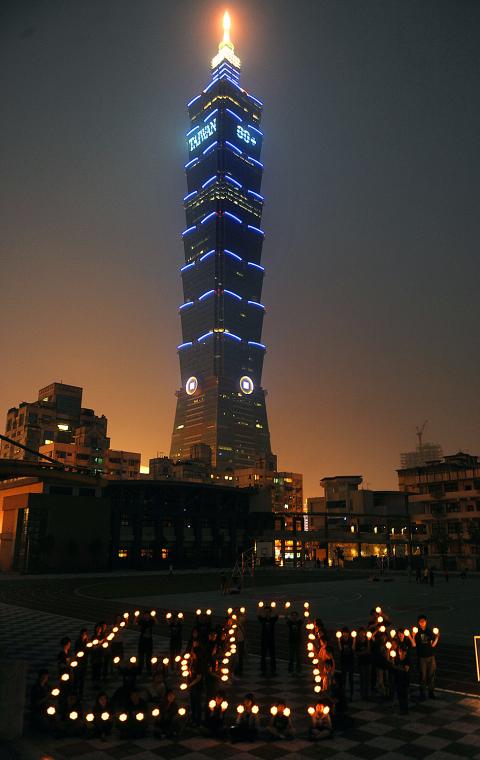
Photo: Fang Pin-chao, Taipei Times
At the Hsinyi Elementary School, before Taipei 101 turned its lights off at 8:30pm, the Taiwan-based organizer, the Society of Wilderness (SOW), invited participants to hold LED candles in their hands to spell out “60+” in front of the building, symbolizing that they will do more than just turn off the lights for 60 minutes and would aim to make lifestyle adjustments and expand environmental education.
Urging the public to save energy and reduce carbon emissions to ease global warming, the SOW said that about 100,000 kilowatt-hour of electricity could be saved if a million people responded to the campaign and turned their lights off for just one hour.
The organization also presented the concept of an “eco-sponge city” this year, as a long-term measure to cope with global warming.
Citing Chen Chang-po (陳章波), a research fellow at Academia Sinica’s Biodiversity Research Center, the group said that to create an “eco-sponge city” means making the city a living entity by replacing more pavements in the city with breathable material – meaning water and air can penetrate through it – so that concrete in cities would not block the relationship between human beings and the earth’s natural ecosystem.
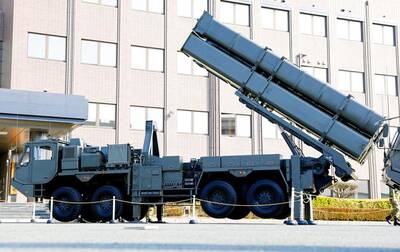
Japan has deployed long-range missiles in a southwestern region near China, the Japanese defense minister said yesterday, at a time when ties with Beijing are at their lowest in recent years. The missiles were installed in Kumamoto in the southern region of Kyushu, as Japan is attempting to shore up its military capacity as China steps up naval activity in the East China Sea. “Standoff defense capabilities enable us to counter the threat of enemy forces attempting to invade our country ... while ensuring the safety of our personnel,” Japanese Minister of Defense Shinjiro Koizumi said. “This is an extremely important initiative for

Chinese Nationalist Party (KMT) Chairwoman Cheng Li-wun (鄭麗文) today accepted an invitation from Chinese President Xi Jinping (習近平) to lead a delegation to China next month, saying she hopes to promote the peaceful development of cross-strait relations and bring stability to the Taiwan Strait. “I am grateful and happy to accept this invitation,” Cheng said in a statement from the KMT chairperson’s office. Cheng said she hopes both sides can work together to promote the peaceful development of cross-strait relations, enhance exchange and cooperation, bring stability to the Taiwan Strait and improve people’s livelihoods. At today's news conference, Cheng said any efforts to
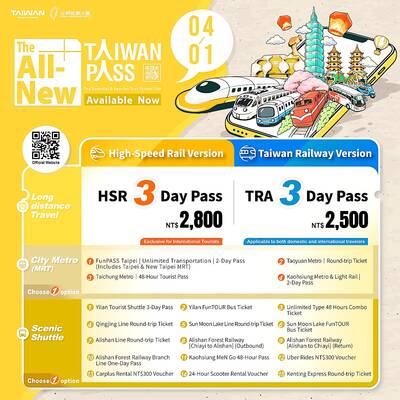
MORE POPULAR: Taiwan Pass sales increased by 59 percent during the first quarter compared with the same period last year, the Tourism Administration said The Tourism Administration yesterday said that it has streamlined the Taiwan Pass, with two versions available for purchase beginning today. The tourism agency has made the pass available to international tourists since 2024, allowing them to access the high-speed rail, Taiwan Railway Corp services, four MRT systems and four Taiwan Tourist Shuttles. Previously, five types of Taiwan Pass were available, but some tourists have said that the offerings were too complicated. The agency said only two types of Taiwan Pass would be available, starting from a three-day pass with the high-speed rail and a three-day pass with Taiwan Railway Corp. The former costs NT$2,800

The nation’s fastest supercomputer, Nano 4 (晶創26), is scheduled to be launched in the third quarter, and would be used to train large language models in finance and national defense sectors, the National Center for High-Performance Computing (NCHC) said. The supercomputer, which would operate at about 86.05 petaflops, is being tested at a new cloud computing center in the Southern Taiwan Science Park in Tainan. The exterior of the server cabinet features chip circuitry patterns overlaid with a map of Taiwan, highlighting the nation’s central position in the semiconductor industry. The center also houses Taiwania 2, Taiwania 3, Forerunner 1 and


 RSS
RSS