


Animal rights advocates yesterday rallied outside the Chingshui Zushi Temple (清水祖師廟) in Sansia District (三峽), New Taipei City (新北市), urging an end to “divine pig” contests.
Chanting “overweight pigs do not bring fortune” while parading a model of a cartoon pig on the bridge leading to the temple, the advocates urged passers-by to join their campaign to halt the practice, the last such contest in the Taipei metropolitan area.
“I would like to make it clear that we are not against the tradition of having pigs as offering to deities and immortals, but if you choose to do this, please buy pigs that are raised in a healthy way and slaughtered humanely,” Environmental and Animal Society Taiwan (EAST) director Chen Yu-min (陳玉敏) told the crowd.
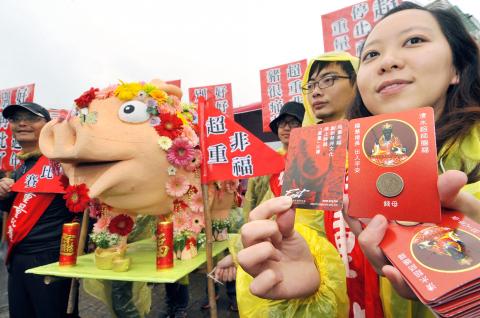
Photo: Chen Chih-chu, Taipei Times
“Pigs normally grow to over 100 jin [60kg], but the divine pigs are force-fed and grow to about 1,000 jin or more, then have their throats cut while they are conscious. This is unhealthy, cruel and inhumane,” Chen said.
She said that all deities are merciful and would not appreciate offerings that cause suffering in living creatures.
“Don’t forget that Chingshui Zushi was a learned and much respected Buddhist master and a vegetarian,” Chen said.
According to tradition, the heavier the pig that a devotee presents as an offering, the more sincere the devotee, though both Buddhist and Taoist teachings urge vegetarian offerings at religious rituals.
While contests on the weight of divine pigs were once popular across the country, only a few temples still hold such events.
In Sansia, seven family clans take turns each year to be in charge of raising such pigs, receiving certificates and medals according to the weight of the animals.
According to EAST, there are 126 Chingshui Zushi temples across the country, but the Sansia temple is the only one still holding annual divine pig contests.
Most people at the event reacted positively to the call.
“Killing is discouraged in Taoism, so why kill pigs for deities? Pigs are also living creatures,” a local resident surnamed Wu (吳) said.
A man surnamed Chang (張), who traveled to Sansia with his family to attend the festivities, said that he did not see the point in having overweight pigs as offerings.
Another man, surnamed Huang (黃), from Fusing Township (復興), Taoyuan County, said that there are alternatives to offering pigs.
“A few years ago, when I had to prepare an offering for deities at a temple in my hometown, I made a ‘divine pig’ with bags of rice, with each bag weighing 20kg,” Huang said. “After the ritual, I gave the rice to poor families. I think this is a better idea.”
Responding to the activists, the temple’s executive director Liu Chin-ta (劉金達) said that it may consider ending the divine pig contest in 2017.
“Seven clans take turns to raise divine pigs, so each cycle lasts seven years. The current cycle started in 2010, and since we cannot just stop it, we have to wait until at least 2017 to put an end to the practice,” Liu said. “Of course, it’s up to the temple’s board of directors to make the final decision on the matter.”

A signaling system malfunction disrupted high-speed rail (HSR) services beginning at 8am today, with trains temporarily reduced to three northbound and three southbound trains per hour as authorities conduct inspections. The malfunction occurred on a section of track in Miaoli County during pre-operation checks early this morning, forcing northbound and southbound trains to use a single track, the HSR operator said. The regular schedule has been replaced with three hourly trains offering only nonreserved seating in each direction, stopping at every station, it said, adding that business class cars would still have reserved seating. Departures from terminal stations are scheduled at the top

Taiwan is still in the process of assessing the possibility of recruiting workers from Eswatini, the Ministry of Foreign Affairs said yesterday, adding that its goal is to help Eswatini upgrade its vocational training centers. If there are plans to recruit workers from Eswatini, safeguarding national security, protecting public health and ensuring the employment rights of Taiwanese would be prerequisites, Department of West Asian and African Affairs Director-General Yen Chia-liang (顏嘉良) told a news conference. Key considerations would also include filling labor shortages in specific industries, and fostering bilateral professional and technical exchanges, he said. Yen was asked about the progress of labor

VERBOSE VESSELS: A CGA cutter and a China Coast Guard exchanged verbal barbs for more than a day in Taiwanese-controlled waters before the Chinese vessel left The Taiwanese and Chinese coast guards had a standoff near the strategically located Pratas Islands (Dongsha Islands, 東沙群島) in the north of the South China Sea, the Coast Guard Administration (CGA) said yesterday. The two sides engaged in intense radio exchanges over sovereignty claims during the 33-hour standoff. China Coast Guard vessel 3501 eventually left the restricted waters, 26.6 nautical miles (49.2km) west of the Pratas Islands, at 5pm yesterday, the CGA said. Lying approximately between southern Taiwan and Hong Kong, the Taiwan-controlled Pratas are seen by some security experts as vulnerable to Chinese attack due to their distance — more than

A US uncrewed surface vessel (USV) encountered multiple Chinese warships during an autonomous transit of the Taiwan Strait, US defense company Seasats said in a statement on Wednesday. Seasats announced that a Lightfish USV had completed the first autonomous transit of the Taiwan Strait. Over five days, the USV traversed the entire length of the Strait while constantly monitoring surface vessel traffic, the company said. The Lightfish encountered multiple Chinese warships, one of which was a Chinese People’s Liberation Army Navy (PLAN) Type 056 corvette, it said. The Chinese vessels were operating “well within Taiwan’s exclusive economic zone without transmitting their identity via the


 RSS
RSS