


Former Executive Yuan secretary-general Lin Yi-shih (林益世) was released on NT$50 million (US$1.7 million) yesterday afternoon.
Lin, who has been detained by prosecutors since July 2, was granted bail early yesterday by the Taipei District Court following his indictment on corruption-related charges on Thursday, but he was not released immediately because he failed to come up with the required amount at the time.
Lin is accused of demanding and accepting bribes, concealing illegal gains and keeping unaccountable assets, according to the Supreme Prosecutors’ Office Special Investigation Division (SID).
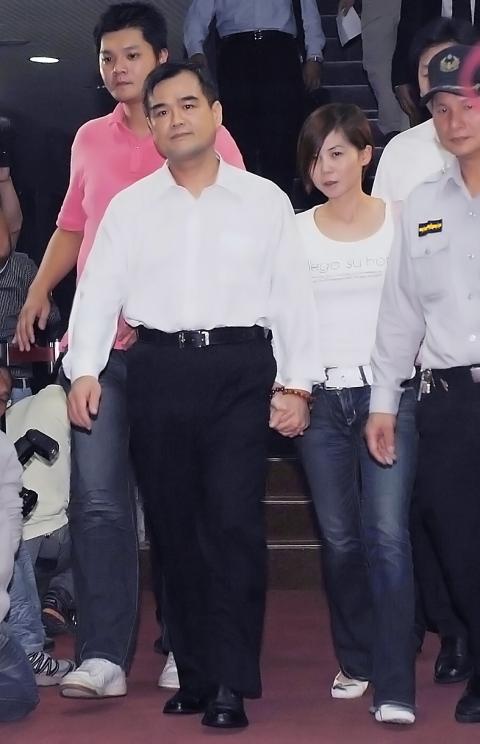
Photo: Lo Pei-der, Taipei Times
Lin’s release sparked an outcry from Democratic Progressive Party (DPP) lawmakers.
“Taiwan’s judiciary is morally bankrupt,” DPP Legislator Cheng Li-chiun (鄭麗君) said.
DPP Legislator Chao Tien-lin (趙天麟) described it as “iron-clad evidence of political interference in the judicial process.”
Some netizens also reacted to reports that Lin’s family was able to come up with NT$50 million for bail within 20 hours.
“For most people, it would take 100 years to round up that amount,” one netizen commented.
“Has the government gone crazy?” another wrote. “Corrupt people can post money to be released on bail?”
A netizen using the name “ming_ray” said: “No wonder Mr Ma Ying-jeou promised to make people feel good about the economy within one month. Now we have the state coffers earning NT$50 million. This is quite a good, credible promise!”
Chinese Nationalist Party (KMT) Legislator Lo Shu-lei (羅淑蕾), who has frequently drawn the party’s ire with her comments, said: “The KMT government should not dig its own grave just to protect Lin.”
“The SID should publicly explain the many questions surrounding the case, or else the public will have no confidence in the judiciary,” Lo said.
KMT caucus whip Wu Yu-sheng (吳育昇), on the other hand, said that DPP members involved in corruption cases such as Yunlin County Commissioner Su Chih-fen (蘇治芬) and DPP Legislator Chen Ming-wen (陳明文) had also been released upon posting bail, adding that there was no difference in treatment between pan-blue and pan-green politicians.
Lin’s case came to light on June 27 when a local magazine reported that he helped Kaohsiung-based Ti Yung Co (地勇選礦公司地勇選礦公司) to secure a slag treatment contract from a subsidiary of China Steel Corp (CSC, 中鋼) in 2010, when Lin was serving as a KMT legislator.
In return, Ti Yung owner Chen Chi-hsiang (陳啟祥) gave Lin NT$63 million, the indictment read.
The magazine reported that Lin demanded a further NT$83 million from Chen early this year after he was appointed Cabinet secretary-general.
When Chen refused to pay up, Lin allegedly pressured CSC, a listed company in which the government has a controlling stake, to stop supplying slag to Ti Yung.
Lin’s mother, Shen Juo-lan (沈若蘭), who allegedly received the bribe along with Lin, was indicted as another principal offender in the case, according to the indictment.
Lin’s wife, Peng Ai-chia (彭愛佳), and his two maternal uncles — Shen Huan-yao (沈煥瑤) and Shen Huan-chang (沈煥璋) — were charged with money laundering for concealing the bribe on behalf of Lin, the indictment said.
Chen, who gave testimony against Lin as a witness for the prosecutors in the investigation, was under investigation in a separate case by the Kaohsiung District Prosecutors’ Office.
Additional reporting by Chien Li -chung
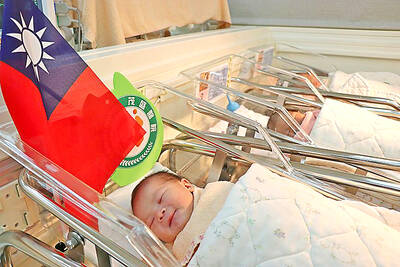
AGING: As of last month, people aged 65 or older accounted for 20.06 percent of the total population and the number of couples who got married fell by 18,685 from 2024 Taiwan has surpassed South Korea as the country least willing to have children, with an annual crude birthrate of 4.62 per 1,000 people, Ministry of the Interior data showed yesterday. The nation was previously ranked the second-lowest country in terms of total fertility rate, or the average number of children a woman has in her lifetime. However, South Korea’s fertility rate began to recover from 2023, with total fertility rate rising from 0.72 and estimated to reach 0.82 to 0.85 by last year, and the crude birthrate projected at 6.7 per 1,000 people. Japan’s crude birthrate was projected to fall below six,
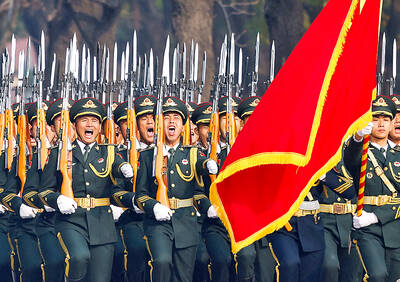
Conflict with Taiwan could leave China with “massive economic disruption, catastrophic military losses, significant social unrest, and devastating sanctions,” a US think tank said in a report released on Monday. The German Marshall Fund released a report titled If China Attacks Taiwan: The Consequences for China of “Minor Conflict” and “Major War” Scenarios. The report details the “massive” economic, military, social and international costs to China in the event of a minor conflict or major war with Taiwan, estimating that the Chinese People’s Liberation Army (PLA) could sustain losses of more than half of its active-duty ground forces, including 100,000 troops. Understanding Chinese
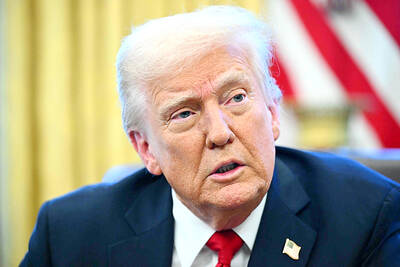
US President Donald Trump in an interview with the New York Times published on Thursday said that “it’s up to” Chinese President Xi Jinping (習近平) what China does on Taiwan, but that he would be “very unhappy” with a change in the “status quo.” “He [Xi] considers it to be a part of China, and that’s up to him what he’s going to be doing, but I’ve expressed to him that I would be very unhappy if he did that, and I don’t think he’ll do that. I hope he doesn’t do that,” Trump said. Trump made the comments in the context
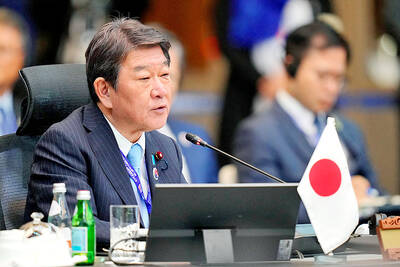
SELF-DEFENSE: Tokyo has accelerated its spending goal and its defense minister said the nation needs to discuss whether it should develop nuclear-powered submarines China is ramping up objections to what it sees as Japan’s desire to acquire nuclear weapons, despite Tokyo’s longstanding renunciation of such arms, deepening another fissure in the two neighbors’ increasingly tense ties. In what appears to be a concerted effort, China’s foreign and defense ministries issued statements on Thursday condemning alleged remilitarism efforts by Tokyo. The remarks came as two of the country’s top think tanks jointly issued a 29-page report framing actions by “right-wing forces” in Japan as posing a “serious threat” to world peace. While that report did not define “right-wing forces,” the Chinese Ministry of Foreign Affairs was


 RSS
RSS