


About 1,000 people marched from Sun Yat-sen Memorial Hall to the Japanese representative office in Taipei yesterday to protest against Japan’s nationalization of three of the Diaoyutai Islands (釣魚台) and to urge Taiwan and China to collaborate in defending their sovereignty over them.
Chanting “the Diaoyutais are ours,” “the two sides of the Taiwan Strait should work to defend the Diaoyutais” and “down with Japanese imperialism,” the protesters, who mostly came from pro-unification groups — including the Labor Party, the Alliance for Reunification of China, the Chinese Association for the Defense of the Diaoyutais and the People’s Alliance for Defense of the Diaoyutais — marched from Sun Yat-sen Memorial Hall to the Taipei Office of the Interchange Association, Japan, the representative office of Japan in Taiwan.
“We’re opposed to proposals to share resources, such as fisheries, around the Diaoyutais with Japan before confirming that the Republic of China [ROC] has sovereignty over the islands,” People’s Alliance for Defense of the Diaoyutais convener Lin Hsia-hsin (林孝信) told the crowd before the march began. “It’s time for the two sides of the Taiwan Strait to put aside our differnces and work together for the sovereignty of the Diaoyutais.”
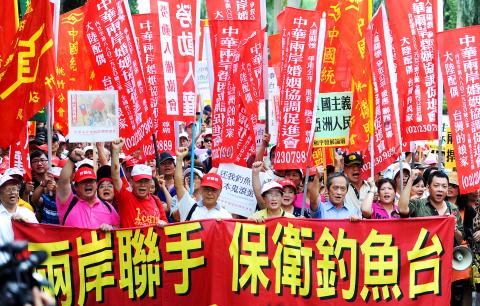
Photo: Lo Pei-der, Taipei Times
He asked “Without defending our sovereignty, how can we defend our fishing rights?”
A number of protesters carried People’s Republic of China (PRC) flags as they marched.
As they passed by the Pacific Sogo Department Store — a joint venture between Taiwan’s Pacific Construction Co (太平洋建設) and Japan’s Sogo Department Store — on Zhongxiao E Road, demonstrators chanted slogans urging a boycott of Japanese merchandise.
At one point, a man rushed a demonstrator holding a PRC flag, grabbed the flag, and asked: “Why are you holding this flag? Is this our national flag?”
The two men briefly engaged in a clash before being separated by others.
Chang Chih-min (張志民), another demonstrator who carried a PRC flag, defended the use of the Chinese flag.
“I am Chinese, there is only one China and there is nothing wrong in holding a Chinese flag,” he said. “I am displaying a Chinese flag, so the Japanese will know that Taiwan is backed by its motherland and will cease being so arrogant.”
A shouting match also broke out between a demonstrator and China Times reporter Chen Wen-hsin (陳文信), who was on the scene to cover the protest and wore a sun hat with neck protection.
The demonstrator told Chen he should not wear such a hat, because “that’s the kind of hat that the Japanese soldiers wore when they invaded China.”
“But I am Taiwanese, what you just said is not appropriate,” Chen replied, to which the demonstrator responded: “You young people should learn some history.”
The dispute ended with Chen walking away after saying: “You are very rude.”
Demonstrators gathered outside the Interchange Association, Japan at about 4pm and delivered a letter of protest to Economic Affairs Director Masahiko Sugita.
The letter urged Japan to “return the Diaoyutais immediately to Taiwan. Do not create more hatred in Asia and do not create more enemies for generations to come.”
Clashes then broke out between pro-unification demonstrators and a pro-independence demonstrator, Yang Tzu-fu (楊梓富).
Pro-unification demonstrators were upset by a banner displayed by Yang, which said that the waters surrounding the Diaoyutais were historical fisheries for Taiwanese fishermen and that Taiwan is not part of China.
“What do you mean Taiwan is not part of China?” a pro-unification demonstrator asked, approached. “This is nonsense! You stupid Taiwan independence supporter!”
Meanwhile, the Presidential Office said it welcomed the peaceful method by which Taiwanese had expressed their opinions on the Diaoyutais, adding that as Taiwan was a democratic society, the government would do everything to uphold citizens’ right to express their opinions on the issue.
At a separate event, a group of fishermen announced that 60 Taiwanese fishing boats from Yilan County would set sail today for the Diaoyutai Islands to safeguard Taiwanese fishermen’s trawling rights in waters near the resource-rich island chain.
The action is to mark the first large-scale attempt by Taiwanese fishermen to bolster their right to fish near the Diaoyutais since the territorial dispute reached a new level following a Sept. 11 announcement by the Japanese government that it had nationalized three of the islands in the chain.
Former Yilan County Longline Fishing Association director Lin Jih-cheng (林日成), who is to serve as commander for the mission, said that in addition to the 60 fishing boats, which are to set sail from Suao Township (蘇澳) at 3pm today, more fishing vessels operating near the island group are also expected to take part.
“These fishing vessels are scheduled to converge at 20 nautical miles [37km] southwest of the islands at 5am on Tuesday and sail clockwise around the chain in a move to claim Taiwanese fishermen’s fishing rights in the water area,” the Chinese-language United Evening News reported reported Lin as saying.
The vessels could approach up to 12 nautical miles of the contested archipelago, Lin said, adding that the mission did not include landing on the islands.
The vessels will return to the Nanfangao fishing harbor in Suao on Wednesday morning.
“The mission aims to make sure our voices are heard by the Japanese and serves as a test to see how much emphasis the government will put upon Taiwanese fishermen,” Suao Fishermen Association director Chen Chun-sheng (陳春生) said, after an earlier mission was postponed due to a failure to obtain NT$5 million (US$170,000) in fuel subsidies from Yilan County Government.
The archipelago — claimed by Taiwan, China and Japan — is currently registered under the jurisdiction of Yilan County in Taiwan.
“We are defending our fishing rights by ourselves,” Chen said, adding they were only able to carry out the postponed action after receiving a NT$5 million donation.
Chen said the vessels are to fly banners with slogans defending their fishing rights, while participating fishermen are to wear a T-shirt with the words: “Fighting for fishing rights to survive” on the front and a Republic of China (ROC) flag printed on the back.
A “secret counter-attack plan” is also on standby should the Japanese coast guard dispatch vessels to jeopardize the sail, Chen said, declining to give details.

Japan has deployed long-range missiles in a southwestern region near China, the Japanese defense minister said yesterday, at a time when ties with Beijing are at their lowest in recent years. The missiles were installed in Kumamoto in the southern region of Kyushu, as Japan is attempting to shore up its military capacity as China steps up naval activity in the East China Sea. “Standoff defense capabilities enable us to counter the threat of enemy forces attempting to invade our country ... while ensuring the safety of our personnel,” Japanese Minister of Defense Shinjiro Koizumi said. “This is an extremely important initiative for

Chinese Nationalist Party (KMT) Chairwoman Cheng Li-wun (鄭麗文) today accepted an invitation from Chinese President Xi Jinping (習近平) to lead a delegation to China next month, saying she hopes to promote the peaceful development of cross-strait relations and bring stability to the Taiwan Strait. “I am grateful and happy to accept this invitation,” Cheng said in a statement from the KMT chairperson’s office. Cheng said she hopes both sides can work together to promote the peaceful development of cross-strait relations, enhance exchange and cooperation, bring stability to the Taiwan Strait and improve people’s livelihoods. At today's news conference, Cheng said any efforts to

MORE POPULAR: Taiwan Pass sales increased by 59 percent during the first quarter compared with the same period last year, the Tourism Administration said The Tourism Administration yesterday said that it has streamlined the Taiwan Pass, with two versions available for purchase beginning today. The tourism agency has made the pass available to international tourists since 2024, allowing them to access the high-speed rail, Taiwan Railway Corp services, four MRT systems and four Taiwan Tourist Shuttles. Previously, five types of Taiwan Pass were available, but some tourists have said that the offerings were too complicated. The agency said only two types of Taiwan Pass would be available, starting from a three-day pass with the high-speed rail and a three-day pass with Taiwan Railway Corp. The former costs NT$2,800

The nation’s fastest supercomputer, Nano 4 (晶創26), is scheduled to be launched in the third quarter, and would be used to train large language models in finance and national defense sectors, the National Center for High-Performance Computing (NCHC) said. The supercomputer, which would operate at about 86.05 petaflops, is being tested at a new cloud computing center in the Southern Taiwan Science Park in Tainan. The exterior of the server cabinet features chip circuitry patterns overlaid with a map of Taiwan, highlighting the nation’s central position in the semiconductor industry. The center also houses Taiwania 2, Taiwania 3, Forerunner 1 and


 RSS
RSS