


The Presidential Office confirmed yesterday that President Ma Ying-jeou (馬英九) plans to visit Pengjia Islet (彭佳嶼) later this month.
Pengjia is situated just over 30 nautical miles (55km) north of Keelung and 76 nautical miles (141km) east of the Diaoyutai Islands (釣魚台). It is the closest Taiwan-held territory to the disputed island chain.
Presidential Office spokesman Fan Chiang Tai-chi (范姜泰基) said Ma has not inspected Pengjia since taking office, though he has visited many outlaying islands, including Green Island (綠島) and Lanyu (蘭嶼). Fan Chiang said the president planned to visit Pengjia this month to gain a better understanding of residents lives and demands.
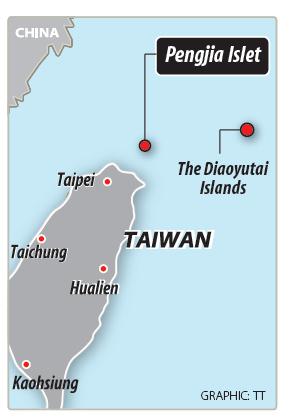
“President Ma hopes to visit every town and outlaying island during his term and have direct communication with local residents. The Presidential Office has arranged the trip to Pengjia Islet because President Ma has never visited the island,” he said.
Fan Chiang declined to reveal details of the trip or comment on the speculation that the trip was aimed at asserting the nation’s sovereignty over the Diaoyutais.
Disputes over the sovereignty of the Diaoyutais continue to escalate as Japanese media recently reported that the Japanese government is planning to buy some of the islands in the chain, known as the Senkakus in Japan, for ¥2 billion (US$25 million).
The Ministry of Foreign Affairs (MOFA) has called for a peaceful and rational solution to the dispute in response to Japan’s move. Meanwhile, Ma has reiterated his proposed East China Sea peace initiative, while insisting that the government will not make any compromises in handling the nation’s sovereignty issues.
Ma will take a helicopter to Pengjia. In addition to visiting the islet’s weather station and inspecting the coast guard deployment, he is expected to hear a report on the current situation of the Diaoyutai Islands.
According to the Chinese-language China Times, the helicopter will fly to the air defense identification zone as a gesture to demonstrate the nation’s determination in defending the sovereignty of the Diaoyutai Islands.
The foreign ministry declined to say if there was any political connotation with sovereignty over the Diaoyutai Islands related to the trip.
Ministry spokesman Steve Hsia (夏季昌) said he did not think any country was in a position to comment on the trip because Pengjia is the Republic of China’s territory.
However, Democratic Progressive Party Chairman Su Tseng-chang (蘇貞昌) described the planned visit as “self-aggrandizing.”
“Ma should have come up with positive and aggressive measures which contribute to regional stability, national security and sovereignty in the past,” Su said in response to a media inquiry.
“To inspect an islet unrelated to the Diaoyutais when the controversy is a hot topic in the media is only a self-aggrandizing and negative move,” he said.
Additional reporting by Shih Hsiu-chuan and Chris Wang

The National Chungshan Institute of Science and Technology yesterday showcased its locally developed variants of the Vision 60 robotic patrol dog, which it plans to deploy on the nation’s outlying territories in the South China Sea. The variants were produced under the Joint Lab project — created by the institute and domestic companies — and assembled with domestically produced motors, lenses and artificial intelligence (AI) systems alongside licensed tech from the US, Missile and Rocket Systems Research Division deputy director Jen Kuo-kang (任國光) told the media event at a military base in Taipei’s Dazhi (大直) area. Taiwan has built up its strengths

RIGHT DIRECTION: Taiwan’s efforts to prevent forced labor include a proposal to ‘fully prohibit’ employers from withholding workers’ documents, an official said Taiwan is to establish a mechanism to restrict imports of goods linked to forced labor, the Executive Yuan said yesterday, after the US proposed imposing additional tariffs on Taiwanese goods over labor concerns. “The Ministry of Labor and the Ministry of Economic Affairs are to establish an interministerial review procedure,” Executive Yuan spokesperson Michelle Lee (李慧芝) said at a news briefing in Taipei. “The government is to use the Foreign Trade Act [貿易法] as the legal basis to restrict imports of goods produced with forced labor” and bring its supply chain governance more in line with international standards on human rights, resilience

NOT IMMEDIATE: Taiwan has a chance to appeal the proposed 10 percent tariff before it starts, while other countries face a 12.5 percent tariff from the trade office Taiwan is among 60 economies determined by the US to have failed to impose or enforce a ban on the importation of goods produced with forced labor, according to a notice released on Tuesday by the Office of the US Trade Representative (USTR), which proposed imposing an additional 10 percent or more tariff on them. The USTR in a statement said that following an investigation, it had determined under Section 301 of the Trade Act of 1974 that the failure of the 60 economies to impose and effectively enforce a prohibition on the importation of goods produced with forced labor is

TIT-FOR-TAT: The US allegedly revoked the visa of a Chinese national working at Xinhua News Agency in the US in response to Beijing’s expulsion of Vivian Wang The Presidential Office yesterday condemned China for expelling a New York Times correspondent from Beijing following the newspaper’s interview with President William Lai (賴清德), saying the move highlighted Beijing’s suppression of press freedom and its threat to international news media. Taiwan has noted a series of recent incidents in which Beijing used similar tactics to “threaten and pressure international media outlets and journalists,” Presidential Office spokeswoman Karen Kuo (郭雅慧) said in a statement. “This concerns not only press freedom and freedom of expression, but also the safety of journalists, and Taiwan and relevant partners are paying close attention to the situation,” she


 RSS
RSS