


California has changed its policy and will now allow Taiwanese Americans to list their place of birth as “Taiwan” when they register to vote rather than “Taiwan, Province of China.”
The move was made less than a week after California Democratic Representative Howard Berman wrote a letter of protest.
“Today is a victory for the Taiwanese-American community in California,” Berman said.
“An unfortunate wrong was righted and when Taiwanese Americans register to vote in California. No longer will they have to list ‘Taiwan, Province of China’ as their country of birth,” he said.
California Secretary of State Debra Bowen had resisted making a change — despite protests from Taiwanese Americans — until Berman became involved.
In 1994, Berman was responsible for a bill that for the first time allowed Taiwanese Americans to list Taiwan rather than China as their birthplace when applying for a US passport.
“It is incontestable reality that Taiwan is not a province of China,” Formosan Association of Public Affairs (FAPA) president Mark Kao (高龍榮) said.
“If American citizens travel to Taiwan, the Chinese embassy is unable to issue a visa to Taiwan,” he said.
In other developments, a legislative draft calling on US President Barack Obama to resume normal diplomatic relations with Taiwan and “aggressively support” Taiwan’s full participation in the UN will be introduced in the US House of Representatives tomorrow.
The new resolution is being jointly co-sponsored by Republican Representative Michael McCaul and Democrat Representative Robert Andrews.
Washington cut diplomatic relations with Taiwan in 1979 when then-US president Jimmy Carter formally recognized China. Carter acted without consulting the US Congress or seeking its approval.
“Taiwan is a vibrant democracy and has been a steadfast ally of the United States and a compassionate member of the international community,” McCaul said.
“Obama should support a ‘one China, one Taiwan’ policy that gives legitimacy to our Taiwanese friends and partners,” he said.
“It is time the US government acknowledged Taiwan as the sovereign and independent state that it is,” Andrews said. “Throughout our history we have supported the right to self determination for sovereign peoples throughout the world. In the case of Taiwan, it is time to stand on that principle once again.”
Taiwan is one of only five countries in the world with which the US does not have diplomatic relations. The others are Bhutan, Cuba, Iran and North Korea.
While the resolution to resume normal diplomatic relations with Taiwan has no chance of passing at this time, it is considered important as a way to remind the US Congress of Taiwan’s status.
“There is enormous sympathy for the island,” FAPA official Coen Blaauw said. “A great many members of Congress are appalled that democratic Taiwan is linked with such bad actors as Cuba, Iran and North Korea.”
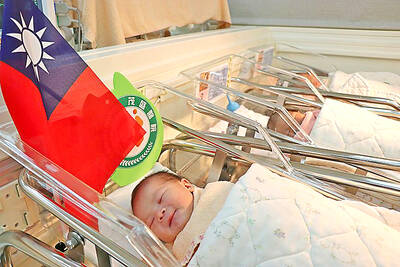
AGING: As of last month, people aged 65 or older accounted for 20.06 percent of the total population and the number of couples who got married fell by 18,685 from 2024 Taiwan has surpassed South Korea as the country least willing to have children, with an annual crude birthrate of 4.62 per 1,000 people, Ministry of the Interior data showed yesterday. The nation was previously ranked the second-lowest country in terms of total fertility rate, or the average number of children a woman has in her lifetime. However, South Korea’s fertility rate began to recover from 2023, with total fertility rate rising from 0.72 and estimated to reach 0.82 to 0.85 by last year, and the crude birthrate projected at 6.7 per 1,000 people. Japan’s crude birthrate was projected to fall below six,
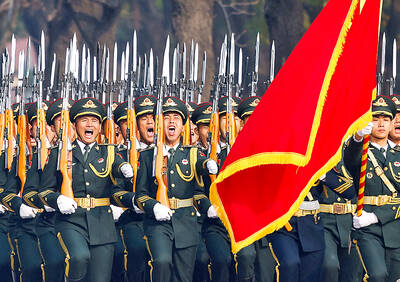
Conflict with Taiwan could leave China with “massive economic disruption, catastrophic military losses, significant social unrest, and devastating sanctions,” a US think tank said in a report released on Monday. The German Marshall Fund released a report titled If China Attacks Taiwan: The Consequences for China of “Minor Conflict” and “Major War” Scenarios. The report details the “massive” economic, military, social and international costs to China in the event of a minor conflict or major war with Taiwan, estimating that the Chinese People’s Liberation Army (PLA) could sustain losses of more than half of its active-duty ground forces, including 100,000 troops. Understanding Chinese
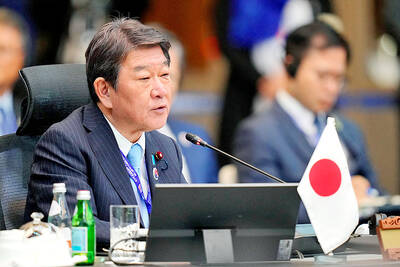
SELF-DEFENSE: Tokyo has accelerated its spending goal and its defense minister said the nation needs to discuss whether it should develop nuclear-powered submarines China is ramping up objections to what it sees as Japan’s desire to acquire nuclear weapons, despite Tokyo’s longstanding renunciation of such arms, deepening another fissure in the two neighbors’ increasingly tense ties. In what appears to be a concerted effort, China’s foreign and defense ministries issued statements on Thursday condemning alleged remilitarism efforts by Tokyo. The remarks came as two of the country’s top think tanks jointly issued a 29-page report framing actions by “right-wing forces” in Japan as posing a “serious threat” to world peace. While that report did not define “right-wing forces,” the Chinese Ministry of Foreign Affairs was
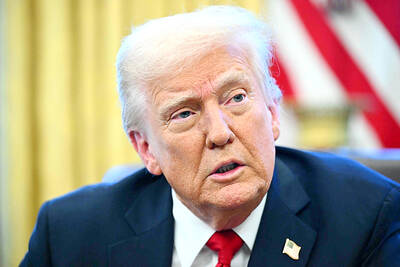
US President Donald Trump in an interview with the New York Times published on Thursday said that “it’s up to” Chinese President Xi Jinping (習近平) what China does on Taiwan, but that he would be “very unhappy” with a change in the “status quo.” “He [Xi] considers it to be a part of China, and that’s up to him what he’s going to be doing, but I’ve expressed to him that I would be very unhappy if he did that, and I don’t think he’ll do that. I hope he doesn’t do that,” Trump said. Trump made the comments in the context


 RSS
RSS