


Following overnight protests that descended into violent clashes between demonstrators and police, the Taipei City Government yesterday evicted the owners of two buildings in Shilin District (士林), demolishing their homes to make way for an urban renewal project.
The project, under which a construction firm plans to turn an old residential complex for 38 households into a 15-story high-rise apartment complex, was stalled for three years because of opposition from a family surnamed Wang (王), who had lived in two two-story apartment buildings in the area for more than a decade.
As the city government prepared to demolish the two houses, more than 300 advocates of the Wang family rushed to the site late on Tuesday evening to show their opposition to the project, blocking the entrance to the houses, with some even chaining themselves in front of the buildings to stop the demolition.
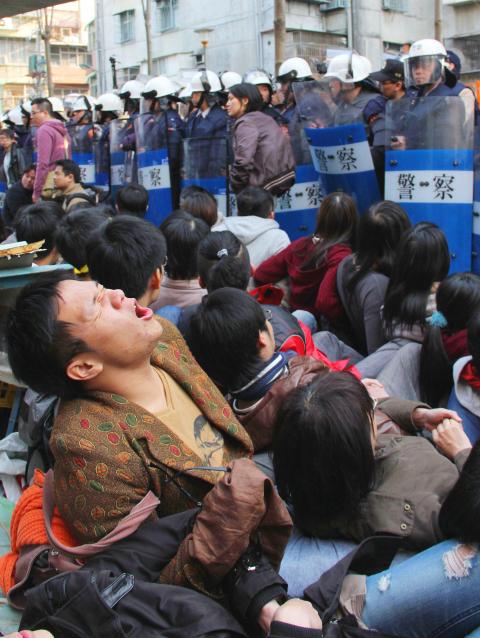
Photo: CNA
More than 1,000 police officers arrived in the morning with barricades and shields.
Met with shouts of “Taipei City Government has no right” and “Protect land justice,” the police cut the protesters’ chains and dragged several away to clear the site for demolition, while evacuating members of the Wang family.
About 10 members of the Wang family left their homes later in the morning, accusing the city government of abusing its authority by tearing down their houses and vowing to continue the fight for freedom of abode.
“We’ve lived in these homes for decades and we do not want to move,” said Wang Yao-teh (王耀德), a family member.
“It’s not about the money and we did not demand NT$200 million [US$6.7 million] from the construction firm. We never wanted to participate in the urban renewal project from the very beginning,” he said.
Wang Yao-teh and the protesters said that the city government’s razing of their homes was illegal and unconstitutional, as the Constitution states that people’s rights to own a property and move freely should be protected.
As the demolition crew started tearing down the houses, about a dozen protesters stood on the rooftops of the buildings, displaying protest signs and chanting slogans denouncing the move.
“Everyone should voice their support for the Wang family and oppose the city government’s illegal action because anyone could be the next victim of an urban renewal project,” a protester surnamed Lee (李) said.
Although the family has refused to give up its land, the construction firm has already received the consent of more than 75 percent of the landowners on the block, and according to the Urban Renewal Act (都市更新條例), the firm can ask the city government to help it evict the Wangs and demolish their home.
The Wangs have done everything they could to prevent their homes from being demolished, including suggesting that their homes be excluded from the project.
Despite the opposition, the city government completed the demolition in the afternoon, which allows the construction firm to proceed with construction.
Taipei Mayor Hau Lung-bin (郝龍斌) yesterday said the project was approved three years ago with the consent of the majority of the landowners, and it was the city government’s responsibility to enforce regulations and protect the rights of the majority.
“Only 5 percent of the landowners are against the project and 95 percent of the landowners have been waiting for more than three years in hopes of moving into a new home,” Hau said.
“It is our responsibility to project the rights of the majority of the landowners. We cannot sacrifice the rights of the majority of the landowners in this case,” the mayor said.

The National Chungshan Institute of Science and Technology yesterday showcased its locally developed variants of the Vision 60 robotic patrol dog, which it plans to deploy on the nation’s outlying territories in the South China Sea. The variants were produced under the Joint Lab project — created by the institute and domestic companies — and assembled with domestically produced motors, lenses and artificial intelligence (AI) systems alongside licensed tech from the US, Missile and Rocket Systems Research Division deputy director Jen Kuo-kang (任國光) told the media event at a military base in Taipei’s Dazhi (大直) area. Taiwan has built up its strengths

RIGHT DIRECTION: Taiwan’s efforts to prevent forced labor include a proposal to ‘fully prohibit’ employers from withholding workers’ documents, an official said Taiwan is to establish a mechanism to restrict imports of goods linked to forced labor, the Executive Yuan said yesterday, after the US proposed imposing additional tariffs on Taiwanese goods over labor concerns. “The Ministry of Labor and the Ministry of Economic Affairs are to establish an interministerial review procedure,” Executive Yuan spokesperson Michelle Lee (李慧芝) said at a news briefing in Taipei. “The government is to use the Foreign Trade Act [貿易法] as the legal basis to restrict imports of goods produced with forced labor” and bring its supply chain governance more in line with international standards on human rights, resilience

NOT IMMEDIATE: Taiwan has a chance to appeal the proposed 10 percent tariff before it starts, while other countries face a 12.5 percent tariff from the trade office Taiwan is among 60 economies determined by the US to have failed to impose or enforce a ban on the importation of goods produced with forced labor, according to a notice released on Tuesday by the Office of the US Trade Representative (USTR), which proposed imposing an additional 10 percent or more tariff on them. The USTR in a statement said that following an investigation, it had determined under Section 301 of the Trade Act of 1974 that the failure of the 60 economies to impose and effectively enforce a prohibition on the importation of goods produced with forced labor is

TIT-FOR-TAT: The US allegedly revoked the visa of a Chinese national working at Xinhua News Agency in the US in response to Beijing’s expulsion of Vivian Wang The Presidential Office yesterday condemned China for expelling a New York Times correspondent from Beijing following the newspaper’s interview with President William Lai (賴清德), saying the move highlighted Beijing’s suppression of press freedom and its threat to international news media. Taiwan has noted a series of recent incidents in which Beijing used similar tactics to “threaten and pressure international media outlets and journalists,” Presidential Office spokeswoman Karen Kuo (郭雅慧) said in a statement. “This concerns not only press freedom and freedom of expression, but also the safety of journalists, and Taiwan and relevant partners are paying close attention to the situation,” she


 RSS
RSS