


Lashing out at an overnight government decision to conditionally lift a ban on beef containing residue of the leanness-enhancing animal feed additive ractopamine, opposition lawmakers yesterday threatened to put the Cabinet to a vote of no-confidence.
In a press release issued late on Monday, the Executive Yuan said it favored conditionally lifting a ban on US beef products that contain ractopamine.
The decision, which came after Premier Sean Chen (陳冲) pledged on Feb. 24 to keep the ban in place at least through the current legislative session, drew heavy criticism from opposition parties.
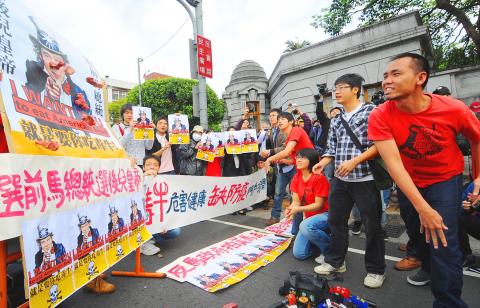
Photo: Wang Min-wei, Taipei Times
Both the Democratic Progressive Party (DPP) and the Taiwan Solidarity Union (TSU) caucuses said the administration of President Ma Ying-jeou (馬英九) was ignoring public opinion and -professional assessments.
DPP caucus convener Ker Chien-ming (柯建銘) told a press conference that Ma’s hasty decision backed allegations that he promised the US before the Jan. 14 presidential election that he would drop the ban in exchange for US support for his re-election bid. Ker said Ma was lying to the public when he said the government had “neither a timetable nor predetermined positions” on the matter.
Ker urged Chinese Nationalist Party (KMT) lawmakers, who supported the ban, to propose legal amendments to keep the ban in place and to stand up to pressure from the administration.
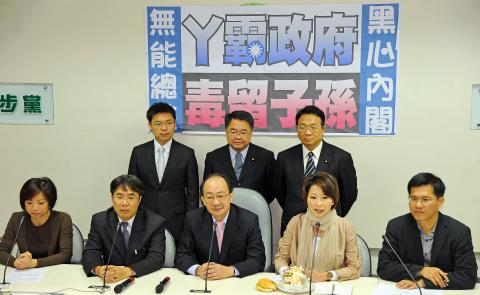
Photo: Liu Hsin-de, Taipei Times
Several DPP lawmakers said they did not rule out proposing a vote of no-confidence regarding the Cabinet.
The timing of the announcement — on the eve of a visit by a US delegation — demonstrates the connection between lifting the ban and US pressure, DPP Legislator Chao Tien-lin (趙天麟) said, adding that he would support a proposal to hold a vote of no--confidence on the Chen Cabinet.
Given Ma’s poor track record in keeping its promises, DPP Legislator Chen Ting-fei (陳亭妃) said a conditional lifting of the ban could easily be turned into -complete abolition, which would allow US pork imports as well. In addition, Chen Ting-fei questioned the Ma administration’s ability to enforce mandatory labeling of US beef products.
DPP spokesperson Lin Chun-hsien (林俊憲) said the party would combine the clout of DPP lawmakers and DPP-governed cities and counties to keep the ban in place.
Although DPP Legislator Huang Wei-cher (黃偉哲) opposed proposing a vote of no-confidence, saying it would incite further division between the pan-green and the pan-blue camps, another DPP official, who wished to remain anonymous because he was not authorized to speak on the matter, said the proposal for a vote of no-confidence “is a political gesture that the DPP must take.”
“Everyone knows that [the proposal] is not going to clear the legislative floor because the pan-green camp is still in the minority,” he said. “However, we need to do something as a countermeasure.”
The People First Party (PFP) caucus would support an initiative to hold a vote of no-confidence, PFP caucus whip Thomas Lee (李桐豪) said, adding that the Ma government’s decision “showed disrespect to opposition parties” and “damaged the harmonious relations between the ruling and opposition parties.”
Lee said the the PFP caucus would consider joining forces with the DPP and the TSU caucuses to boycott deliberations of government-initiated bills or to possibly initiate an impeachment of Sean Chen unless the Executive Yuan apologizes for the policy shift and explains why it decided lift the ban.
TSU Chairman Huang Kun-huei (黃昆輝) endorsed the actions of his party’s three lawmakers, who yesterday launched a boycott in the legislature of an interpolation session of Chen, saying the Executive Yuan’s decision showed contempt for the legislature.
KMT lawmakers are divided on the Cabinet’s announcement, with some throwing support behind the Executive Yuan, while others are still remaining firm in their opposition to lifting the ban.
Before the Executive Yuan’s announcement on Monday night that it would seek to conditionally lift the ban, KMT Secretary-General Lin Join-sane (林中森) and Cabinet officials conducted negotiations with KMT lawmakers during the day, but failed to convince those who opposed lifting the ban to soften their positions.
KMT caucus whip Lin Hung-chih (林鴻池) said the issue should be dealt with based on professional considerations.
The KMT caucus was of the opinion that a safety standard allowing for ractopamine residue in US beef should be established, but “we will not sacrifice public health in determining the standard in exchange for diplomatic and economic benefits,” Lin said.
KMT Legislator Yang Li-huan (楊麗環), who has proposed including a ban on the use of ractopamine in the Act Governing Food Sanitation (食品衛生管理法), said she did not agree with the Executive Yuan’s proposal to conditionally lift the ban.
Yang was among an estimated 30 KMT lawmakers who called for an amendment to the act to regulate the use of ractopamine.
“Wasn’t it funny that we were asked to have a meeting [on Monday night] to discuss the issue, but we were then told that [the government] had decided to lift the ban?” KMT Legislator Lu Hsueh-chang (呂學樟) said.
KMT Legislator Chang Chia-chun (張嘉郡) said she would join a scheduled protest by pig farmers tomorrow to voice opposition to lifting the ban.
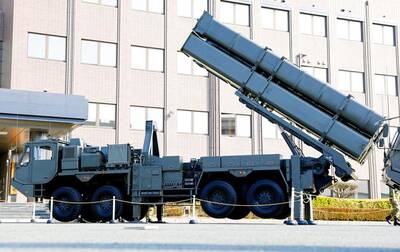
Japan has deployed long-range missiles in a southwestern region near China, the Japanese defense minister said yesterday, at a time when ties with Beijing are at their lowest in recent years. The missiles were installed in Kumamoto in the southern region of Kyushu, as Japan is attempting to shore up its military capacity as China steps up naval activity in the East China Sea. “Standoff defense capabilities enable us to counter the threat of enemy forces attempting to invade our country ... while ensuring the safety of our personnel,” Japanese Minister of Defense Shinjiro Koizumi said. “This is an extremely important initiative for
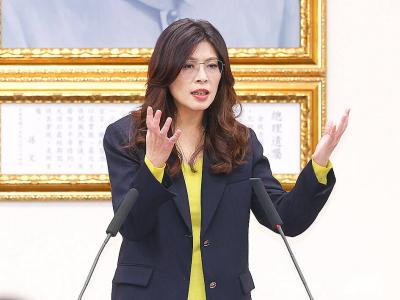
Chinese Nationalist Party (KMT) Chairwoman Cheng Li-wun (鄭麗文) today accepted an invitation from Chinese President Xi Jinping (習近平) to lead a delegation to China next month, saying she hopes to promote the peaceful development of cross-strait relations and bring stability to the Taiwan Strait. “I am grateful and happy to accept this invitation,” Cheng said in a statement from the KMT chairperson’s office. Cheng said she hopes both sides can work together to promote the peaceful development of cross-strait relations, enhance exchange and cooperation, bring stability to the Taiwan Strait and improve people’s livelihoods. At today's news conference, Cheng said any efforts to

MORE POPULAR: Taiwan Pass sales increased by 59 percent during the first quarter compared with the same period last year, the Tourism Administration said The Tourism Administration yesterday said that it has streamlined the Taiwan Pass, with two versions available for purchase beginning today. The tourism agency has made the pass available to international tourists since 2024, allowing them to access the high-speed rail, Taiwan Railway Corp services, four MRT systems and four Taiwan Tourist Shuttles. Previously, five types of Taiwan Pass were available, but some tourists have said that the offerings were too complicated. The agency said only two types of Taiwan Pass would be available, starting from a three-day pass with the high-speed rail and a three-day pass with Taiwan Railway Corp. The former costs NT$2,800

The nation’s fastest supercomputer, Nano 4 (晶創26), is scheduled to be launched in the third quarter, and would be used to train large language models in finance and national defense sectors, the National Center for High-Performance Computing (NCHC) said. The supercomputer, which would operate at about 86.05 petaflops, is being tested at a new cloud computing center in the Southern Taiwan Science Park in Tainan. The exterior of the server cabinet features chip circuitry patterns overlaid with a map of Taiwan, highlighting the nation’s central position in the semiconductor industry. The center also houses Taiwania 2, Taiwania 3, Forerunner 1 and


 RSS
RSS