


Former premier Hau Pei-tsun (郝柏村) caused a stir yesterday when he criticized the content of high school history textbooks over the country’s name and the 228 Incident, which he said jeopardized the nation’s founding spirit and had implications for independence.
In an op-ed in the Chinese-language United Daily News yesterday, the retired general — Taipei Mayor Hau Lung-bin’s (郝龍斌) father — said he was displeased after reading his granddaughter’s junior-high school history textbook, which refers to the country as the “Taiwan region” and includes Taiwan proper, Kinmen, Matsu and islands in the South China Sea as its territories.
Hau Pei-tsun said the islands were territories of the Republic of China (ROC) and that “Taiwan region” was not the official name of the country under the ROC Constitution.
In the op-ed, he questioned why a high-school history textbook continued to use a curriculum that was designed during the Democratic Progressive Party (DPP) administration, which he said was “too Taiwan-centric.”
The textbook’s description of the 228 Incident, which says Chinese Nationalist Party (KMT) troops killed more than 10,000 people in the uprising, was incorrect, he said, because a panel formed while he was premier in 1990 concluded that about 500 people were killed or went missing.
Hau Pei-tsun said the number increased to about 1,000 when he later lowered the threshold of compensation for victims’ families.
The content of the textbooks “jeopardizes the founding spirit of the ROC and has strong political undertones of the ideology of ‘one country on each side [of the Taiwan Strait].’ It also implies that Taiwan is not China and that Taiwanese are not Chinese,” Hau Pei-tsun wrote.
Pan Wen-chung (潘文忠), deputy director of the National Academy for Educational Research, which is in charge of establishing curriculum guidelines, said the institution stipulates that all textbooks should be written in accordance with the law, including the ROC Constitution and the Act Governing Relations Between the People Of the Taiwan Area and the Mainland Area (臺灣地區與大陸地區人民關係條例).
The text relating to the 228 Incident is based on research conducted by the Executive Yuan, Pan said.
“If sovereignty is involved, textbooks refer to the country as ‘the ROC.’ ‘Taiwan region’ is used to describe a geographic area,” Pan said in summing up the guidelines, adding that a meeting would be convened in two weeks to review high-school history textbooks.
Hau Pei-tsun is no stranger to history-related controversies.
In November last year, he said that martial law was necessary for Taiwan to defend itself against communists in the 1940s.
The DPP reacted strongly to the op-ed.
As a former premier and vice chairman of the KMT, Hau Pei-tsun’s remarks were “highly inappropriate” and a “distortion of history,” DPP spokesperson Lin Chun-hsien (林俊憲) said.
“We can only hope that the op-ed was not a prelude of a fresh round of attempts by the KMT to distort the true history of the 228 Incident,” Lin said.
Lin said the comment risked “tearing up the wound” after the long struggle by Taiwanese to piece together the facts behind the incident.
Historians reached their conclusions on the massacre after careful professional research and Hau Pei-tsun’s comments are unacceptable to the victims’ families, Lin said.
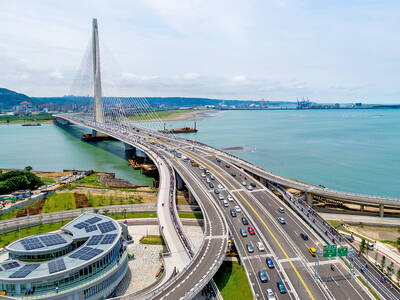
The Ministry of Transportation and Communications yesterday inaugurated the Danjiang Bridge across the Tamsui River in New Taipei City, saying that the structure would be an architectural icon and traffic artery for Taiwan. Feted as a major engineering achievement, the Danjiang Bridge is 920m long, 211m tall at the top of its pylon, and is the longest single-pylon asymmetric cable-stayed bridge in the world, the government’s Web site for the structure said. It was designed by late Iraqi-British architect Zaha Hadid. The structure, with a maximum deck of 70m, accommodates road and light rail traffic, and affords a 200m navigation channel for boats,
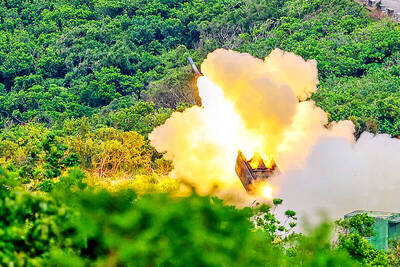
PRECISION STRIKES: The most significant reason to deploy HIMARS to outlying islands is to establish a ‘dead zone’ that the PLA would not dare enter, a source said A High Mobility Artillery Rocket System (HIMARS) would be deployed to Penghu County and Dongyin Island (東引) in Lienchiang County (Matsu) to force the Chinese military to retreat at least 100km from the coastline, a military source said yesterday. Taiwan has been procuring HIMARS and Army Tactical Missile Systems (ATACMS) from the US in batches. Once all batches have been delivered, Taiwan would possess 111 HIMARS units and 504 ATACMS, which have a range of 300km. Considering that “offense is the best defense,” the military plans to forward-deploy the systems to outlying islands such as Penghu and Dongyin so that
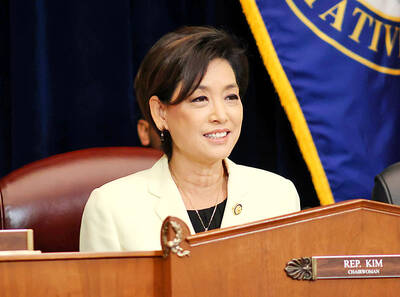
‘CLEAR MESSAGE’: The bill would set up an interagency ‘tiger team’ to review sanctions tools and other economic options to help deter any Chinese aggression toward Taiwan US Representative Young Kim has introduced a bill to deter Chinese aggression against Taiwan, calling for an interagency “tiger team” to preplan coordinated sanctions and economic measures in response to possible Chinese military or political action against Taiwan. “[Chinese President] Xi Jinping [習近平] has directed the People’s Liberation Army to be ready to invade Taiwan by 2027. China has a plan. America should have one too,” Kim said in a news release on Thursday last week. She introduced the “Deter PRC [People’s Republic of China] aggression against Taiwan act” to “ensure the US has a coordinated sanctions strategy ready should

TAIWAN ISSUE: US treasury secretary Scott Bessent said on the first day of meetings that ‘it wouldn’t be a US-China summit without the Taiwan issue coming up’ There were no surprises on the first day of the summit between US President Donald Trump and Chinese President Xi Jinping (習近平), the Mainland Affairs Council (MAC) said yesterday, as the government reiterated that cross-strait stability is crucial to the Asia-Pacific region, as well as the world. As the two presidents met for a highly anticipated summit yesterday, Chinese state media reported that Xi warned Trump that missteps regarding Taiwan could push their two countries into “conflict.” Trump arrived in China with accolades for his host, calling Xi a “great leader” and “friend,” and extending an invitation to visit the White House


 RSS
RSS