


Chang Chih-yang (張志揚), the primary suspect in the murder of two female Taiwanese students in Tokyo on Thursday, committed suicide in Nagoya, Aichi Prefecture, Japanese police confirmed last night.
Chang killed himself by slashing his neck with a knife, the Metropolitan Police Department told a press conference at 9pm in Tokyo.
Police said Chang died of blood loss as he was being rushed to hospital.
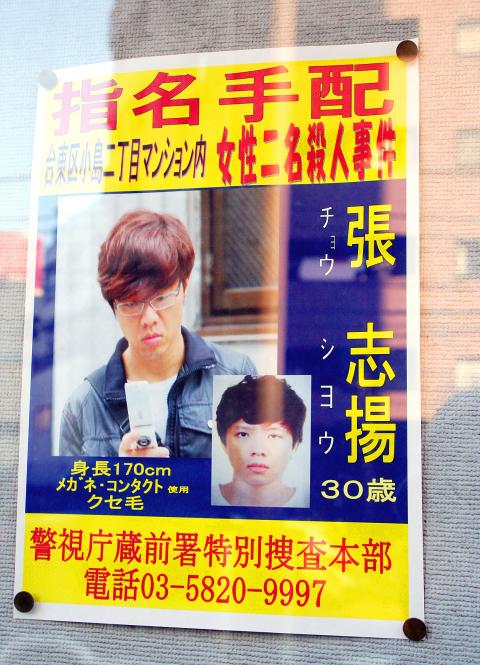
Photo: CNA
Chang was uninjured when he was arrested by police officers and taken in a police car to a nearby station for questioning.
After getting out of the car, Chang took out a concealed knife and slashed his throat, police said, not commenting on why the suspect had not been searched and was not handcuffed.
On Sunday, the 30-year-old Chang was put on the wanted list after police obtained a warrant for his arrest in connection with the stabbing death of 23-year-old Lin Chih-ying (林芷瀅) and 25-year-old Julia Chu (朱立婕) in an apartment building in Tokyo’s Taito Ward, which is used by students at the Intercultural Institute of Japan’s language school.
The two women were found covered in blood on Thursday morning, one inside her bedroom and the other in the doorway. One of the women died at the scene, while the other died a short time later after being rushed to a hospital.
Police said Chang was spotted in security camera footage near the murder site about one hour prior to the estimated time of the attack, adding that they also made a match between a bloodstain at the crime scene and blood found in his room.
Chang, who is said to have been fond of Lin, reportedly told an acquaintance that she had been acting coldly toward him, police said earlier yesterday.
The Metropolitan Police Department enhanced its personnel deployment in the Kansai area to track down Chang’s location because he had told his roommates that he had gone to Osaka and his cellphone signal had been detected in Nagoya.
Chang’s father, who said last night that he had learned of his son’s death from television reports, is expected to head to Japan today.
Additional reporting by Staff Writer
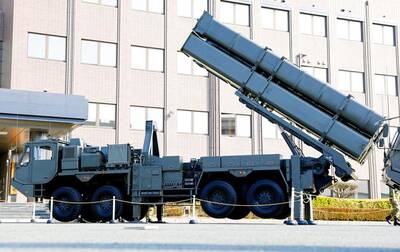
Japan has deployed long-range missiles in a southwestern region near China, the Japanese defense minister said yesterday, at a time when ties with Beijing are at their lowest in recent years. The missiles were installed in Kumamoto in the southern region of Kyushu, as Japan is attempting to shore up its military capacity as China steps up naval activity in the East China Sea. “Standoff defense capabilities enable us to counter the threat of enemy forces attempting to invade our country ... while ensuring the safety of our personnel,” Japanese Minister of Defense Shinjiro Koizumi said. “This is an extremely important initiative for
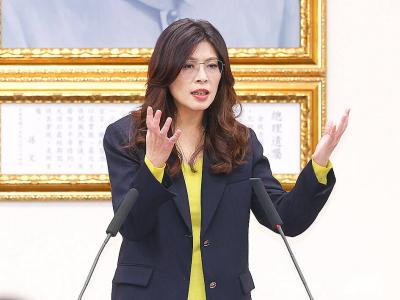
Chinese Nationalist Party (KMT) Chairwoman Cheng Li-wun (鄭麗文) today accepted an invitation from Chinese President Xi Jinping (習近平) to lead a delegation to China next month, saying she hopes to promote the peaceful development of cross-strait relations and bring stability to the Taiwan Strait. “I am grateful and happy to accept this invitation,” Cheng said in a statement from the KMT chairperson’s office. Cheng said she hopes both sides can work together to promote the peaceful development of cross-strait relations, enhance exchange and cooperation, bring stability to the Taiwan Strait and improve people’s livelihoods. At today's news conference, Cheng said any efforts to
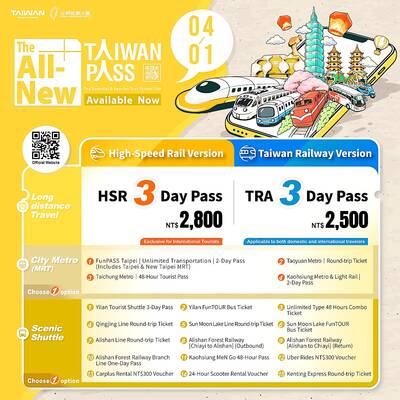
MORE POPULAR: Taiwan Pass sales increased by 59 percent during the first quarter compared with the same period last year, the Tourism Administration said The Tourism Administration yesterday said that it has streamlined the Taiwan Pass, with two versions available for purchase beginning today. The tourism agency has made the pass available to international tourists since 2024, allowing them to access the high-speed rail, Taiwan Railway Corp services, four MRT systems and four Taiwan Tourist Shuttles. Previously, five types of Taiwan Pass were available, but some tourists have said that the offerings were too complicated. The agency said only two types of Taiwan Pass would be available, starting from a three-day pass with the high-speed rail and a three-day pass with Taiwan Railway Corp. The former costs NT$2,800

The nation’s fastest supercomputer, Nano 4 (晶創26), is scheduled to be launched in the third quarter, and would be used to train large language models in finance and national defense sectors, the National Center for High-Performance Computing (NCHC) said. The supercomputer, which would operate at about 86.05 petaflops, is being tested at a new cloud computing center in the Southern Taiwan Science Park in Tainan. The exterior of the server cabinet features chip circuitry patterns overlaid with a map of Taiwan, highlighting the nation’s central position in the semiconductor industry. The center also houses Taiwania 2, Taiwania 3, Forerunner 1 and


 RSS
RSS