


The Chinese Nationalist Party (KMT) yesterday blocked a proposal by the Democratic Progressive Party (DPP) to write into the Referendum Act (公民投票法) that holding political talks with China would require referendums before and after all negotiations.
Holding a majority at the legislature’s Procedure Committee, KMT lawmakers voted not to put the proposed amendment to the Referendum Act and 66 other bills onto the legislative agenda for the plenary sessions on Friday and Tuesday next week.
That the DPP proposed revising the Referendum Act at this moment was “nothing but an election tactic,” KMT Legislator Lin Yi-shih (林益世) said. “Although the amendment is well-intended, the content was carelessly written. The legislature can’t pass a bill like this.”
The DPP proposed the amendment after President Ma Ying-jeou (馬英九) pledged that he would not sign a peace agreement with China if it failed to pass a referendum.
Lin accused the DPP of applying double standards, saying that the DPP did not ask for the inclusion of such articles in the Referendum Act when DPP Chairperson Tsai Ing-wen (蔡英文) proposed a cross-strait peace agreement when she was the head of the Mainland Affairs Council, but found fault with Ma when he proposed a similar idea.
“The proposal to amend the Referendum Act is a phony issue. The DPP’s main purpose is to paralyze the legislature so that it can accuse President Ma of being incompetent,” KMT caucus whip Chao Li-yun (趙麗雲) said.
DPP caucus whip Wong Chin-chu (翁金珠) said she was disappointed and upset by the boycott. She slammed the KMT veto, saying it proved that Ma’s proposed cross-strait peace accord was nothing more than a campaign gambit.
Ma earlier this month said “cautious consideration” would be given to signing a cross-strait peace pact within a decade, under several preconditions.
Tsai said she was sorry to learn that the proposal had been blocked by the KMT.
“However, if President Ma is sincere in fulfilling his commitment of allowing the 23 million Taiwanese to determine their future through referendums, he should work toward the institutionalization of referendums,” Tsai said.
With the KMT’s blocking of the proposal, Taiwanese have witnessed the inconsistency of Ma’s position on referendums, she said, adding that the DPP would continue to promote the institutionalization of referendums.
With references to the Republic of China (ROC) and the People’s Republic of China (PRC) in the text of its proposal, the DPP tried to highlight the state-to state status of relations across the Taiwan Strait, DPP Legislator Tsai Huang-liang (蔡煌瑯) said after the proposal was blocked.
The KMT move showed that its determination to safeguard the ROC’s sovereignty was questionable, he said.
The DPP still hopes the KMT will agree to a bilateral consultation on the legislation by Friday, after Tsai Ing-wen proposed on Friday last week that talks on the matter be held within a week.
In the press conference, Tsai Huang-liang said Ma’s statement on Monday that negotiations for a peace agreement with China would need “10 guarantees” and be conducted “under the framework of the ROC Constitution” and promote bilateral engagement based on the so-called “1992 consensus” were “contradictory” because the Constitution does not recognize the PRC’s sovereignty.
Ma referred to the 10 guarantees as “one framework, two prerequisites, three principles and four assurances.”
The first guarantee is maintaining no unification, no independence and no use of force under the framework of the ROC Constitution, while promoting cross-strait exchanges based on the “1992 consensus,” which allows both sides to recognize “one China,” but differ on its precise political definition.
Negotiating a cross-strait peace accord would only be possible when two prerequisites are met — a high degree of domestic consensus and mutual trust between Taipei and Beijing, he said.
It would also have to meet the true needs of the country, have strong public support and be supervised by the legislature, Ma said.
In addition, talks on a peace agreement would have to safeguard the ROC’s sovereignty, Taiwan’s safety and prosperity, ethnic harmony and cross-strait peace, as well as a sustainable environment and just society, he said.
Meanwhile, former vice president Annette Lu (呂秀蓮) told reporters that any cross-strait peace agreement should involve a third country so that the agreement would be an international agreement, rather than one only between Taiwan and China.
Additional reporting by CNA
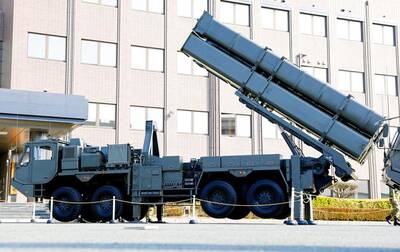
Japan has deployed long-range missiles in a southwestern region near China, the Japanese defense minister said yesterday, at a time when ties with Beijing are at their lowest in recent years. The missiles were installed in Kumamoto in the southern region of Kyushu, as Japan is attempting to shore up its military capacity as China steps up naval activity in the East China Sea. “Standoff defense capabilities enable us to counter the threat of enemy forces attempting to invade our country ... while ensuring the safety of our personnel,” Japanese Minister of Defense Shinjiro Koizumi said. “This is an extremely important initiative for
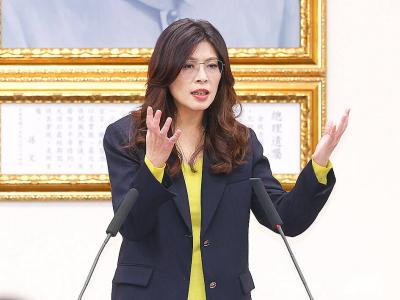
Chinese Nationalist Party (KMT) Chairwoman Cheng Li-wun (鄭麗文) today accepted an invitation from Chinese President Xi Jinping (習近平) to lead a delegation to China next month, saying she hopes to promote the peaceful development of cross-strait relations and bring stability to the Taiwan Strait. “I am grateful and happy to accept this invitation,” Cheng said in a statement from the KMT chairperson’s office. Cheng said she hopes both sides can work together to promote the peaceful development of cross-strait relations, enhance exchange and cooperation, bring stability to the Taiwan Strait and improve people’s livelihoods. At today's news conference, Cheng said any efforts to
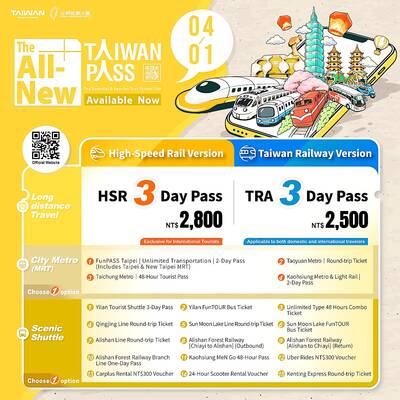
MORE POPULAR: Taiwan Pass sales increased by 59 percent during the first quarter compared with the same period last year, the Tourism Administration said The Tourism Administration yesterday said that it has streamlined the Taiwan Pass, with two versions available for purchase beginning today. The tourism agency has made the pass available to international tourists since 2024, allowing them to access the high-speed rail, Taiwan Railway Corp services, four MRT systems and four Taiwan Tourist Shuttles. Previously, five types of Taiwan Pass were available, but some tourists have said that the offerings were too complicated. The agency said only two types of Taiwan Pass would be available, starting from a three-day pass with the high-speed rail and a three-day pass with Taiwan Railway Corp. The former costs NT$2,800

The nation’s fastest supercomputer, Nano 4 (晶創26), is scheduled to be launched in the third quarter, and would be used to train large language models in finance and national defense sectors, the National Center for High-Performance Computing (NCHC) said. The supercomputer, which would operate at about 86.05 petaflops, is being tested at a new cloud computing center in the Southern Taiwan Science Park in Tainan. The exterior of the server cabinet features chip circuitry patterns overlaid with a map of Taiwan, highlighting the nation’s central position in the semiconductor industry. The center also houses Taiwania 2, Taiwania 3, Forerunner 1 and


 RSS
RSS