


Saudi Arabia’s Crown Prince Sultan bin Abdulaziz Al Saud died at dawn yesterday, the country’s royal court said in a statement carried by state media.
Sultan, whose age was officially given as 80 and who died in New York of colon cancer early yesterday Saudi time, had been heir to the throne of the world’s top oil exporter since 2005, but was a central figure in Saudi decision-making since becoming defense minister in 1962.
“With deep sorrow and sadness the Custodian of the Two Holy Mosques King Abdullah bin Abdulaziz mourns the death of his brother and his Crown Prince Sultan ... who died at dawn this morning Saturday outside the kingdom following an illness,” the statement carried on state news agency SPA and state television said.
Sultan’s health had declined in recent years and he spent long periods outside the kingdom for medical treatment. A 2009 US diplomatic cable released by WikiLeaks described him as “to all intents and purposes incapacitated.”
King Abdullah is now expected to call to session an untested “Allegiance Council” to appoint his new heir, widely expected to be Prince Nayef, the veteran interior minister.
Set up in 2006 soon after Abdullah became king, the Allegiance Council is tasked with voting to approve the monarch’s choice of crown prince or nominating its own choice instead.
The Allegiance Council consists of a representative from each of the 34 branches of the Al Saud ruling family who were born to Saudi Arabia’s founder, King Abdulaziz Ibn Saud.
Because some members are thought to be traveling, the council might not be able to convene to approve a new crown prince for some days.
Previously, the succession was decided only by the king and a small coterie of top princes.
“The succession will be orderly,” said Asaad al-Shamlan, a professor of political science in Riyadh. “The point of reference will be the ruling of the Allegiance Council. It seems to me most likely Nayef will be chosen. If he becomes crown prince, I don’t expect much immediate change.”
Prince Nayef has been interior minister since 1975 and was appointed second deputy prime minister in 2009, a position usually given to the man considered third in line to rule.
Thought to be more conservative than either King Abdullah or Prince Sultan, Prince Nayef is in his late 70s and has managed the kingdom’s day-to-day affairs during absences of both the king and crown prince.
Saudi television broke its schedules early yesterday to broadcast Koranic verses accompanied by footage of the Kaaba in Mecca, Islam’s holiest site.
Funeral services will be held in the Saudi capital, Riyadh, on Tuesday, SPA said.
King Abdullah is in his late 80s and underwent back surgery earlier this month, but has been pictured since then in apparently good health.
The king was absent for three months late last year while he underwent treatment for a herniated disc that caused blood to accumulate around his spine.
Unlike in European monarchies, the line of succession does not move directly from father to eldest son, but has moved down a line of brothers born to the kingdom’s founder Ibn Saud, who died in 1953.
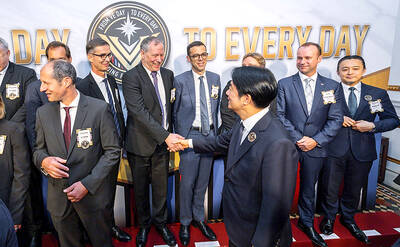
DEFENDING DEMOCRACY: Taiwan shares the same values as those that fought in WWII, and nations must unite to halt the expansion of a new authoritarian bloc, Lai said The government yesterday held a commemoration ceremony for Victory in Europe (V-E) Day, joining the rest of the world for the first time to mark the anniversary of the end of World War II in Europe. Taiwan honoring V-E Day signifies “our growing connections with the international community,” President William Lai (賴清德) said at a reception in Taipei on the 80th anniversary of V-E Day. One of the major lessons of World War II is that “authoritarianism and aggression lead only to slaughter, tragedy and greater inequality,” Lai said. Even more importantly, the war also taught people that “those who cherish peace cannot

Taiwanese Olympic badminton men’s doubles gold medalist Wang Chi-lin (王齊麟) and his new partner, Chiu Hsiang-chieh (邱相榤), clinched the men’s doubles title at the Yonex Taipei Open yesterday, becoming the second Taiwanese team to win a title in the tournament. Ranked 19th in the world, the Taiwanese duo defeated Kang Min-hyuk and Ki Dong-ju of South Korea 21-18, 21-15 in a pulsating 43-minute final to clinch their first doubles title after teaming up last year. Wang, the men’s doubles gold medalist at the 2020 and 2024 Olympics, partnered with Chiu in August last year after the retirement of his teammate Lee Yang
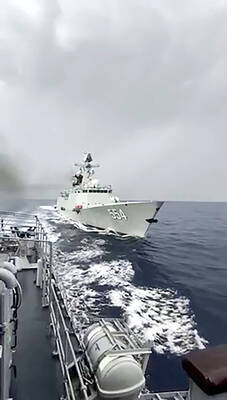
The Philippines yesterday criticized a “high-risk” maneuver by a Chinese vessel near the disputed Scarborough Shoal (Huangyan Island, 黃岩島) in a rare incident involving warships from the two navies. The Scarborough Shoal — a triangular chain of reefs and rocks in the contested South China Sea — has been a flash point between the countries since China seized it from the Philippines in 2012. Taiwan also claims the shoal. Monday’s encounter took place approximately 11.8 nautical miles (22km) southeast” of the Scarborough Shoal, the Philippine military said, during ongoing US-Philippine military exercises that Beijing has criticized as destabilizing. “The Chinese frigate BN 554 was

The number of births in Taiwan fell to an all-time monthly low last month, while the population declined for the 16th consecutive month, Ministry of the Interior data released on Friday showed. The number of newborns totaled 8,684, which is 704 births fewer than in March and the lowest monthly figure on record, the ministry said. That is equivalent to roughly one baby born every five minutes and an annual crude birthrate of 4.52 per 1,000 people, the ministry added. Meanwhile, 17,205 deaths were recorded, resulting in a natural population decrease of 8,521, the data showed. More people are also leaving Taiwan, with net


 RSS
RSS