


President Ma Ying-jeou (馬英九) yesterday called on the People’s Republic of China (PRC) to model itself on the Republic of China (ROC), which he said “remade itself in Taiwan” during the past six decades.
Yesterday marked the centennial of the beginning of the Xinhai Revolution, which ended imperial rule in China and led to the establishment of the ROC by Sun Yat-sen (孫逸仙).
Chinese President Hu Jintao (胡錦濤) on Sunday made an appeal for unification with Taiwan, saying Taiwan and China should achieve “the great rejuvenation of the Chinese nation” together.
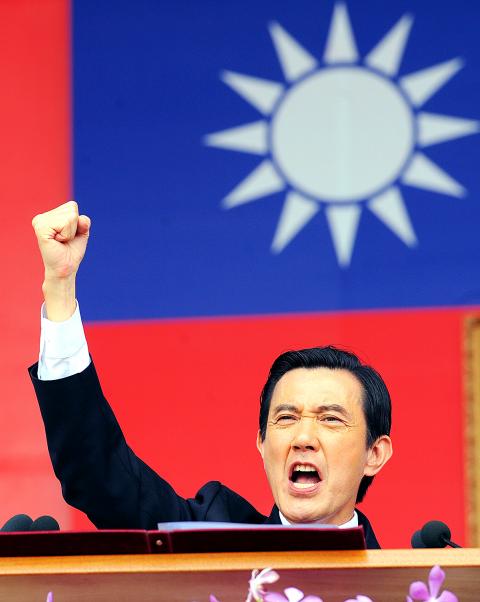
Photo: Fang Pin-chao, Taipei Times
Hu’s speech was characterized by the Democratic Progressive Party (DPP) as a “stark denial” of the assertion under the so-called “1992 consensus” that each side could have its own interpretation of “one China.” The consensus has been a cornerstone of Ma’s cross-strait policy.
Ma’s Double Ten National Day speech did not respond to Hu’s call, but toward the conclusion, Ma said: “The republic’s road ahead and Taiwan’s future lie in the hands of our 23 million people.”
However, like Hu, Ma used the same term Zhonghua minzu (中華民族) when he described the people of both sides of the Taiwan Strait, while the official English version of his speech translated the term as “ethnically Chinese.”
Photo: Fang Pin-chao, Taipei Times
Titled “A Century of Struggle, a Democratic Taiwan,” Ma divided his speech into three parts — “Why we commemorate the Xinhai Revolution,” “The ROC remakes itself in Taiwan” and “New prospects to unfold with a golden decade.”
Commemorating the Xinhai Revolution, which he called “a memory and heritage shared by both sides of the Taiwan Strait,” Ma encouraged China to “courageously move in the direction” of a free and democratic nation set by Sun.
Ma also urged China to “face the existence of the Republic of China head-on” as the ROC’s existence “is referred to not in the past tense, but in the present.”
“Had it not been for the retrocession of Taiwan from Japan to the republic, the setbacks encountered by ROC armed forces in the civil war against the communists in mainland China might have spelled the death of the republic more than six decades ago, with no chance for a transformative rebirth or possibility of development of the two sides of the Strait along different trajectories,” Ma said.
The ideals that Sun sought in establishing the republic were not achieved in China during his lifetime, but have come to full fruition in Taiwan, with Taiwanese now enjoying freedom, democracy and affluence, Ma said.
The country has cultivated an image that is “free and democratic; robust and innovative; caring and compassionate; and globally engaged and self-confident,” Ma said, citing various individuals and their stories as examples.
Turning to the future, Ma reiterated his campaign pledge and slogan that he would usher in a “golden decade” of prosperity in his second term if he were re-elected.
“In the face of the pressure of global competition, the next decade will be a critical period for us. We must strive to fully realize our vision for a golden decade. We must remain confidently engaged with the world, pursuing development through innovation, and moving forward in the spirit of social justice,” he said.
Ma said the 15 agreements his administration has signed with China since May 2008 all conformed to the principle of “parity, dignity and reciprocity, while putting Taiwan first for the benefit of its people.”
“The people on both sides of the Taiwan Strait are ethnically Chinese. Our hope is that the two sides will be able — based on a clear-eyed appreciation and acceptance of reality — to seek common ground, while respecting differences, assist and cooperate with each other, and build a peaceful relationship within an institutionalized framework,” he said.
Ma said that this month also bore special significance for him on a personal level.
“Sixty years ago in October 1951, at a time of great turmoil, my parents brought their family, including one-year-old me, from Hong Kong to Taiwan, seeking a life of freedom and tranquility. Never could they have imagined that more than 50 years later, their son would have the opportunity to become the ROC president,” Ma said.
At a separate event later in the day, Ma told a gathering of China-based Taiwanese businesspeople that the country had become an asset to the world, not a liability.
Ma said building a peaceful relationship with China within an institutionalized framework was the nation’s first line of defense, which was more important than procuring F-16C/D aircraft.

A signaling system malfunction disrupted high-speed rail (HSR) services beginning at 8am today, with trains temporarily reduced to three northbound and three southbound trains per hour as authorities conduct inspections. The malfunction occurred on a section of track in Miaoli County during pre-operation checks early this morning, forcing northbound and southbound trains to use a single track, the HSR operator said. The regular schedule has been replaced with three hourly trains offering only nonreserved seating in each direction, stopping at every station, it said, adding that business class cars would still have reserved seating. Departures from terminal stations are scheduled at the top

Taiwan is still in the process of assessing the possibility of recruiting workers from Eswatini, the Ministry of Foreign Affairs said yesterday, adding that its goal is to help Eswatini upgrade its vocational training centers. If there are plans to recruit workers from Eswatini, safeguarding national security, protecting public health and ensuring the employment rights of Taiwanese would be prerequisites, Department of West Asian and African Affairs Director-General Yen Chia-liang (顏嘉良) told a news conference. Key considerations would also include filling labor shortages in specific industries, and fostering bilateral professional and technical exchanges, he said. Yen was asked about the progress of labor

VERBOSE VESSELS: A CGA cutter and a China Coast Guard exchanged verbal barbs for more than a day in Taiwanese-controlled waters before the Chinese vessel left The Taiwanese and Chinese coast guards had a standoff near the strategically located Pratas Islands (Dongsha Islands, 東沙群島) in the north of the South China Sea, the Coast Guard Administration (CGA) said yesterday. The two sides engaged in intense radio exchanges over sovereignty claims during the 33-hour standoff. China Coast Guard vessel 3501 eventually left the restricted waters, 26.6 nautical miles (49.2km) west of the Pratas Islands, at 5pm yesterday, the CGA said. Lying approximately between southern Taiwan and Hong Kong, the Taiwan-controlled Pratas are seen by some security experts as vulnerable to Chinese attack due to their distance — more than

A US uncrewed surface vessel (USV) encountered multiple Chinese warships during an autonomous transit of the Taiwan Strait, US defense company Seasats said in a statement on Wednesday. Seasats announced that a Lightfish USV had completed the first autonomous transit of the Taiwan Strait. Over five days, the USV traversed the entire length of the Strait while constantly monitoring surface vessel traffic, the company said. The Lightfish encountered multiple Chinese warships, one of which was a Chinese People’s Liberation Army Navy (PLAN) Type 056 corvette, it said. The Chinese vessels were operating “well within Taiwan’s exclusive economic zone without transmitting their identity via the


 RSS
RSS