


A fine given to a reporter by the police for following a celebrity couple was determined to be constitutional yesterday. The ruling handed down by the Council of Grand Justices in the case that has been dubbed “Press Freedom Versus Individual Privacy” is expected to have a significant impact on the future of the nation’s media.
In 2008, Wang Wei-bao (王煒博), a reporter with the Chinese-language Apple Daily, was fined NT$1,500 (US$52) by police after following model Flora Sun (孫正華) and her husband, Miao Hua-pin (苗華斌) — the heir to the MiTAC (神通集團) fortune — over a period of two months.
Wang sometimes waited outside their residence, which the couple considered a form of harassment.
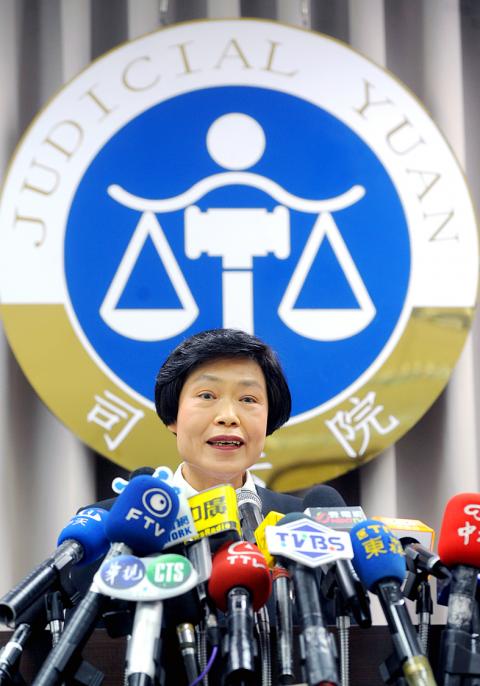
Photo: Wang Wei-min, Taipei Times
After the couple reported the matter to the authorities, police charged Wang with violating subparagraph 2 of Article 89 of the Social Order Maintenance Act (社會秩序維護法) and fined him NT$1,500.
Wang later requested a constitutional interpretation of the case, contending that the law and its application by the police violated press freedom.
However, in their ruling -yesterday, the Council of Grand Justices said the police’s enforcement of the law has been legitimate because the couple being followed were not of sufficient public interest to warrant Wang’s actions.
“Press freedom is not an absolute constitutional right,” Judicial Yuan Secretary-General Lin Ching-fang (林錦芳) said in response to the ruling.
“There was no legitimate reason in this case for the reporter to infringe on the inviolability of the person, even though the victims are public figures,” she said.
Lin said the Council of Grand Justices had decided that -subparagraph 2 of Article 89 of the Act, which stipulates that people who follow others without a reason and do not stop after being urged to do so can be fined a maximum of NT$3,000, is meant to protect an individual’s freedom of action and the privacy of an individual’s information.
Lin added that although Article 11 of the Constitution stipulates protections for press freedom, those protections were not unlimited. When media workers gather news relating to public affairs and public interests, and they need to follow people to investigate these matters, such actions might be tolerated, but when following people is unrelated to public affairs and they have been asked to stop, personal rights should be protected and it is constitutional that the police fine the followers, Lin said.
At a press conference held following the ruling, the Apple Daily yesterday lauded the Council of Grand Justices for upholding press freedom. However, it said it was disappointed at the overall interpretation as it felt the Council of Grand Justices had too narrowly defined the term “newsgathering.”
“We certainly think it’s something positive that the Grand Justices believe the freedom of the press should be protected and that closely following a person could be an acceptable behavior in news gathering,” said Yu Poh-hsiang (尤伯祥), an attorney representing the Apple Daily.
However, Yu said the overall interpretation was disappointing, as the Council of Grand Justices seems to believe that such an idea should only apply to news gathering that involves the public interest and a news event that is “newsworthy.”
Lin Ming-hsin (林明昕), another attorney representing the Apple Daily, said it should be up to the news reporter or media outlet to decide what is considered newsworthy.
He added that news gathering activities could be regulated, “but it should not be regulated by the Social Order Maintenance Act, which allows government institutions to decide whether a certain behavior is in violation of the law — the decision should be made by the court instead.”
Meanwhile, Ministry of the Interior official Liu Wen-shih (劉文仕), who represented the ministry in court, said via telephone that “the right to work should not be protected at the expense of other people’s freedom and happiness.”
ADDITIONAL REPORTING BY CNA

LEVERAGE: China did not ‘need to fire a shot’ to deny Taiwan airspace over Africa when it owns ‘half the continent’s debt,’ a US official said, calling it economic warfare The EU has raised concerns about overflight rights following the delay of President William Lai’s (賴清德) planned state visit to the Kingdom of Eswatini after three African nations denied overflight clearance for his charter at the last minute. Taiwanese allies Paraguay and Saint Kitts and Nevis, as well as several US lawmakers and the Inter-Parliamentary Alliance on China (IPAC) condemned China for allegedly pressuring the countries. Lai was scheduled to fly directly to Taiwan’s only African ally from yesterday to Sunday to celebrate the 40th anniversary of King Mswati III’s accession and his 58th birthday, but Seychelles, Mauritius and Madagascar suddenly revoked
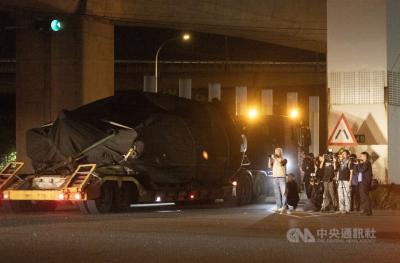
The final batch of 28 M1A2T Abrams tanks purchased from the US arrived at Taipei Port last night and were transported to the Armor Training Command in Hsinchu County’s Hukou Township (湖口), completing the military’s multi-year procurement of 108 of the tanks. Starting at 12:10am today, reporters observed more than a dozen civilian flatbed trailers departing from Taipei Port, each carrying an M1A2T tank covered with black waterproof tarps. Escorted by military vehicles, the convoy traveled via the West Coast Expressway to the Armor Training Command, with police implementing traffic control. The army operates about 1,000 tanks, including CM-11 Brave Tiger

China on Wednesday teased in a video an aircraft carrier that could be its fourth, and the first using nuclear power, while making an allusion to Taiwan and vowing to further build up its islands, as it looks to boost maritime power, secure resources and bolster territorial claims. The video, issued on the eve of the 77th founding anniversary of the Chinese People’s Liberation Army Navy, featured fictional officers with names that are homophones of three commissioned aircraft carriers, the Liaoning (遼寧), Shandong (山東) and Fujian (福建). Titled Into the Deep, it showed a 19-year-old named “Hejian” (何劍) joining the group, sparking
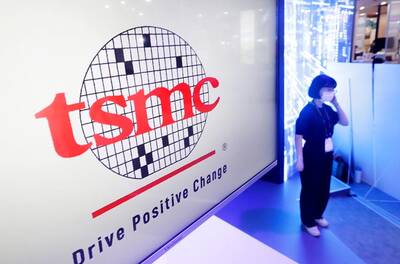
BIG YEAR: The company said it would also release its A12 chip the same year to keep a ‘reliable stream of new silicon technologies’ flowing to its customers Taiwan Semiconductor Manufacturing Co (TSMC, 台積電) yesterday said its newest A13 chip is to enter volume production in 2029 as the chipmaker seeks to hold onto its tech leadership and demand for next-generation chips used in artificial intelligence (AI), high-performance-computing (HPC) and mobile applications. TSMC, the world’s biggest contract chipmaker, also unveiled its A12 chip at its annual technology symposium in Santa Clara, California. The A12 chip, which features TSMC’s super-power-rail technology to provide backside power delivery for AI and HPC applications, is also to enter volume production in 2029, a year after the scheduled release of the A14 chip. The technology moves


 RSS
RSS