


Hundreds of college students assembled in Taipei last night to mark the 22nd anniversary of China’s Tiananmen Square Massacre, joining the candlelit vigils held in Hong Kong and Macau to honor the victims of the bloody crackdown and call for a spotlight on Chinese rights abuses.
Speaking at the event at Liberty Square, Wang Dan (王丹), a student leader of the 1989 pro-democracy movement, said the problems facing China today, including corruption, high unemployment, unequal distribution of wealth and moral failings, were a result of the crackdown on the movement.
“The crackdown snuffed out an opportunity” for China to peacefully transform into a democracy, he said.
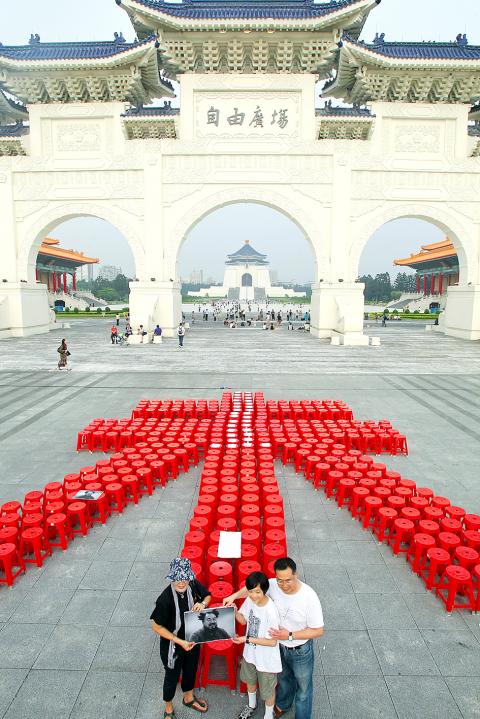
Photo: Wang Wen-lin, Taipei Times
What the students appealed for would have been proven right had the crackdown not happened, as they had pointed out that China needed not only economic reform but also political reform, Wang said.
“Today, we are here to commemorate victims, to condemn killers and to boost survivors. The way to democracy is bumpy and it’s a very long way. It is because the sky is dark that we need to head toward the light. It is because the road is long that we must continue to move ahead,” he said.
The event was mainly initiated by two National Taiwan University (NTU) students from Hong Kong, along with Taiwanese students from National Tsing Hua University (NTHU), National Chengchi University (NCCU) and Soochow University, who formed a task force of Taiwanese students to promote democracy in China.
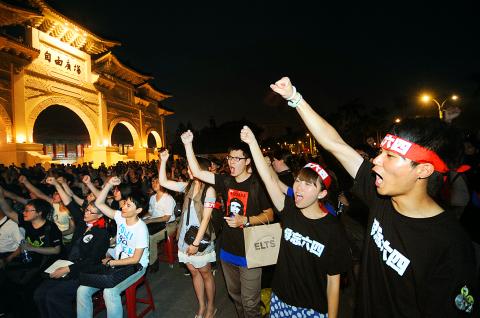
Photo: Fang Pin-chao, Taipei Times
“Candlelit vigils have been staged in Victoria Park in Hong Kong every year for the past 22 years, but it is rarely seen in Taiwan. We hope that friends in Taiwan do not forget the history,” said Fan Tsun-long (樊俊朗), an NTU student from Hong Kong.
China today poses a bigger threat than it did 22 years ago and its growing economic clout could negatively influence democratic development in Taiwan as it has already done in Hong Kong, he said.
Seaman Wong (黃俊傑), also an NTU student from Hong Kong, said the reason Taiwan must pay attention to the issue was simple — to pursue democracy, freedom and human rights, all universal values.
“Young Taiwanese do not always bear in mind high ideals and lofty aims, but 22 years ago, there were young people who sacrificed their lives fighting for those values in China,” Wong said.
Wong, who has been studying history at NTU since 2009, said the relentless efforts made by the late democracy activist Szeto Wah (司徒華) to rehabilitate the 1989 pro-democracy movement was the major reason why Hong Kongers showed a higher level of concern for the incident.
Lin Chia-hsing (林家興), an NCCU student, said that he wished the vigil would be the start of the grouping of students in Taiwan, Hong Kong and Macau, not only on June 4, but also afterwards, to encourage students in China not to give up on pursuing democracy, freedom and human rights.
Wang, currently a visiting academic at NTHU, said he was happy to see Taiwanese students attending the vigil.
“With the deepening of democracy in Taiwan, the younger generation can understand that economic exchanges with China is not all they want. They also care about political reform in China,” he said.
Earlier yesterday at Liberty Square, Bei Ling (貝嶺), an exiled Chinese poet, staged an installation art, in which 1,001 empty chairs were placed to form the characters of detained Chinese artist Ai Weiwei’s (艾未未) name to urge Beijing to release him.
“The chairs are waiting for Ai Weiwei. The installation was to let the Chinese authorities know that Ai Weiwei has not been forgotten even though he has been arrested. We are waiting for his return,” Bei said.

‘NO SECURITY RISK’: The Railway Bureau reassured the public that the technicians’ activities were limited to technical guidance and did not involve sensitive systems The Railway Bureau yesterday said it had invited eight Chinese technicians to assist with an airport MRT construction project. The bureau issued the confirmation after an Internet user said Chinese nationals had entered the construction zone of Taiwan Taoyuan International Airport’s Terminal 3 project. They asked why “individuals from an enemy state” were allowed access to such a major national infrastructure project, which raised serious concerns over Taiwan’s industrial safety, sensitive systems and information security. The bureau’s Northern Region Engineering Branch Office said subcontractor Taiwan Handle Industrial Co (台灣手把工業) of the Taoyuan airport MRT’s “Contract No. CU05 Project A14 Station Civil, MEP &

A US uncrewed surface vessel (USV) encountered multiple Chinese warships during an autonomous transit of the Taiwan Strait, US defense company Seasats said in a statement on Wednesday. Seasats announced that a Lightfish USV had completed the first autonomous transit of the Taiwan Strait. Over five days, the USV traversed the entire length of the Strait while constantly monitoring surface vessel traffic, the company said. The Lightfish encountered multiple Chinese warships, one of which was a Chinese People’s Liberation Army Navy (PLAN) Type 056 corvette, it said. The Chinese vessels were operating “well within Taiwan’s exclusive economic zone without transmitting their identity via the
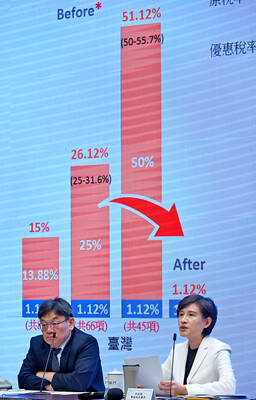
GREATER REACH? Auto parts and wood products would face tariffs of up to 15%, matching those targeting the EU, Japan and South Korea, Vice Premier said The US has announced that preferential tariff treatment for Taiwan’s non-semiconductor Section 232 goods would take effect retroactively from May 1, the Executive Yuan said yesterday. The US government yesterday posted a notice on the Federal Register’s public inspection Web site previewing tariff concessions for Taiwan under a memorandum of understanding (MOU) on Taiwan-US investment after two months of negotiations. The MOU signed on Jan. 15 stipulated three major preferential tariff arrangements: a 15 percent “reciprocal” tariff rate for Taiwan without stacking most-favored nation (MFN) rates; preferential Section 232 treatment for semiconductors and related products; and preferential Section 232 treatment for non-semiconductor

The National Chungshan Institute of Science and Technology yesterday showcased its locally developed variants of the Vision 60 robotic patrol dog, which it plans to deploy on the nation’s outlying territories in the South China Sea. The variants were produced under the Joint Lab project — created by the institute and domestic companies — and assembled with domestically produced motors, lenses and artificial intelligence (AI) systems alongside licensed tech from the US, Missile and Rocket Systems Research Division deputy director Jen Kuo-kang (任國光) told the media event at a military base in Taipei’s Dazhi (大直) area. Taiwan has built up its strengths


 RSS
RSS